Kanika Kaur is a research analyst at the Institute of South Asian Studies at the National University of Singapore and an alumna of the Master in International Affairs (MIA) programme at the Lee Kuan Yew School of Public Policy (LKYSPP). Her research interests include China–India relations, South Asian security, feminist foreign policy, and technology policy.
Why LKYSPP
After completing her undergraduate studies in New Delhi, Kanika set her sights in a master’s degree and LKYSPP was s her first choice throughout the application process. She was keen to remain in the Asian region, and having developed a strong interest in China–India relations, she wanted to be in an environment where she could engage with experts from both countries and grapple with the issues firsthand. Many of the scholars she admired were affiliated with LKYSPP, making the school a natural fit. She had long felt an affinity with Singapore, and her previous visits to the city made the prospect of studying there all the more appealing.

Studying at LKYSPP
During her undergraduate years at Miranda House, University of Delhi, the shift to online teaching during the pandemic made meaningful interaction between students and faculty difficult. Arriving at LKYSPP and returning to in-person classes was a turning point. The school’s Socratic style of teaching, she says, “completely changed the way I think,. I still carry those habits with me today.”
Two professors left a particularly lasting impression. From her first semester, Kanika had regular meetings with her academic adviser, Associate Professor Selina Ho, whose probing questions “Why this? Why not that?” helped her sharpen and clarify her research interests over time. Her conversations with Assistant Professor Adam Liu were equally formative. “We would have one-on-one conversations, which I think were really valuable,” she recalled. Watching how he drew connections between seemingly unrelated events and uncovered fresh angles on familiar topics gave her deep insight into the craft of research thinking. Nearly two years after graduation, Kanika says she can still hear her professors’ voices in her head when she sits down to work on a research project.
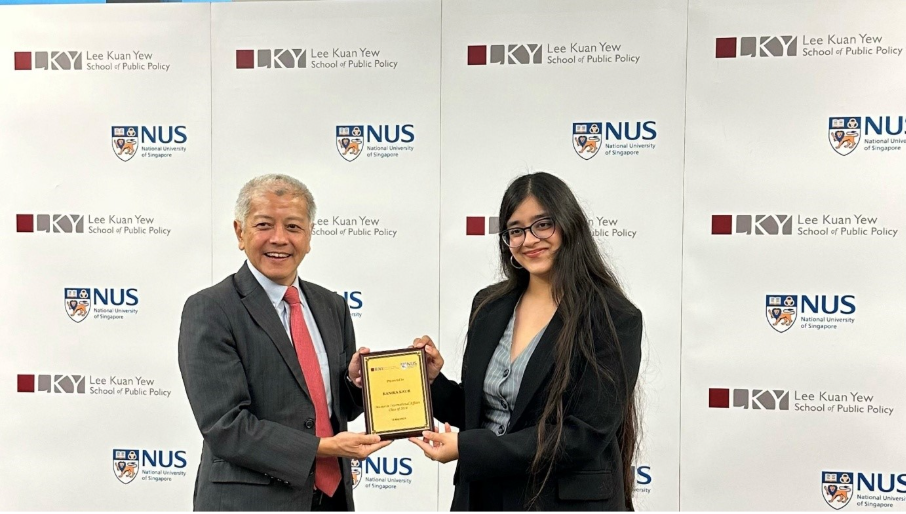
Kanika receiving her plaque of completion of the MIA programme at LKYSPP.
Research Interests and Current Work
Around 2022, as border tensions mounted and debates over TikTok dominated headlines, much of the academic focus fell on China–US relations. China–India relations, by contrast, received far less attention and that gap is precisely what drew Kanika in. She began exploring whether the analytical frameworksapplied to the China-US dynamic, could be meaningfully adapted to the China-India context. The relative scarcity of scholarship in this area, far from being a deterrent, became part of what pulled her more deeply into the field.
After graduation, Kanika joined the Institute of South Asian Studies at NUS. Her day-to-day work involves both short current-affairs briefings for industry audiences and longer research reports intended for academic discussion. Her portfolio has included research on Sri Lanka, in-depth analysis on China–India relations, and, more recently, a growing focus on technology policy. She acontributed to a comparative research report on the development and regulation of large language models in India, examining the corresponding landscape in China, the United States, Singapore, and the United Kingdom.
As technology policy becomes an increasingly unavoidable dimension in public policy research, AI has also begun to play a more concrete role in Kanika’s daily work. However, one should take a measured view of its potential. AI can assist with organising texts, processing data, and debugging code, she acknowledges, but when it comes to generating ideas or engaging in creative thought, Kanika believes people must remain in the lead: “I would never use it for art or creative [work] or brainstorming… I think that’s for humans.”
That emphasis on human judgement extends to how she views the often-overlooked effects of policymaking, Even modest changes, she notes, can yield significant benefits that were not originally anticipated. She shared the example of a Nordic country that changed its snow-clearing priorities from roads for cars to pedestrian walkways, a policy adjustment that reduced the number of women admitted to hospital after slipping on icy surfaces. “Just a simple change like that led to a real decrease in accidents,” she said.
Advice for Current Students
For students hoping to enter the field of policy research, Kanika offers two pieces of advice. The first: be willing to step outside your comfort zone and take courses in areas that feel unfamiliar or demanding. Quantitative methods were a particular challenge during her time at LKYSPP, but she is grateful that she pushed through as those skills have proven invaluable in her work since. The second: identify your research direction as early as possible and actively reach out to relevant institutions. Starting that process early gives you time to build both your academic foundation and your professional network simultaneously.
The path into policy research may not be clear from the outset. But in Kanika’s experience, by following your intellectual curiosity, broadening your skill set, and staying connected with people practising in the field, it becomes much easier to recognise which questions are worth pursuing and to find your own place within them.