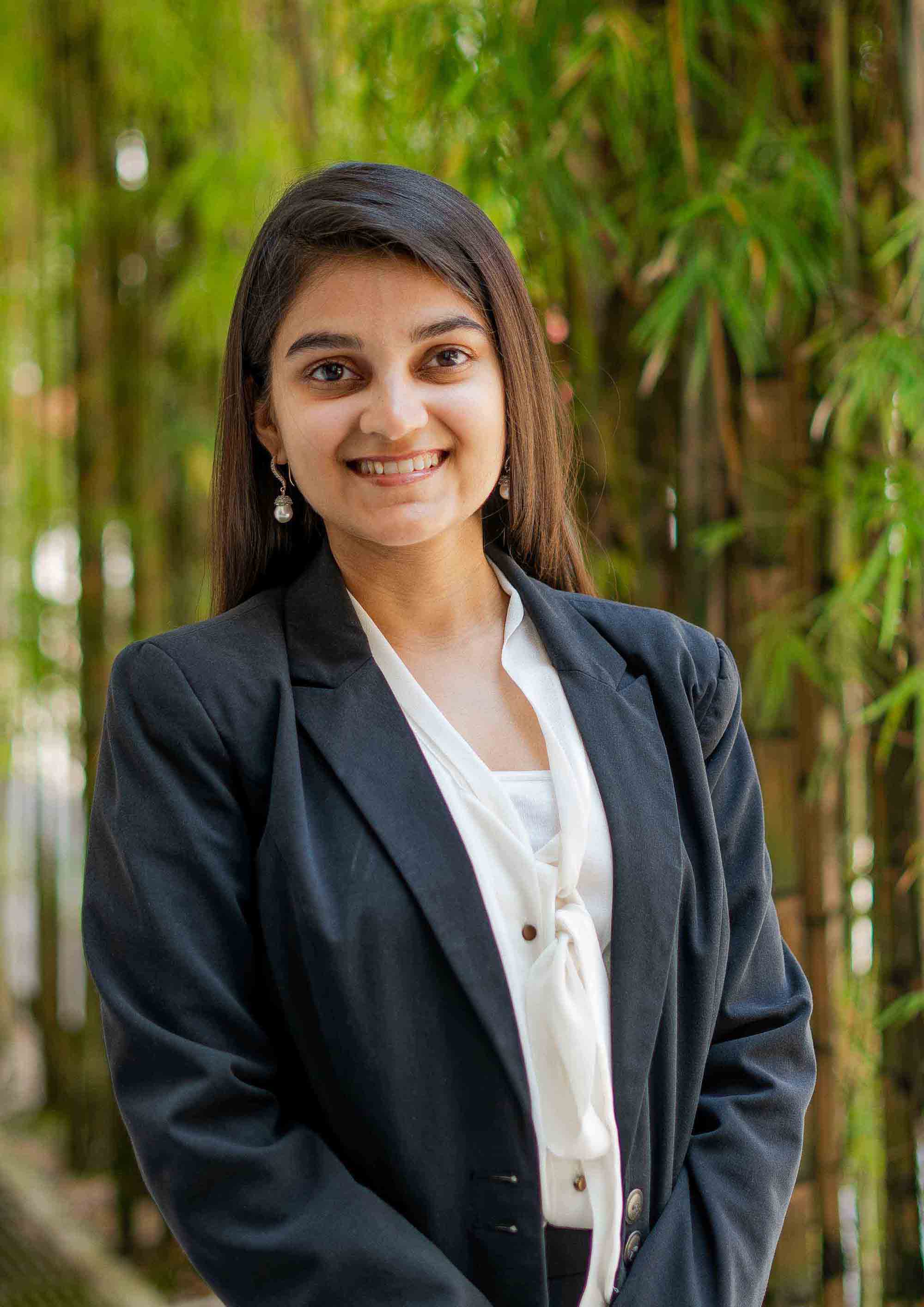
If you had asked Bhavya Gupta what she wanted to be when she grew up, a career in sustainability would not have been on the cards. On her LinkedIn, Bhavya is listed as a postdoctoral research fellow (Net Zero Governance Systems) at the University of Oxford’s Blavatnik School of Government. “I lead the work on tracking carbon crediting rules and financial sector green policies across countries,” she explains.
Bhavya’s team monitors how countries manage their sustainability and green plans and tracks whether their objectives have been met. More specifically, her team monitors the uptake and quality of climate mitigation policies across different areas, including corporate and financial sector regulations. “We track how climate change may impact the financial system, the balance sheets of financial institutions including banks and insurers, and the steps they take to mitigate the risks,” expounds Bhavya.
She does this across 37 jurisdictions globally, which includes the G20 countries. Cutting through the industry speak, Bhavya’s work feeds directly into conversations that shape how countries, central banks and corporations respond to the crisis of our time: Climate change. Her research feeds the United Nations (UN) Task Force on Net Zero Policy. It relies on Bhavya’s open-source data to assess whether corporate and financial actors are truly moving towards net zero.
How economics and climate change added up
Bhavya graduated from the Shri Ram College of Commerce (SRCC), University of Delhi with a Bachelors degree in Economics in the top 10 per cent of her cohort. She followed that up with a Masters in International Relations at the London School of Economics and Political Science before working as a research analyst at the Economist Intelligence Unit in India. She got her first taste of public policy at the Australian National University’s Crawford School of Public Policy as a National Parliamentary Fellow from India. This experience was the push she needed to apply for a doctorate.
Her career moves led her to apply to do her doctoral thesis at the Lee Kuan Yew School of Public Policy (LKYSPP). She wanted to expand her career through an inter-disciplinary setting that lets her work on policy-relevant and applied issues yet retain her expertise and interest in macro-economics as well as in the international monetary and financial system. She felt LKYSPP was the perfect place for her as it focused on public policy and it was very receptive to her research interest and dissertation ideas.
It was here that she met Professor Ramkishen Rajan who turned her onto the economics of sustainability. “Deciding on the PhD thesis topic was an exercise in looking for policy areas that are new, pertinent, and currently under-researched. These have more potential to make a novel, scholarly contribution,” she notes.
Having grown up in India, climate change is an issue that Bhavya has felt personally and directly. “In a country where much of the population spends a significant part of their day outdoors yet does not have access to the basics of thermal comfort such as fans, air conditioning and other forms of cooling. I shudder to think how they could cope with the rising temperature each year and what inaction on climate mitigation — both locally and globally — means for India’s future,” she points out. From there, it wasn’t a big leap to co-join the economics factor with policymaking and climate change.
Mastering knowledge and her confidence
Today Bhavya speaks with corporate and global leaders in her work. Being able to hold her own with senior policymakers and industry leaders means she must be at the top of her game — and have the confidence to carry it well. She credits this to her time at LKYSPP, where she transformed from a soft-spoken post-grad student to a confident speaker.
Her assured poise comes with practice from defending her thesis, arguments in publishing peer-reviewed articles, as well as in the numerous commentaries she has co-written in broadsheets in Singapore and in the region. LKYSPP also put her up for the Fox International Fellowship, where she spent a year at Yale University presenting at conferences and research seminars. She was one of only two representatives from the National University of Singapore (NUS) in 2023.
Additionally, she credits teaching at LKYSPP as a further tool to extend her certainty and courage. As a teaching assistant for the Economics of Public Policy module, she mentored candidates in the Master of Public Policy programme. She also designed a boot camp for inbound students without economics background.
“As an instructor, your own understanding of the material is tested. Students come with different perspectives. That helps my own thinking of said concepts. This evolves my knowledge base and ultimately seals my own position as a subject expert,” Bhavya admits.
Room to explore with institutional support
Bhavya came into LKYSPP with a clear idea of what she wanted to get out of her time here. Beyond the faculty support, opportunities for speaking engagements and teaching stints that cemented her concepts, LKYSPP provided significant institutional support in broadening her horizons and helping her hone her research to another level.
Like children her age, Bhavya dreamed of being a doctor, an airline pilot and even a civil servant in India. Disparate as they are, they had an underlying theme of not being stuck behind a desk. In her high school, she developed a taste for economics, particularly macroeconomics. “As an undergrad, I realised there is a big disconnect between what actually happens on the ground and what is assumed in simplified economic models,” she reveals. “What I’m doing now takes open-source data and makes them real (provides real use cases) for companies and countries planning to stop or at least reduce the impacts of climate change.”
Her present work ticks off her childhood dreams and current interests — taking her around the world to champion climate change while trying to keep countries and corporates accountable towards their sustainability goals.