Ding Xi is an alumna of the Master in Public Policy (MPP) Class of 2025 at the Lee Kuan Yew School of Public Policy (LKYSPP), National University of Singapore. She also earned a double degree from Columbia University’s School of International and Public Affairs (SIPA). Her interest in sustainability began during her undergraduate years. Through internships across the private sector, think tanks and the public sector, she gradually developed a strong interest in international development and working with international organisations. Today, she is based in Laos with the Global Green Growth Institute (GGGI).
In this alumni interview, Xi reflects on what drew her to public policy, her experience at LKYSPP, and how these experiences have shaped the way she thinks about sustainability and policy in practice.
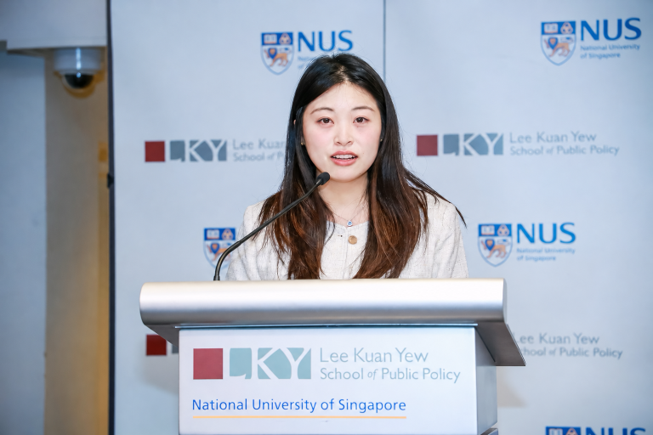
Ding Xi as the event moderator.
What inspired you to pursue a Master in Public Policy (MPP)?
I had been interested in sustainability since my undergraduate years. Before applying for graduate school, I interned across the private sector, think tanks and the public sector, which gave me the chance to explore different areas of sustainability.
Through those experiences, I gradually realised that I was most drawn to international development and working with international organisations, and public policy felt like the most relevant field to build my career in. I had also studied French and intercultural communication as an undergraduate, and I had always enjoyed learning and working in multicultural environments. Together, these experiences ultimately led me to pursue an MPP.
Looking back on your time at LKYSPP, what left the strongest impression on you?
Beyond the classroom, LKYSPP offered many opportunities to learn through direct exposure and experience. I joined the first-year cohort on a study trip to Thailand, where we visited organisations including the United Nations Economic and Social Commission for Asia and the Pacific (ESCAP). It gave me a closer look at how international organisations operate in practice.
The Policy Analysis Exercise (PAE) at the end of the semester was another memorable experience. It gave us the opportunity to apply what we had learned in class to a real-world policy issue, and that experience has been very useful in my subsequent work and career development.
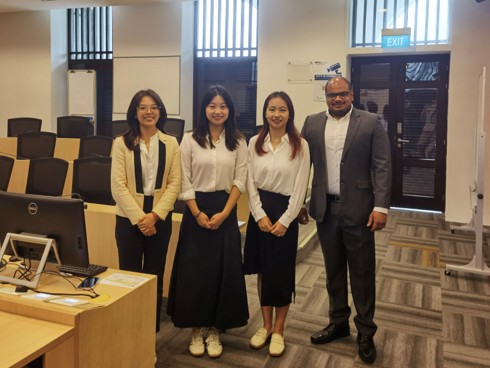
Ding Xi at the PAE Final Group Presentation
During your studies at LKYSPP and Columbia SIPA, which sustainability issues interested you most?
At SIPA, I focused mainly on energy transition and took several courses in quantitative analysis and modelling. I also joined a sustainable development workshop in Rwanda focused on challenges facing emerging markets and developing regions, where my group studied clean cooking in Africa. That experience made me realise how closely many sustainability challenges are tied to economic realities.
This became even clearer during my internship with the United Nations Environment Programme (UNEP), where I gained a deeper appreciation of the role economics and finance can play in advancing energy and environmental goals. At LKYSPP, my interests broadened to include environmental and urban issues, while I also developed a stronger grounding in macroeconomics. These experiences have been directly relevant to my current work in agriculture and private-sector engagement.
What has been most valuable from your LKYSPP experience in your current work?
I am currently with the Global Green Growth Institute (GGGI), based in Laos, where I work on projects across Southeast Asia, including climate-resilient agriculture, landscape management and sustainable investment. Much of this work is closely related to what I studied at LKYSPP.
Just as valuable were the conversations I had with classmates from across Southeast Asia. They gave me a more grounded understanding of the policy contexts and realities of different countries in the region.
How has your time at LKYSPP changed the way you approach public policy issues?
Now, when I look at a policy, I think much more about whether it can actually be implemented. That means considering the institutional environment, the stakeholders involved, where the funding will come from, and whether there is sufficient capacity to carry it out.
This is especially important in developing countries in Asia. A policy may work in theory, but it also has to fit local realities. This way of thinking has been particularly useful in my current work with government agencies and companies in Laos.
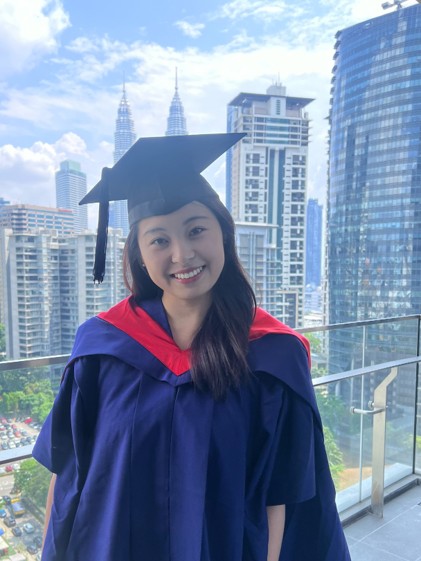
Ding Xi in graduation gown.
What advice would you give to students considering applying to LKYSPP?
Public policy and management cover a wide range of fields, so you do not need to have a fixed direction from the outset. Try different things and talk to different people throughout the application process, your studies and internships. Over time, you will get a clearer sense of what genuinely interests you.
LKYSPP's courses, field-based projects and classmates from different countries are all valuable resources.
The Master in Public Policy (MPP) programme at the Lee Kuan Yew School of Public Policy (LKYSPP) is designed to equip students with the core knowledge and analytical skills needed to tackle pressing public policy problems.
Official applications for the August 2027 intake are now open! The application deadline is 15 December 2026.
Please visit the official website for more details about the programme: click here