By Seema Chowdhry (MPA 2017)
Yugal Kishore Joshi, 50, came to Lee Kuan Yew School of Public Policy (LKYSPP) to find the purpose of his life. In 2008, this former Indian Railways officer remembers being at the crossroads and he said so in his admission interview. He was selected for the Master in Public Administration programme 2009-2010.
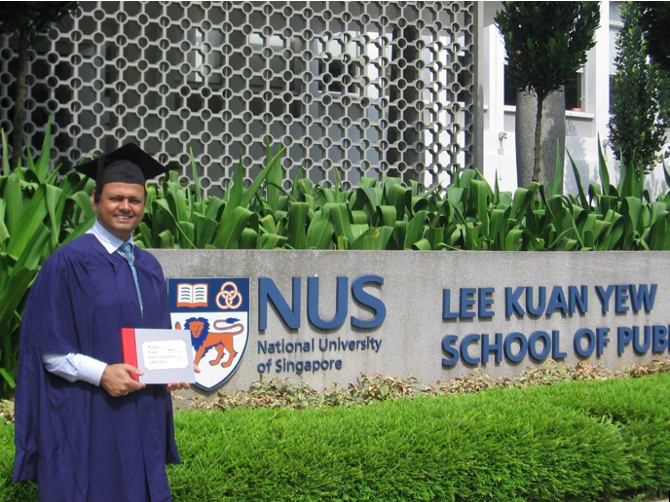 Yugal Kishore Joshi was selected for the Master in Public Administration programme 2009-2010.
Yugal Kishore Joshi
MPA 2010
Director , Swachh Bharat Mission (Clean India Mission), Ministry of Drinking Water and Sanitation, Govt of India
Government Administration
A year at the school and another at the Institute of Water Policy changed the course of his career. “At LKYSPP, I met Professor Asit Biswas who introduced me to water management. While doing research with him for the book Singapore Water Story: Sustainable Development in a City-State, I became passionate about water. Professor Biswas encouraged me to research more and then offered co-authorship of the book. It was such a huge compliment,” says Joshi, who is currently Director, Swachh Bharat Mission and Director, Department of Drinking Water and Sanitation, Ministry of Jal Shakti, India.
One lesson Joshi has carried with him from Singapore is that a public problem cannot be solved in isolation. For sustainable development, it is necessary that long-term and short-term policies complement each other, and different government departments talk to each other. “The kind of professionalism that Singapore showed in identifying its water problem, finding correct technological solutions, providing budgetary support, behaviour change communication, and more is exemplary,” says Joshi.
According to him, though India too has become a severely water-stressed country now, the good thing is that there is a strong political will to resolve the issue. “Apart from being in charge of the information, education and communication for capacity building, and the faecal sludge management in the villages, I am also working closely with grey water management in rural India. Considering 600,000 villages and about 800 million rural population this is a huge task. If we could reuse even grey water in rural areas, it would be huge to replenish groundwater levels and rejuvenate local water bodies,” he adds.
A multiple service excellence award winner including the Prime Minister's Award for Excellence in Public Administration in 2018, Joshi started to work with the Department of Drinking Water and Sanitation in the year 2016. Alongside, he headed the first National Sanitation Centre inaugurated in August 2020.
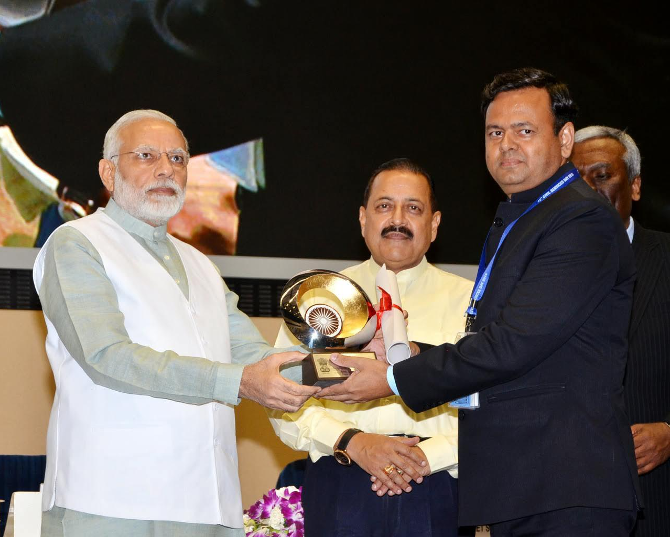 In April 2018, Yugal Kishore Joshi received the Award in Innovation from Narendra Modi, Prime Minister of India at the 12th Civil Services Day.
“The kind of professionalism that Singapore showed in identifying its water problem, finding correct technological solutions, providing budgetary support, behaviour change communication, and more is exemplary,” says Joshi.
While running behaviour change campaigns for Swachh Bharat (Clean India), Joshi learned that if the scale of the project is huge and there are challenges of speed, stigma and sustainability, four things make a difference: political will and leadership, adequate public finance, forging partnerships with multiple stakeholders and making it a people’s movement through public participation. “India has done remarkably well in sanitation in the past five years, and I am very proud of being one of the key members of the core team. Not only has India built more than 100 million toilets in a period of five years but we also persuaded people to use them as well. In 2014, out of 1,000 million people who defecated in the open, 600 million were in India. By 2019, the 600 million was down to 50 million,” he says. According to him, India achieved SDG Goal 6.2 (access to sanitation for all) 11 years ahead of the target year 2030.
An author of three books, Joshi also hosts his own podcast on storytelling. “I always wanted to write books. At LKYSPP, I read versions of Ramayana from Indonesia, Malaysia, Chinese and Sri Lanka. Then I realised I should tell lord Ram’s story from three distinct perspectives. I was struggling to write but Prof Jonathan Marshall came up with an idea that I would write daily, and he would read the stories. That helped me a lot.”
Now that he is about to complete his term as Director of Swachh Bharat Mission, Joshi hopes that he can continue in the water and sanitation sector. Meanwhile, his advice to civil servants hoping to study public policy at LKYSPP is to view this period as an opportunity to explore the outer world as well as the inner world. “Use this time to reinvent oneself. Often mid-career crises make civil servants sluggish. This one year can really fire up the will to learn new things, adopt best practices from the world and more importantly to see and judge how fast the world is changing.”