The global economic order is undergoing a profound structural shift. For decades, international trade was governed by a predictable, rules-based system designed to maximise economic efficiency and comparative advantage. Today, that system is being quickly dismantled. Trade, investment, and supply chains are no longer viewed solely through an economic lens; they have become primary battlegrounds for national security, economic coercion, and geopolitical rivalry.
On 21 August 2026, the Lee Kuan Yew School of Public Policy hosted a public lecture titled “Trade in an Age of Uncertainty: Tariffs, Geopolitics and Business Resilience”. Chaired by Dr Denis Hew, Senior Research Fellow at Centre on Asia and Globalisation (CAG), the lecture featured Professor Dennis Novy, Chief Economist at the UK Foreign, Commonwealth and Development Office and Professor of Economics at the University of Warwick.
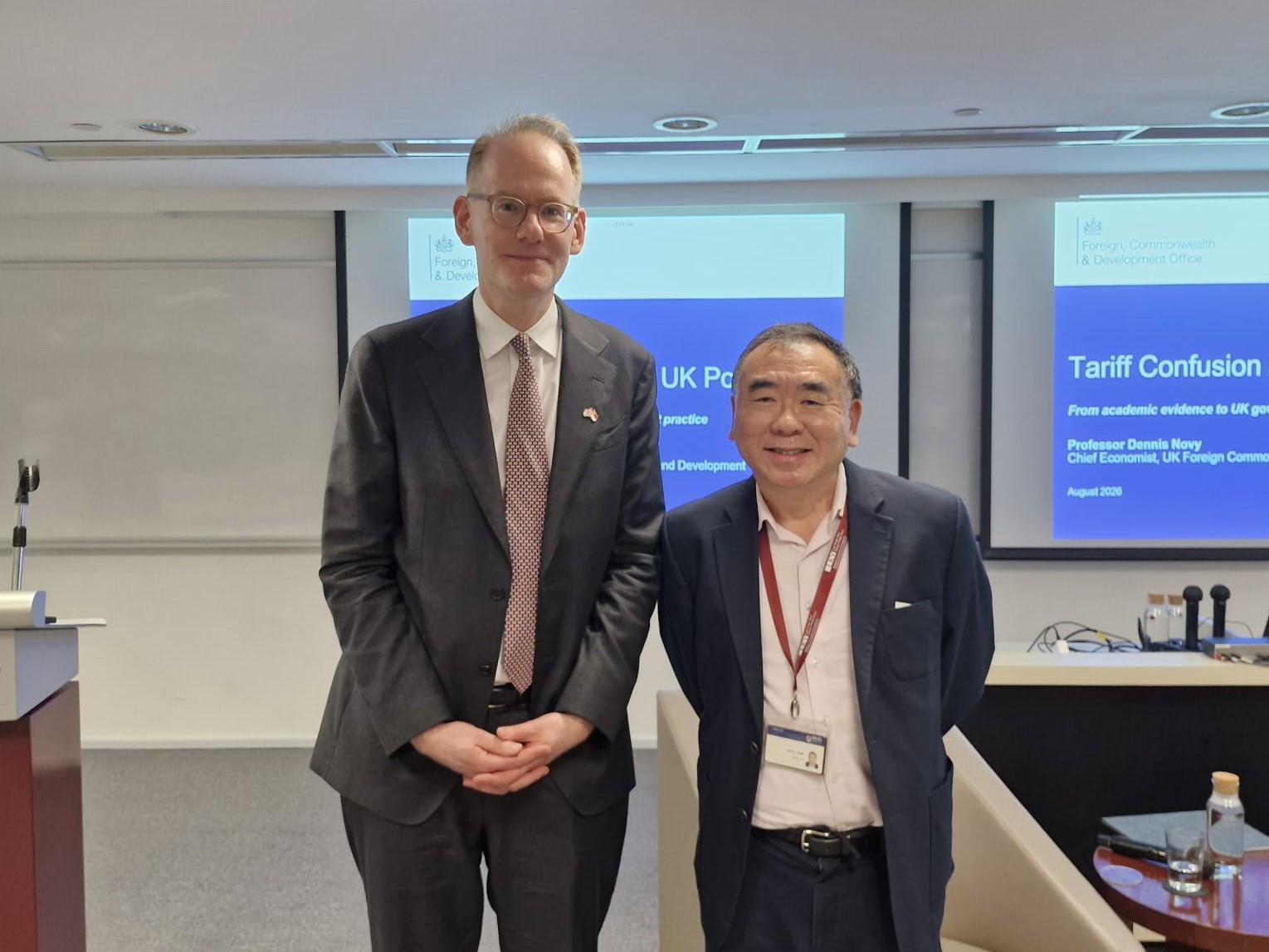
The Lee Kuan Yew School of Public Policy hosted a public lecture on tariff confusion and UK policy, featuring Professor Dennis Novy (left) and chaired by Dr Denis Hew (right).
“For those of us here in Southeast Asia and Singapore, the economy is deeply integrated into very established global production networks,” Dr Hew highlighted in his opening remarks. “Our governments and businesses navigate a more uncertain and geopolitically contested trading environment.” These questions are particularly important and thus have major implications for the future of both the region and the global economy.
An unquantified hidden tax
Drawing on cutting-edge empirical research, Prof Novy introduced a critical new concept: ‘tariff confusion’, revealing a substantial, previously unquantified ‘hidden tax’. His core message is that the level of tariffs is not simply dampening global trade, but the utter chaos, volatility, and complexity of how those tariffs are implemented.
Using US trade policy in 2025 as a case study – a year characterised by an unprecedented storm of executive orders, proclamations, and sudden tariff adjustments – Prof Novy and his co-authors built a comprehensive database to track the economic impact of trade policy volatility.
The findings are striking. While statutory tariff increases significantly reduced US imports in 2025, the confusion surrounding those tariffs more than doubled the negative impact. “It actually has very persistent effects,” Prof Novy described. “And it turns out it’s almost exactly a one-for-one pass-through to import prices. What that means is prices went up, and firms and consumers in the United States paid almost everything.”
“As far as our data go here, we have had 53 announcements of introduced, delayed, reinstated, or changed tariffs,” Prof Novy said. When mapped across thousands of product codes and origin countries, this translated into over a million individual policy updates. Even the US International Trade Commission struggled to keep its online schedules up to date, leaving firms in the woods. “That is really costly, especially for small and medium-sized businesses.”
“Complexity is a tax,” Prof Novy noted, quoting one of many pithy headlines. “And today, US companies are paying through the nose.”
Enduring the tariff storm test
Importantly, the research shows that the impact of tariff confusion is not uniform. The key factors that emerged as powerful shields against such policy chaos were relationship specificity and bilateral trust.
Highly customised, differentiated goods – where buyers and sellers have deeply integrated, long-term technical partnerships – proved remarkably resilient. Because these goods cannot be easily substituted, firms chose to absorb the administrative costs of confusion rather than break the relationship.
Trade flows between countries with historically high levels of mutual trust and strong institutional relationships suffered far less from confusion. Trust acts as a form of social infrastructure, allowing firms to navigate regulatory ambiguity together.
Conversely, generic, easily substitutable commodities traded between low-trust partners were the first to collapse under the weight of policy uncertainty.
Moving from reaction to resilience
What does this mean for the future of trade policy and economic diplomacy? Prof Novy argues that governments must fundamentally rethink how they design and communicate economic statecraft.
If a government must implement tariffs for strategic reasons, doing so in a transparent, predictable, and flat manner is far less economically damaging than a volatile, highly targeted regime. If policymakers want to protect their own domestic industries and consumers, clarity is an economic asset.
As Prof Novy highlighted: “The clarity and predictability of trade policy is important, so all else equal, if you're clear, then you reduce the harmful impact of tariffs.” While this is not a surprise per se, he said, having empirical, data-driven results to prove it makes quantification an indispensable tool for modern policy design.
Furthermore, Prof Novy outlined how the UK government is actively translating these academic insights into practical policy support, particularly in highly integrated regions like Southeast Asia. These initiatives include the establishment of a supply chain centre and an economic security advisory service; building regulatory capacity through technical analysis and investment screening approaches with regional partners like Singapore, Cambodia, and Laos; and joining meetings such as ASEAN-UK analytical dialogue and regional agreements.
Predictability – a premium in global trade
Despite the dramatic headlines, the lecture cautions against total pessimism as pointed out during the lively audience discussion. We are not quite reliving the dark days of the 1930s, where a spiral of retaliatory tariffs contributed to the Great Depression. Today's global economy is far more interconnected, and businesses are actively lobbying governments to prevent a total collapse of the trading system.
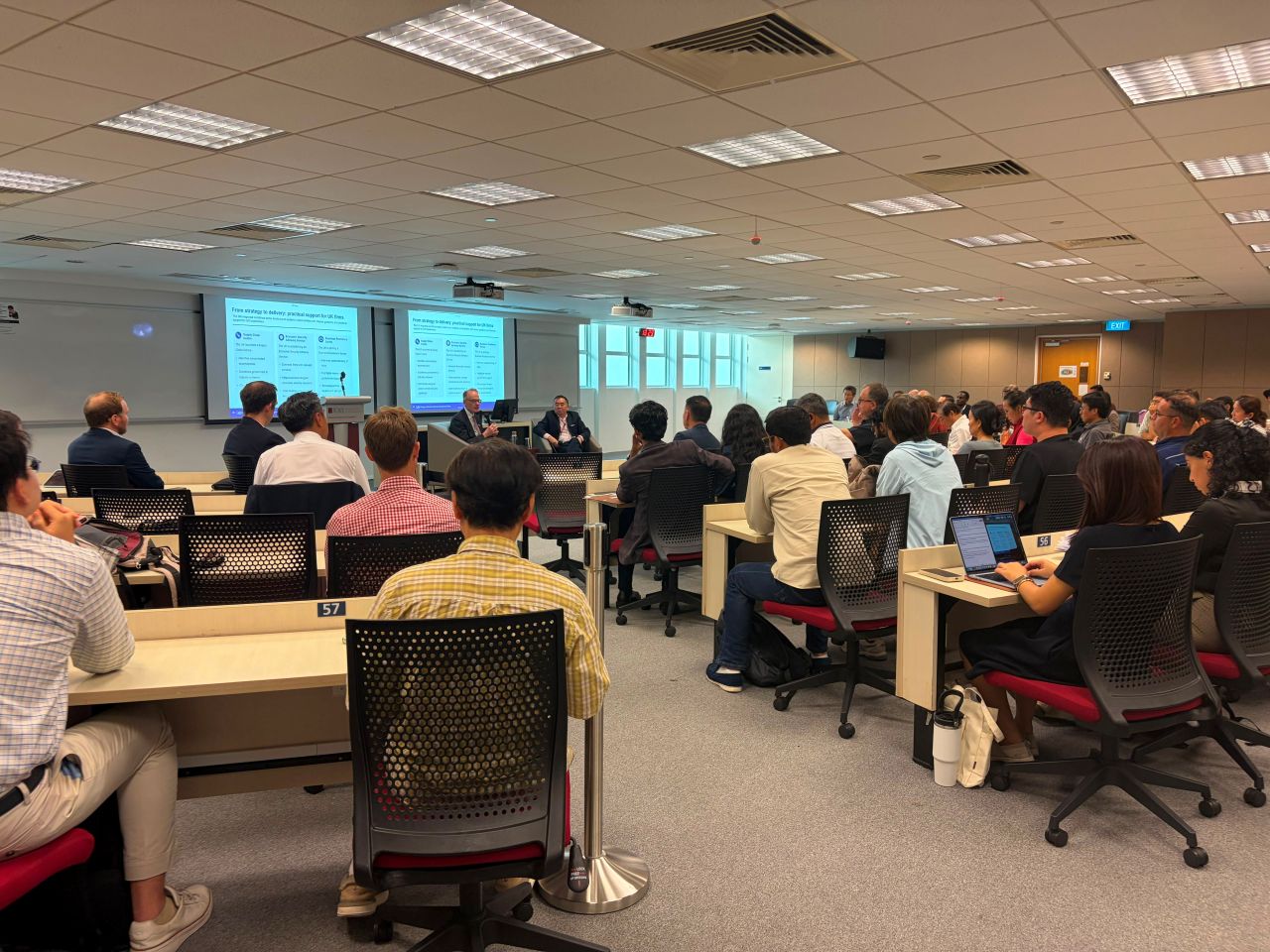
A lively audience discussion between industry professionals, researchers, academics, and policymakers who attended the session.
However, as geopolitics continues to override pure economics, tariff confusion will remain a persistent threat. For policymakers, the lesson is clear: the manner in which trade policy is implemented is just as important as the policy itself. Beyond being a boardroom headache, tariff confusion is a chaos tax that trickles down to every level of society. It overwhelms public administration, squeezes small businesses, and inflates the cost of everyday goods. In a highly interconnected world, policy chaos does not simply stop at the foundations of commerce – eventually, it knocks on your front door.
Follow the Lee Kuan Yew School of Public Policy on our social channels to stay updated on the latest news, events, and announcements.