Against a backdrop of trade tensions, supply chain disruptions, and rapid digital change, experts examined how APEC China 2026 is shaping Asia Pacific’s policy agenda.
On 21 July 2026, the Centre on Asia and Globalisation (CAG) at the Lee Kuan Yew School of Public Policy hosted a panel discussion on “Asia-Pacific Economic Cooperation (APEC) China 2026: Key Updates and Developments”. Moderated by Dr Denis Hew, Senior Research Fellow at CAG, the session brought together Eduardo Pedrosa of the APEC Secretariat, Kaewkamol (Karen) Pitakdumrongkit of the Pacific Economic Cooperation Council (PECC), and LKYSPP Master in Public Management (MPM) alumnus, Christopher Tan of Singapore’s Committee of Trade and Investment (CTI).
A challenging regional setting
China's hosting of APEC this year came at an especially consequential moment for Asia Pacific. “The region remains a major engine of growth, but it’s also navigating a much more complex, uncertain economic environment,” Dr Hew said in his opening remarks. Trade tensions, supply chain disruptions, geopolitical friction, and fast-moving technological change are reshaping the policy landscape. Against this backdrop, speakers argued that APEC’s role as a platform for cooperation continues to be especially important.
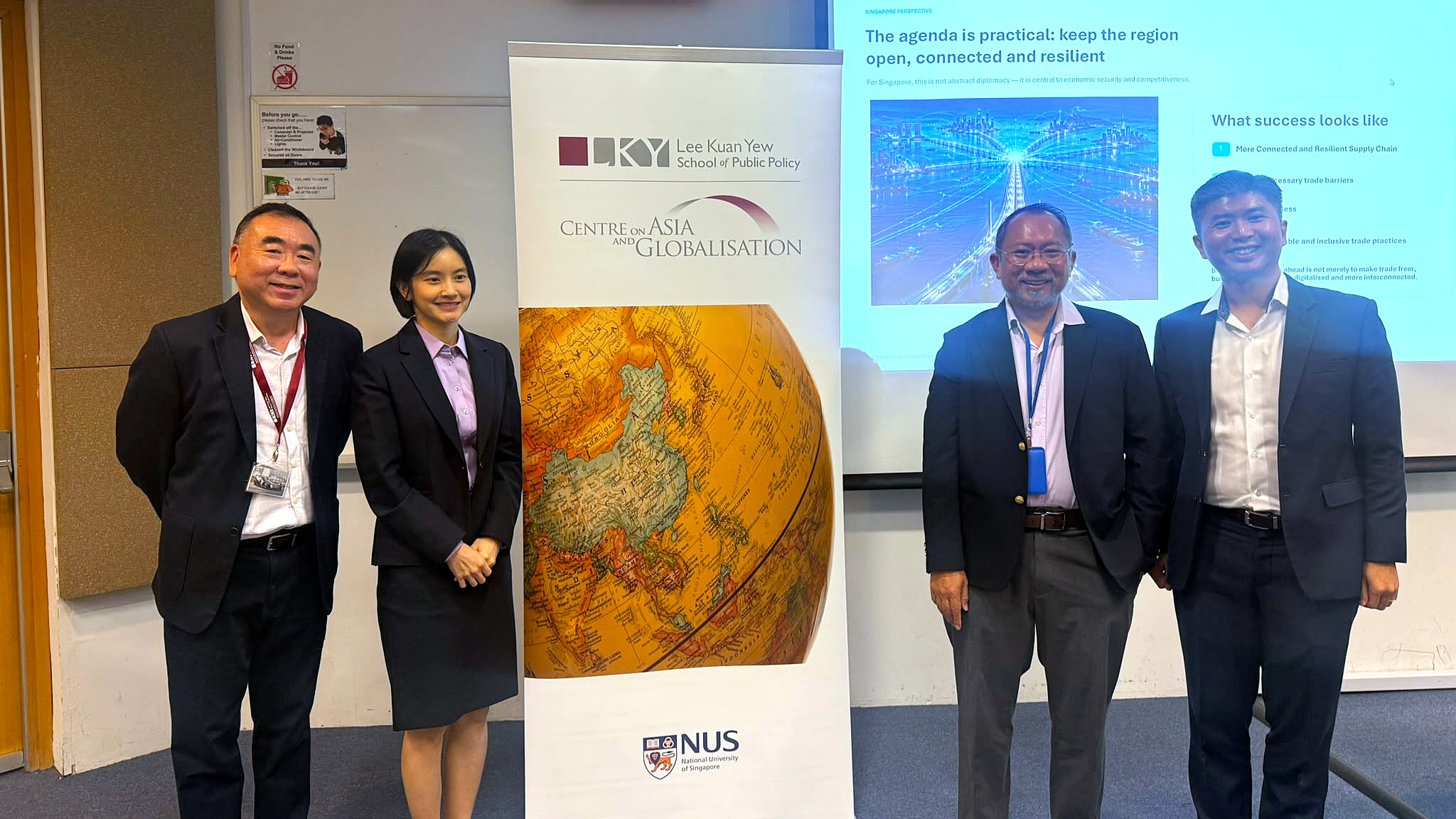
The Centre on Asia and Globalisation (CAG) hosted a panel discussion on key updates and developments from APEC China 2026. From left to right: Denis Hew, Kaewkamol Pitakdumrongkit, Eduardo Pedrosa, and Christopher Tan.
Protectionism and regional confidence
Pitakdumrongkit stressed that regional stakeholders remain deeply concerned about rising protectionism and trade wars. She cited PECC survey findings showing that 88% of respondents viewed protectionism and trade wars as the top risk to growth, while 81% wanted APEC leaders to prioritise reducing such barriers.
At the same time, she noted that confidence in regional cooperation remains strong. In her view, APEC continues to matter because it offers a flexible space for dialogue and can support deeper integration through multiple pathways, including the Free Trade Area of the Asia-Pacific (FTAAP), bottom-up engagement, and pathfinder initiatives.
“We are seeing FTA as one of the tools to achieve a means to an end, which is deepening of trade and investment in the region,” Pitakdumrongkit highlighted. “Focusing on the ultimate goal of deepening regionalism can unlock a wider range of options.”
APEC’s 2026 priorities
Tan outlined five major developments shaping APEC’s agenda in 2026. These included renewed momentum behind FTAAP, greater emphasis on supply chain resilience, the final review of the Supply Chain Connectivity Framework Action Plan Phase 3, stronger trade digitisation efforts, and deeper collaboration between APEC and the APEC Business Advisory Council (ABAC). He also highlighted the need to move beyond paper-based processes towards true paperless trade, with interoperability across economies and systems as a key challenge.
“Related events have shown that efficiency without resilience, without continuity, can be costly for economies,” Tan said. He emphasised that resilience now matters as much as efficiency, and that trade facilitation must be adapted to a world where disruptions are more frequent and more costly. “The objective is not to eliminate risk, but to ensure that trade continues to flow when disruptions occur.”
APEC’s broader agenda and MRT outcomes
Pedrosa placed the discussion in a wider global context, describing APEC China 2026 under the theme of “Building an Asia-Pacific Community to Prosper Together”. He said the agenda reflects current realities: fragile supply chains, trade uncertainty, and the growing impact of artificial intelligence and digital transformation.
He pointed to the Ministers Responsible for Trade (MRT) Meeting outcomes as evidence that APEC can still make progress on difficult issues. Areas of discussion included services trade, regulatory practices, state-owned enterprises, digital trade, trade facilitation, competition policy, and intellectual property enforcement. He also underscored APEC’s non-binding, consensus-based nature as one of its strengths.
As Pedrosa noted: “APEC is not a negotiating forum; it is normative, and it also tries to have policy dialogue.”
From dialogue to implementation
A recurring theme throughout the panel was that APEC’s value lies in turning dialogue into practical cooperation. “We all talk about digital transformation,” Dr Hew remarked in a segue to the Q&A segment. “But getting implementation done is going to be a challenge; there’s no enforcement mechanism.” The speakers agreed that while the forum cannot enforce compliance, it can build trust, align technical understanding, and encourage economies to move forward where there is convergence.
The audience discussion extended this theme, touching on geopolitical tensions, private sector engagement, and the slow progress of paperless trade. In response, the panellists pointed out that APEC’s broad network of meetings, working groups, and public-private platforms gives it a unique capacity to support cooperation in a fragmented world.
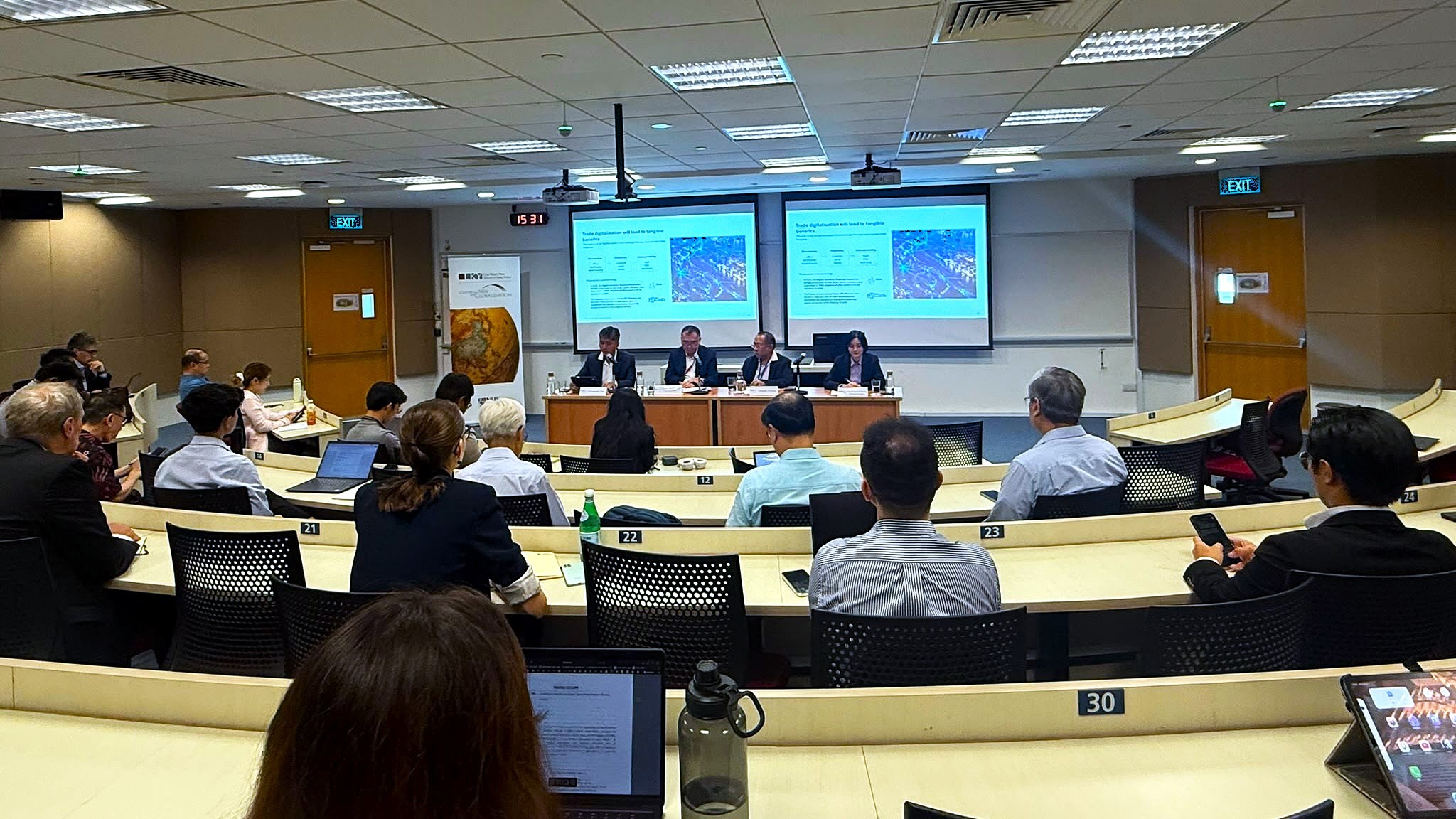
Industry professionals, researchers, academics, and policymakers attended the session to hear about APEC China’s role and future directions.
Looking ahead
The panel concluded that the real test for APEC China 2026 will not be the volume of declarations, but whether economies can translate shared concerns into tangible progress. In a more volatile regional environment, APEC’s continued relevance will depend on its ability to remain open, adaptive, and focused on implementation.
Follow the Lee Kuan Yew School of Public Policy on our social channels to stay updated on the latest news, events, and announcements.