China and India, two Asian countries with the largest populations in the world, 1.4 and 1.3 billion people respectively, constitute 40% of the world’s population. Both have been colonised by European powers and are still considered developing nations by the United Nations. They have tried to manage their differences, have cooperated on global issues, and have built a robust economic relationship, but they remain rivals, and in 2020 their troops were involved in a fracas in the Himalayan borderlands. Why are the two stubbornly at odds?
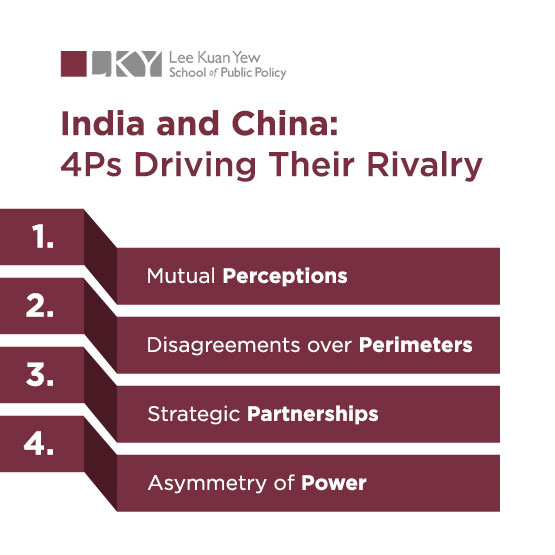
In his latest book, India Versus China:Why They Are Not Friends, Wilmar Professor of Asian Studies and Director, Centre on Asia and Globalisation (CAG), Lee Kuan Yew School of Public Policy, Kanti Bajpai, tries to unpack their troubled relationship. He lays out four key differences between China and India that drive their rivalry in terms of what he calls the 4Ps:
- Mutual Perceptions
- Disagreements over Perimeters
- Strategic Partnerships
- Asymmetry of Power
From mutual respect to disdain
Historically, the two countries had respect for one another. Buddhism, which originated from India, was admired by the Chinese and eventually became the largest institutionalised religion in China. At various times, India held Imperial China in high regard.
By the late 19th century, mutual respect had deteriorated into mutual disdain — especially China’s feelings towards India — particularly at the level of elites and governments but also to some extent at the popular level.
At the government level, top officials in modern China have never seen India as an equal, "China does not see India as a fellow great power, not to the extent of the US," explains Prof. Bajpai. China’s tianxia concept implies that it is the centre of Asia and countries like India are tributary states. In return for tributary deference towards China, "China will open up its markets for tributaries and provide a certain degree of legitimacy to their rulers." Modern and contemporary India, however, does not see China as the middle kingdom. Nor does it regard itself as a tributary state.
At the societal level, there is racism towards India, as seen on social media. "Indians are considered dirty, inefficient, and Indians are consistently placed on the bottom when it comes to racial rankings or surveys. Ultimately, India is not seen in a positive light," said Prof. Bajpai. On the Indian side, too, there are racist feelings towards the Chinese. Both peoples are largely ignorant of each other.
Continuous border dispute
When it comes to territorial issues (Perimeters), there have been many disputes and disagreements. The ongoing disputes are over tracts of land in Ladakh/Aksai Chin in India’s northwest and in Arunachal Pradesh in India’s northeast. Also at issue is Tibet, an autonomous region in China, that is important for both countries for various reasons including security. From India’s perspective, a more autonomous Tibet could limit the Chinese troop presence along the border. On the other hand, China sees Tibet as vital for border security with India. "There have been two cycles of cooperation over the border and Tibet [from 1949 to 1962 and from 1963 to the present] that ended in conflict," recalls Prof. Bajpai.
Since 2013, disputes have occurred in five locations in the borderlands: at Depsang, Chumar, Burtse, Doklam, and Galwan. "All of these disputes are related to infrastructure developments on the other side of the border that both parties didn't like."
Always on opposite sides
Since 1949, India and China have never been on the same side in international politics. For instance, during the Cold War, India aligned itself with the Soviet Union, whereas China aligned itself with the Soviet Union and the US, the two superpowers at that time. On the other hand, India and China were never aligned with each other against the other two powers. After the Cold War, their alignments drifted to the point where India has much more cooperation with the US and China is closer to post-Soviet Russia.
"This pattern of partnerships has meant that Delhi and Beijing have no history of strategic collaboration to balance against their negative perceptions of each other and their conflicts in the perimeters," says Prof. Bajpai. He adds that if they had been on the same side, they would have been in a better position to reassure each other when disputes and conflicts occurred.
A widening gap
"Back in the 1960s to the late 1970s, both countries were on equal footing in economic terms and perhaps comprehensive national power, but today this is no longer the case," notes Prof. Bajpai. China's economy is at least five times the size of India’s; there are also asymmetries of military and soft power (the latter being the ability to persuade and attract other nations to one’s cause). It's safe to say therefore China has the decisive advantage in power terms.
The asymmetry of power can be seen in the 2020 Lowy Asia Power Index that measures the ability of 26 nations to influence the Asia region. China is ranked 2nd behind the US. Meanwhile, India is regarded as a middle power, ranking 4th. A key area of soft power mentioned by Prof. Bajpai is the tourism sector. China attracts many times more tourists than India. “A Chinese friend who's an admirer of India’s cultural and natural riches used to say to me that India has terrible infrastructure, and it focuses more on domestic tourism rather than attracting foreigners," says Prof. Bajpai.
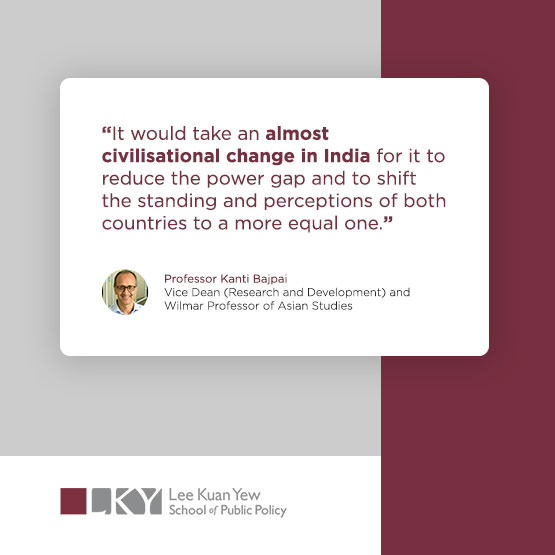
Overall, China's development is years ahead of India. The consequence of this is that from a position of strength, China does not see why it should offer India any concessions in their disputes. For its part, India realises that it is behind China, so it is unwilling to make concessions that could be seen as surrendering to its rival. As a result, the two countries rarely agree on anything. Prof. Bajpai argues that "It would take an almost civilizational change in India for it to reduce the power gap and to shift the standing and perceptions of both countries to a more equal one."
(Photo Credit: Jéan Béller)