


In the Spotlight
.png?sfvrsn=649b060a_1)
The Institute of Policy Studies and Singapore Business Federation will host the IPS-SBF Conference “Global-City Singapore: SG60 and Beyond” from 22 to 29 July 2025.
This landmark SG60 conference will bring together global thought-leaders, policymakers, business leaders and academics to analyse the interaction of complex trends reshaping our world. Key themes include the fragmentation of the liberal multilateral order towards more mercantilist orientations in economic strategy, the shifting policy accent from multilateralism to “minilateralism” resulting in a realignment of global value chains, and the mainstreaming of environmental sustainability, digitalisation and artificial intelligence.
The conference comprises three plenary sessions, with Prime Minister and Minister for Finance Lawrence Wong delivering the opening remarks and a dialogue with IPS Director Janadas Devan. Deputy Prime Minister and Minister for Trade and Industry Gan Kim Yong will participate in the closing dialogue.
Articles

Commentary — The problem with social media is bigger than who gets access ?
(CNA)
By Chew Han Ei
• 6-min read
Across the Asia-Pacific, governments are increasingly tightening social media access through age restrictions and identity verification requirements. But are these measures truly making platforms safer, or are they simply becoming more exclusionary?
In this commentary, Chew Han Ei examines the shift from regulating content to regulating access itself. He argues that blanket restrictions may push vulnerable users to less regulated spaces rather than protecting them. While regulation is necessary, he contends that it should be targeted and harm-responsive. The risk is that overly conditional access could decide who gets to participate in our digital future.

Commentary — Banning #SkinnyTok won’t fix the problem of viral harm
(The Straits Times)
By Chew Han Ei
• 7-min read
Removing #SkinnyTok from TikTok was a relief to many. However, it came too late and did too little, harmful contents relating to extreme dieting and pro-ana (pro anorexia) content remains pervasive online.
In this op-ed, Chew Han Ei warns that hashtag bans are symbolic at best, as harmful content can resurface under new trends, often before regulators can respond. He calls for upstream interventions — features that downrank harmful content, friction prompts for risky engagement, tailored safety settings for young users. and stronger parent-facing features. But most importantly, parents, community groups and researchers all have a part to play in building safer digital spaces for our young people.

Commentary — US Tariffs: Unforeseen slings and arrows aimed at an interconnected trade world
(IPS Commons)
By Vanesia Khoo
• 5-min read
As US Tariffs on Chinese imports continue to impact global trade, a lesser-known consequence is becoming more apparent: a rise in white-collar crime. Firms are turning to illicit practices such as under-invoicing and transhipment fraud to cut costs and remain competitive.
In this contribution to IPS Commons, research practitioner Vanesia Khoo explores how protectionist policies can unintentionally encourage trade-based financial crimes. She argues that Singapore, with its strong regulatory institutions and strategic location, is well placed to lead global efforts in preventing such crimes through smarter enforcement, cross-border cooperation and more transparent trade systems.
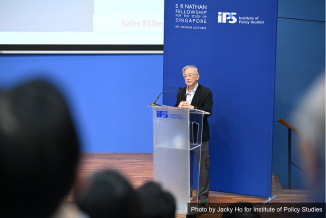
Event Summary — 16th IPS-Nathan Lecture Series: Lecture III "Singapore Enterprises: Grow, Glow, Globalise" by Mr Philip Yeo
• 5-min readOn 16 June 2025, Mr Philip Yeo delivered his third and final lecture as part of his lecture series,“Neither Civil Nor Servant: Singapore’s Disruptive Economic Playbook”.
He presented a framework for Singaporean enterprises to "grow, glow, globalise," emphasising that companies must expand, remain profitable, and venture beyond national borders to achieve scale.
In the Q&A session with Ms Aw Kah Peng, Chairman of Shell Companies in Singapore, they discussed talent development, regional expansion strategies and the need to shift from GDP to GNI for globally operating Singaporean companies.
Recent Releases on the IPS Website
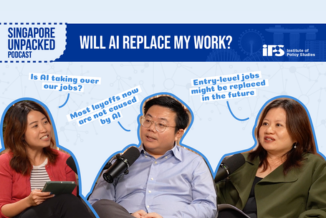
Singapore Unpacked Episode 6 – Will AI replace my work?
With Artificial Intelligence (AI) advancing at a rapid pace, many Singaporeans are asking tough questions about their future in the workforce.
In this episode, Host Liang Kaixin sits down with Dr Laurel Teo, Senior Research Fellow and Head of Society & Culture at IPS, and Jonathan Sim, Lecturer at the NUS Learning & Development Academy, to explore the realities of AI’s impact on jobs, and where human skills remain irreplaceable.
From the changing demands of entry-level roles to practical strategies for fresh graduates, the discussion highlights essential human strengths such as creativity, critical thinking, cultural sensitivity, and storytelling, alongside emerging skills like crafting effective AI prompts.
Recent Publications

Journal Article — Sticky, Yet Precarious: An Ethnographic Insight into F&B Workers in Singapore
In this article published in the Journal of Contemporary Ethnography, Shane Pereira, Mathew Mathews, and Irene Ng (NUS Social Service Research Centre) examine why some young Singaporean workers remain in low-wage, precarious food and beverage (F&B) jobs. Drawing on three years of ethnographic research, the study finds that financial insecurity, workplace camaraderie, and the entanglement of work with personal identity make these jobs “sticky,” even when they appear undesirable.
The article contributes to global discussions on labour precarity and service work by offering insight into how meaning, resilience, and belonging are forged amid structural constraints.

IPS Working Papers No. 63 — Borrowing Berlo: Enhancing Public Understanding of Singapore’s Online Harms Laws through the SMCR Model of Communication
Singapore has enacted a wide-ranging set of laws to tackle online harms in recent years — from false statements of fact and foreign interference to digitally manipulated election content. As the legal landscape grows more layered, understanding the purpose and coverage of each law can be challenging.
This paper introduces a practical taxonomy for organising legislation using David K. Berlo’s classic SMCR communication model — Sender, Message, Channel, Receiver, and Feedback. The framework offers a structured way to clarify what each law targets and how they work together. It contributes to ongoing conversations on digital safety and regulatory coherence, particularly with the forthcoming Online Safety (Relief and Accountability) Bill.
IPS in the News
For media coverage of IPS experts' views on current affairs and IPS events, click here.
For upcoming IPS events, click here. Sign up for the IPS events mailing list here.
Careers at IPS — please check us out and help to spread the word!