


In the Spotlight
“Universities Reinvented: Shaping Legacy and Impact for a New World” by Professor Lily Kong, IPS’ 15th S R Nathan Fellow for the Study of Singapore, was launched on 12 August 2025. The book compiles three lectures delivered by Prof Kong between October and November 2024, along with highlights of her Q&A sessions.
The launch was graced by Mr Desmond Lee, Minister for Education and Minister-in-Charge of Social Services Integration. In his address, he emphasised the need for Singapore’s autonomous universities to prepare graduates for an AI-transformed world, build a culture of lifelong learning, and conduct impactful research that addresses real-world challenges.
Following Minister Lee, Prof Kong reflected on the central question underpinning her book — “What is a university for in the new world?” and discussed how universities can continually reinvent themselves to stay relevant, and how Asian universities can lead in the “Asian Century”.
Purchase the book
here. Enjoy 20% off with promo code WSIPS20, valid till 31st October 2025.
The full videos from the IPS-SBF Conference Global-City Singapore: SG60 and Beyond are now available to watch online. Hear from global thought-leaders, policymakers, and business leaders as they tackle the fragmentation of the multilateral order, the shifting dynamics of global value chains, and how “Global-City Singapore” can thrive in an era of radical uncertainty.
Highlights from the conference, including the opening dialogue with Prime Minister and Minister for Finance Lawrence Wong and the closing dialogue with Deputy Prime Minister and Minister for Trade and Industry Gan Kim Yong, were recently featured in a
special programme by CNA.
Visit the
conference webpage now to watch the sessions, read the report and explore the insights shaping Singapore’s future in the global economy.
Articles
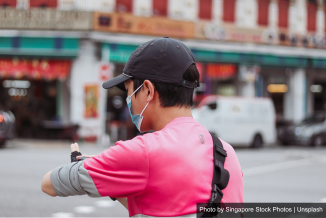
Commentary — For struggling platform workers, loopholes threaten rice bowls
(The Straits Times)
By Mathew Mathews and Tan Lyn Cai
• 7-min read
Foreigners illegally working as delivery riders have sparked concerns among some local platform workers, who struggle with unstable incomes and rising competition.
Mathew Mathews and Tan Lyn Cai argue that these illegal practices expose enforcement loopholes and undermine the livelihoods of platform workers. Enhanced security measures, clearer communication channels and stronger enforcement are not just about curbing unauthorised work. They are crucial in preserving the livelihoods of legitimate platform workers who play a vital role in our modern economy.

Commentary — With Shatec cutting back operations, what’s next for Singapore’s hospitality sector?
(The Straits Times)
By Shane Pereira and Julien Cayla
• 8-min read
A diploma from the renowned hotel management school, Shatec, was once considered a golden ticket to a career in hospitality and service. With the school scaling down its operations, it has raised concerns about the future of talent development in Singapore’s hospitality sector.
In this op-ed, Shane Pereira and Julien Cayla argue that relying on automation alone will not solve the industry’s deep-rooted manpower challenges. Instead, they call for a bold reimagining of hospitality education through the creation of a National Culinary and Hospitality Institute that integrates hands-on training, academic rigour and industry partnerships.
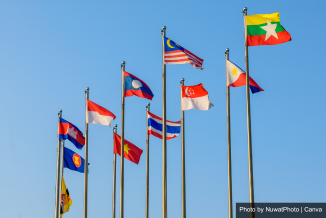
Commentary — NUS-led study reveals need for ASEAN to rev up integration to succeed in a swarm of uncharted global challenges
(IPS Commons)
By Faizal Yahya and Soo Yeon Kim
• 6-min read
As ASEAN doubles down on intra-regional free trade, how should Singapore and ASEAN businesses respond?
In this op-ed for IPS Commons, Dr Faizal Yahya and A/P Soo Yeon Kim present the findings from a two-year survey of manufacturing firms across seven ASEAN countries. The study reveals that firms, particularly those based in Singapore, favour broad-based reforms, such as stronger digital infrastructure and labour mobility, and prefer institutional coordination through trade associations over informal firm-to-firm ties.
Released at the IPS-SBF Conference "Global-City Singapore: SG60 and Beyond", the study offers a timely reminder: to stay competitive, ASEAN must adapt its frameworks to better support business needs in an increasingly complex global economy.

Commentary — 团结不是妄想 多元不是阻挠
(Lianhe Zaobao)
By Melvin Tay
• 8-min read
As Singaporeans prepare to recite the National Pledge this National Day, Melvin Tay reflects on how well we are living up to its ideals.
He argues that unity and diversity are not opposing forces, citing recent IPS surveys showing that over two-thirds of Singaporeans rate racial and religious harmony highly, with most supporting integration while preserving cultural traditions.
Singapore’s multicultural model has enabled this balance, but casual racism and unconscious biases remain. Younger Singaporeans are calling for more open conversations. He calls for thoughtful engagement with global ideas such as Critical Race Theory, while grounding discussions in Singapore’s shared values of mutual respect, inclusion, and collective responsibility.

Commentary — At SG60, it’s time to move from a ‘me’ to ‘we’ society
(CNA)
By Nicholas Thomas and Justin Lee
• 4-min read
As Singapore celebrates its 60th birthday, Nicholas Thomas and Justin Lee call for a shift from a “me” to a “we” society.
They discuss how citizens can become co-creators in policy making, moving beyond just providing feedback. They highlight opportunities such as participatory budgeting, community-driven estate projects, and multi-stakeholder partnerships to address the country's complex challenges.
SG60, they note, is a chance to renew our social compact, where the government leads with openness, institutions remain adaptable, and citizens embrace their role in shaping the nation’s future together.
 Commentary — Singpass use in dating apps raises difficult questions
(The Straits Times)
By Kalpana Vignehsa• 8-min read
With the introduction of Singpass verification in dating app Coffee Meets Bagel, could it be the answer to tackling fake profiles and scams?
Over 70 percent of users have adopted the feature since its launch, drawn by the promise of greater safety. However, Dr Kalpana Vignehsa cautions that it may be a high-tech fix that sidesteps the deeper issues of trust, intimacy, and our efficiency-driven approach to love.
Authentic connections, she argues, require genuine human effort and cannot be optimised by an app, even with verification technology.
Recent Releases on the IPS Website
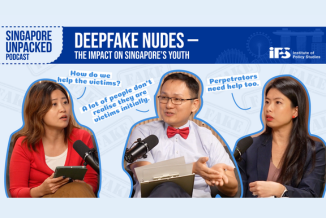
Singapore Unpacked Episode 7 — Deepfake Nudes — The Impact on Singapore’s Youth
In this episode of Singapore Unpacked, we explore the troubling rise of deepfake nudes and its devasting impact on Singapore’s youth.
In light of the recent Singapore sports school accident, host Liang Kaixin, joined by clinical psychologist Dr Annabelle Chow and Dr Chew Han Ei, Senior Research Fellow and Head, Governance and Economy at IPS, unpack how deepfake technology, often dismissed as harmless or unreal, can cause severe emotional trauma and social harm.
The discussion addresses the complexities of accountability and justice for perpetrators, exploring restorative pathways alongside necessary punishments, and emphasises the importance of education, digital empathy, and emotional literacy to effectively tackle this evolving issue.
If you are experiencing emotional distress:
Samaritans of Singapore: 1-767 (24hrs) / 9151 1767 (WhatsApp)
Support for online harm:
SG Her Empowerment (SHE): 8001 01 4616 / 6571 4400 (WhatsApp) / decb64_c2hlY2FyZXNAc2N3by5vcmcuc2c=_decb64
AWARE Sexual Assault Care Centre: 6779 0282 / 9781 4101 (WhatsApp) / decb64_c2FjY0Bhd2FyZS5vcmcuc2c=_decb64
Recent Publications

IPS Working Papers No. 64 — Prejudice, Attitudes and Critical Perspectives on Race in Singapore
Singapore’s multicultural compact, historically anchored in principles of equality and harmony, faces renewed scrutiny amid global debates on racial justice, prejudice, and identity politics. As international discourses on Critical Race Theory (CRT) and structural inequality increasingly permeate local conversations, it is imperative to assess how these global trends intersect with local understandings of race and prejudice. Motivated by this context, this working paper presents findings from the 2024 Institute of Policy Studies’ Survey on Race, Religion and Language (RRL), which canvassed responses from a nationally representative sample of 4,000 Singapore residents, and compares these findings with prior surveys from 2013 and 2018. The goal is to illuminate evolving perspectives on prejudice, attitudes, identity, lived experiences, and CRT within Singapore’s distinct multicultural framework.
IPS in the News
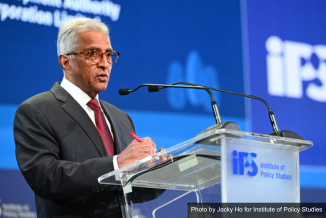
The Institute of Policy Studies extends our heartiest congratulations to our Director, Mr Janadas Devan, as one of the top recipients of this year’s National Day Awards.
He was conferred with the Meritorious Service Medal, or Pingat Jasa Gemilang, for his service to the nation.
For media coverage of IPS experts' views on current affairs and IPS events, click here.
For upcoming IPS events, click here. Sign up for the IPS events mailing list here.
Careers at IPS — please check us out and help to spread the word!