Event
Co-hosted by the Center for Global Asia, NYU Shanghai, the India China Institute, The New School, and the Lee Kuan Yew School of Public Policy, National University of Singapore
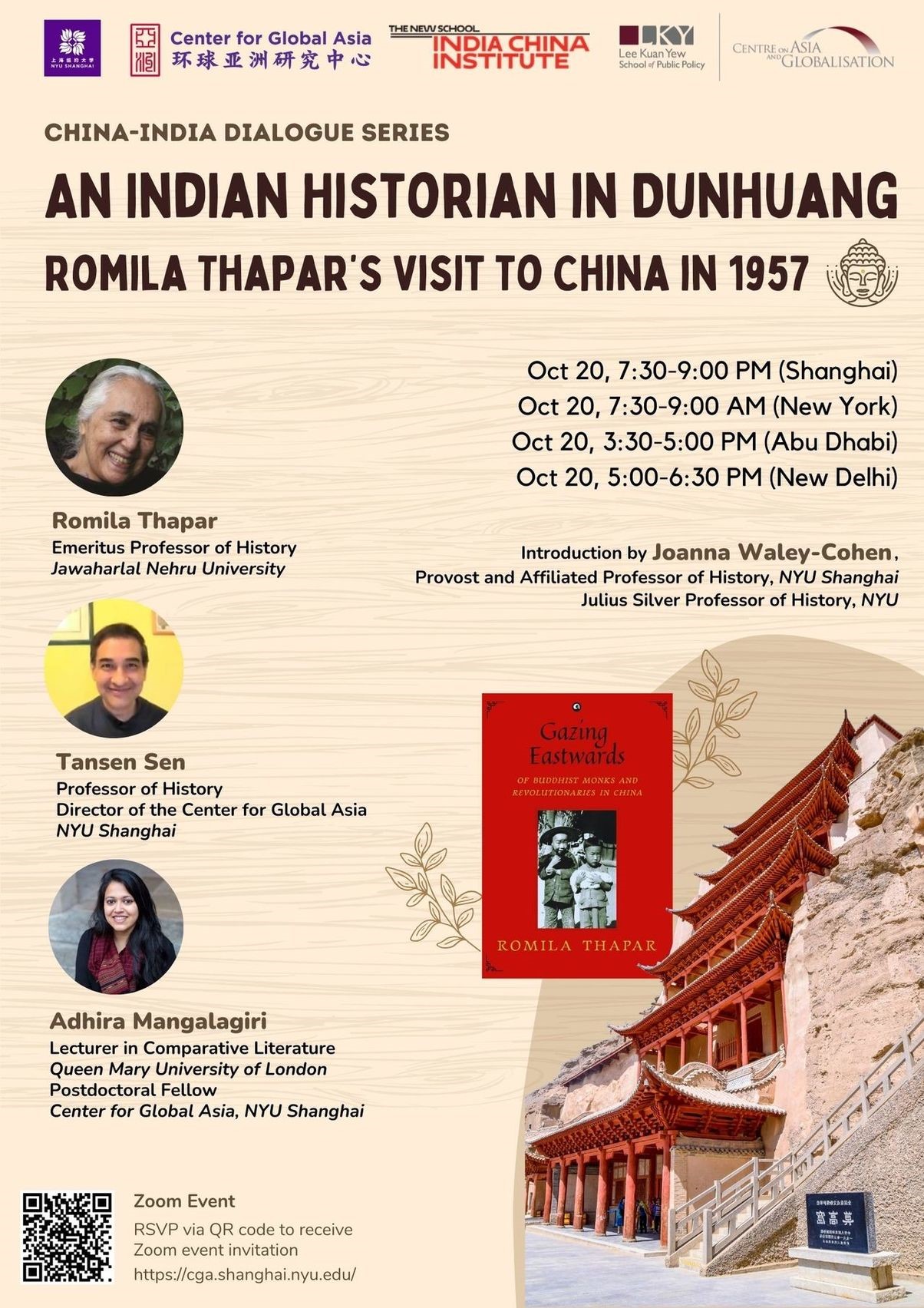
In 1957, renowned Indian historian Romila Thapar visited China, where, together with Sri Lankan art historian Anil de Silva, she worked at two cave sites that were the locations of Buddhist monasteries and shrines from the first millennium CE. The first site was the then lesser known Maijishan in north China, and the second was the famous site of Dunhuang on the edge of the Gobi desert in Northwest China. Now, decades later, she is supplementing the academic work that emerged from that trip with a captivating travelogue: Gazing Eastward takes readers back to midcentury China, through the observations that Thapar made in her diary during her time at the two archaeological sites and her trips there and to other sites. Traveling by train or truck, Thapar met people from throughout the country and all stations in society, from peasants on a cooperative farm to Chairman Mao himself. An enchanting document of a long-lost era, Gazing Eastward is a marvel, a richly observed work of travel writing that brings a time and a place fully to life.
Speakers:
Romila Thapar is an emeritus professor of history at the Jawaharlal Nehru University, New Delhi, and she was previously general president of the Indian History Congress. She is a fellow of the British Academy and holds honorary doctorates from Universities of Calcutta, Oxford University and the University of Chicago, among others. She is an Honorary Fellow of Lady Margaret Hall, Oxford, and SOAS, London. In 2008, she was awarded the prestigious Kluge Prize from the Library of Congress.
Tansen Sen is Professor of history; the Director of the Center for Global Asia at NYU Shanghai; and Global Network Professor at NYU. He is the author of Buddhism, Diplomacy, and Trade: The Realignment of Sino-Indian Relations, 600-1400 (2003; 2016) and India, China, and the World: A Connected History (2017). He has co-authored (with Victor H. Mair) Traditional China in Asian and World History (2012), edited Buddhism Across Asia: Networks of Material, Cultural and Intellectual Exchange (2014), and co-edited (with Burkhard Schnepel) Travelling Pasts: The Politics of Cultural Heritage in the Indian Ocean World (2019) and (with Brian Tsui) Beyond Pan-Asianism: Connecting China and India, 1840s–1960s (2021). He is currently working on a book about Zheng He’s maritime expeditions in the early fifteenth century, a monograph on Jawaharlal Nehru and China, and co-editing (with Engseng Ho) the Cambridge History of the Indian Ocean, volume 1.
Adhira Mangalagiri is a Lecturer (U.S. Assistant Professor) in the Department of Comparative Literature at Queen Mary University of London. Her research focuses on twentieth century Chinese and Hindi/Urdu literatures and engages with the fields of world literature, Global South studies, and postcolonial studies. Her book, States of Disconnect: China-India Literary Relation in the Twentieth Century (forthcoming with Columbia University Press), studies the breakdown of transnationalism in Chinese and Hindi texts (1900-1965) that express an aversion to pairing ideas of China and India together. Such texts may seem to spell the ends of comparative thought, but States of Disconnect shows how literary practice can offer possibilities of relation in the face of insular nationalisms. The book offers “disconnect” as a critical lens for making sense of severed, interrupted, or absent transnational connection, and for finding in such moments an ethics of relation.