
In The Spotlight

“Lee Hsien Loong and Singapore”, a new volume edited by Dr Gillian Koh, Ms Chua Mui Hoong and Mr Terence Ho was launched on 8 September 2026. The book brings together 23 essays by Singapore’s leading thinkers and policy practitioners to examine the leadership and legacy of the country’s third Prime Minister.
In her welcome remarks, Ms Chua described how Mr Lee led Singapore through shifts in geopolitics, economics and society at home. Each chapter of the book captures the essence of adaptive governance. IPS Director Janadas Devan situated Mr Lee within Singapore’s policial trajectory, noting that his tenure as Prime Minister saw "the government take on a more intimate role in the socioeconomic lives of its citizens".
A panel discussion moderated by Professor Leong Ching, Vice Provost (Student Life) at NUS, brought together Professor Chan Heng Chee, Mr Manu Bhaskaran, Professor Paulin Straughan and Associate Professor Eugene Tan. They discussed why Singapore’s transitions between prime ministers have been remarkably smooth, what the younger generation makes of the Lee Hsien Loong years, and what each panellist saw as his most consequential but lesser-known work.
Click here for more information and purchase the book.
Recent Events
Young Singaporeans Conference 2026: "Future Makers" – Pre-conference Engagement
On 12 September 2026, IPS kicked off YSC 2026 “Future Makers” with a day of policy deliberations on Singapore’s declining fertility rate with over 30 youth leaders.
The event featured a World Café across five domains — relationships, housing, career, caregiving, and parenting — surfacing tensions between aspirations, affordability, and connection in busy digital lives.
Using Needs & Assets Mapping and "How Might We" frameworks, participants developed solutions presented to guest-of-honour Ms Goh Hanyan, Senior Parliamentary Secretary for Ministry of Culture, Community and Youth and Ministry of Sustainability and the Environment.
A dialogue session followed, with Ms Goh responding to proposals from participants — from family support accreditation to caregiving grants for siblings — and discussing measuring family formation beyond TFR. She urged youths to pilot ideas and test real demand.
Recent Publications
(Participedia)
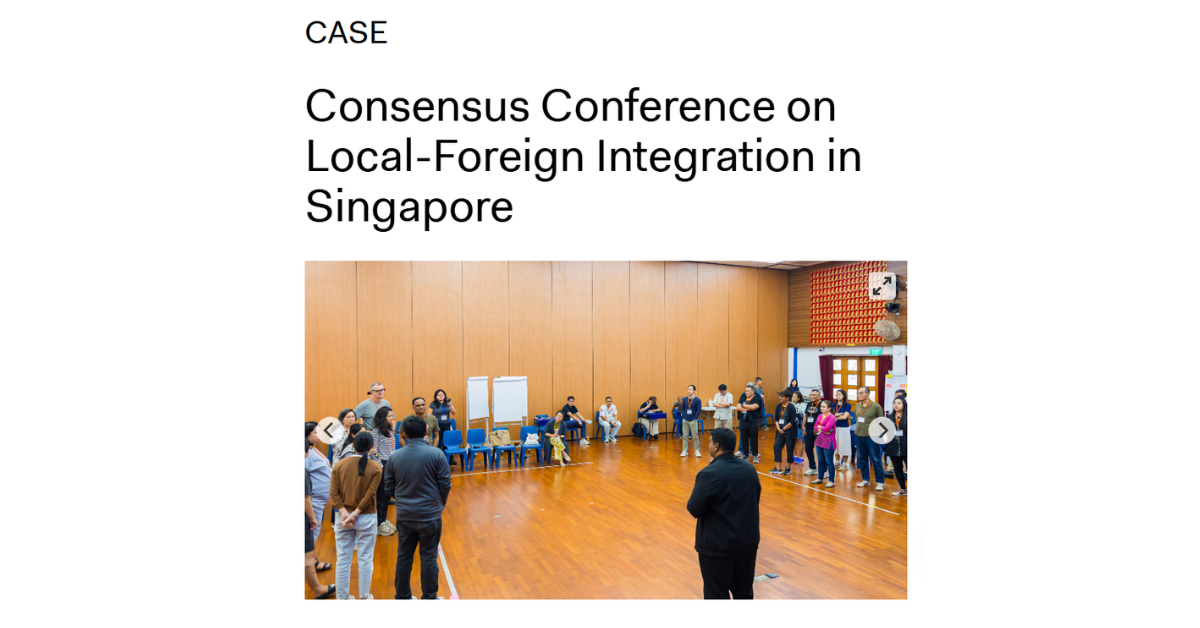
IPS’ submission to Participedia — a practitioner-friendly global platform where researchers and practitioners share concise accounts of deliberation and public participation — is Singapore’s first case published on this platform. The entry is based on the Consensus Conference Report. |
Articles

By Kalpana Vignehsa
(CNA)
• 4-min read
The $70,000 SG Child Support Package announced at this year’s NDR treats child-rearing as social infrastructure, not private cost. Yet gaps remain: long work hours limit childcare leave's use, and caregiving's opportunity cost still falls unrecognised on mothers and grandparents. The Marriage and Parenthood Reset Workgroup has promised fuller recommendations in early 2027.
By Kalpana Vignehsa
(The Straits Times)
• 9-min read
With 64.5% of married residents under 55 living with or near parents, Singapore's housing policy still defaults to nuclear families. This commentary proposes raising co-residence grants, funding second moves after lock-in periods, and expanding multi-generational housing supply to ease genuine choice.

By Tan Poh Lin
(The Straits Times)
• 5-min read
Financial incentives alone won't lift birth rates, argues this commentary. As resources stretch thinner per child, older siblings' well-being deters larger families. Non-cash support — like priority enrichment access and social capital programmes — could reframe siblings as an advantage, opening new paths to family formation.
By Mathew Mathews, Teo Kay Key, Melvin Tay
(CNA)
• 7-min read
Most Singaporeans name multiculturalism as core to identity, with three in four open to new migrants. Yet racist comments about Singaporeans missing in Nepal's floods show prejudices persist in pockets. The authors argue that resisting the normalisation of such views matters if the multiracial compact is to hold.

By Aaron Maniam
(The Straits Times)
• 7-min read
Singapore's political salary framework, meant for five-yearly review, went 15 years unrevised. September's revision rested on Calibre, Commitment, and a Clean wage. A fourth principle — Calibration — was proposed: reviews on schedule would restore dynamism, with the discipline cutting both ways if benchmark incomes fall too.

By Christopher Gee
(CNA)
• 6-min read
PM Lawrence Wong and Minister Chan Chun Sing justified the ministerial salary review using opportunity cost — what capable people forgo entering politics. This commentary noted that neither of them quantified this cost, highlighting the more significant proposal of adding a quality-of-life measure to the National Bonus, tying ministerial pay to national well-being, not just market benchmarks.

By Christopher Gee
(The Straits Times)
• 6-min read
Should en bloc consensus thresholds be lowered? This commentary examines the new Land Titles (Strata) (Amendment) Bill, which cuts consent thresholds for older developments but raises the bar to start proceedings. He argues the real divide is owner motivation, not tenure, and urges structured sentiment-gauging before formal sales committees form.

By Justin Lee
(IPS Commons)
• 6-min read
Following the NCSS (Amendment) Act refocusing NCSS on frontline services, 500 to 600 non-religious charities now lack an umbrella body, unlike social enterprises or co-ops. Unlike the UK, US or Australia, Singapore has no independent apex body — raising questions about communities' room to shape their own solutions.

By Kalpana Vignehsa
(IPS Commons)
• 9-min read
This commentary argues that Singapore's family benefits favour nuclear households over multigenerational ones. Grants, vouchers and rebates often reward living apart from grandparents, despite their vital caregiving role amid record-low fertility rate. She calls for auditing penalties, incentivising co-residence transitions, redesigning flats for shared living, and formally recognising grandparent caregivers.

By Zheng Mu
(IPS Commons)
• 6-min read
More Singaporeans are single in their late 20s and early 30s than five years ago, yet 86% marry by their late 40s — suggesting delay, not decline. This commentary argues that marriage now requires stability, financial independence, housing security and emotional maturity as prerequisites, not outcomes. Policy should ease uncertainties around marriage and parenthood, and support marriages after formation too.