


In the Spotlight
What shaped the vote in GE2025? From the issues that mattered most to voters, to the qualities they valued in candidates, and the role of media in shaping views, new findings provide a clearer picture of Singapore’s political landscape.
The researchers shared their findings in a closed-door discussion on 1 September, to provide insights into Singaporeans’ political attitudes and what these might suggest for political development in the country. Following the 3 May 2025 General Election, IPS conducted three opinion surveys — the Post-Election Survey, the Perceptions of Governance & Belonging Survey, and the IPS-CNM Media Use in GE2025 Survey. Together, these studies reveal what influenced voters’ choices, how they viewed the outcome, and what this could mean for Singapore’s future.
Explore the full findings here.
Announcements
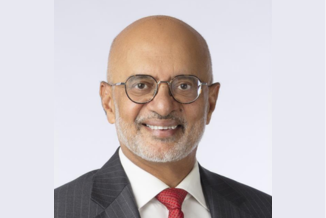 | 17th S R Nathan Fellow for the Study of Singapore — Mr Piyush Gupta We are pleased to announce the appointment of Mr Piyush Gupta, former Chief Executive Officer and Director of DBS Group, as the 17th S R Nathan Fellow for the Study of Singapore. Mr Gupta will work on a series of three lectures on the development of Singapore’s financial sector, tracing its evolution into a leading financial centre, examining the trade-offs between trust and innovation, and exploring the future of finance shaped by emerging technologies like tokenisation and artificial intelligence (AI). Find out more in the press release here. |
|
|
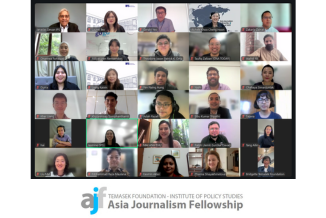 | Asia Journalism Fellowship – 2025 Fellows Twenty journalists from 15 countries across Asia have been selected for the 2025 edition of the Asia Journalism Fellowship (AJF), a programme hosted by the Institute of Policy Studies at the National University of Singapore, in partnership with Temasek Foundation. The eight-week programme will run from 8 September to 31 October and will feature a blend of media training, expert-led seminars and thematic discussions. While in Singapore, Fellows will also meet policymakers, academics, media practitioners, and visit places of interest across the city. Click here to meet the 2025 AJF Fellows. |
Articles
 | Commentary — Protecting the endangered species known as entry-level workers
(The Straits Times)
By Laurel Teo
• 7-min read AI is reshaping the workplace, and entry-level jobs, a crucial first step in many careers, are increasingly at risk. Laurel Teo examines how automating junior roles could cut young people off from vital learning opportunities, disrupt talent pipelines, and ultimately weaken organisations’ future leadership. She highlights Singapore’s timely policy response, such as a new government-funded traineeship scheme, while calling for fresh approaches to apprenticeships and career development in the age of AI. Safeguarding youth careers will require coordinated action from government, businesses and even AI firms, ensuring that the next generation can build skills and thrive. |
|
|
 | Commentary — NDR 2025 – how traineeships can translate into jobs for fresh graduates
(CNA)
By Faizal Yahya
• 5-min read Against the backdrop of sluggish economic growth and global economic uncertainties, a government-funded traineeship programme for ITE, polytechnic and university graduates was announced during the National Day Rally. Faizal Yahya discusses how the traineeship programmes can benefit fresh graduates but also raises concerns on whether companies — especially small- and medium-sized companies — will convert trainees into permanent staff. He suggests that linking traineeships directly to frontier sectors like biomedical sciences and quantum technologies could turn short-term relief into long-term growth. |
|
|
|
 | Commentary — Snap Insight: Ageing well is a challenge Singaporeans must take on together
(CNA)
By Christopher Gee
• 3-min read As Singapore prepares to become a super-aged society by 2026, supporting seniors to age with dignity and connection will be vital. Christopher Gee reflects on Prime Minister Lawrence Wong’s National Day Rally announcement of Age Well Neighbourhoods. By bringing health, wellness and assisted living services directly into the communities where seniors live, he shows how the model makes sense in land-scarce Singapore and how technology and a “we-first” spirit can help sustain it. He further argues that ageing well is not just a policy goal but a shared responsibility, where government support, innovation and citizen care come together to build inclusive communities for all generations. |
|
|
 | Commentary — How Singapore can protect children while helping them navigate social media
(CNA)
By Chew Han Ei
• 4-min read At this year’s National Day Rally, PM Lawrence Wong highlighted growing concerns about excessive screentime among children. Around the world, governments are grappling with this challenge, with Australia recently banning YouTube for users under 16. Chew Han Ei argues that real risks lie in “risky-by-design” features like autoplay and infinite scroll, keeping children hooked regardless of age. Beyond bans, he calls for building digital spaces with children, giving them a voice and fostering resilience as the key to a safer online future. |
|
|
|
 | Commentary — SG60 and Beyond: The Future of the Ordinary
(IPS Commons)
By Joshua Sim
• 6-min read At the recent SG60 IPS-SBF Conference, PM Lawrence Wong characterised Singapore as boring yet reliable — qualities that have long been our strength. In a world unsettled by geopolitical tensions, climate risks and rapid advances in AI, such ordinariness is becoming ever more valuable. In this commentary for IPS Commons, Joshua Sim reflects on how Singapore’s quiet, consistent functionality can be a radical act of resistance in a noisy, uncertain world, and how young Singaporeans can embrace the future by sustaining and reinventing the ordinary. |
|
|
 | Commentary — Want a ‘we first’ society? Members of Parliament are vital to the effort
(The Straits Times)
By Nicholas Thomas and Justin Lee
• 5-min read With the opening of Singapore’s 15th Parliament, PM Lawrence Wong has called for a “we first” society, one that requires stronger trust, networks and shared responsibility. While family bonds and trust in institutions remain resilient, research has shown that social circles are shrinking, and class has become Singapore’s sharpest social divide. In this commentary, Nicholas Thomas and Justin Lee argue that MPs have a vital role to play in enabling participation and strengthening cohesion. From mentoring schemes that connect professionals with youths to co-designed neighbourhood spaces and community heritage campaigns, these efforts illustrate how MPs can help build a more cohesive and future-ready Singapore. |
|
|
 | Commentary — Reimagining Academic Assessment in the Age of AI
(IPS Commons)
By Matthew Hammerton
• 8-min read In the age of AI, traditional assignments in higher education are being upended as students can now generate work without genuine engagement. In this commentary for IPS Commons, SMU’s Associate Professor Matthew Hammerton explores how educators can respond by emphasising intellectual responsibility. By ensuring that students understand and can defend their work while using AI, he argues that a return to “oral examinations” allows students to engage critically with AI tools while preserving independent, higher-order thinking that technology cannot replace. |
|
|
 | Commentary — The Vaping of the mind: Why Singapore should act and how
(IPS Commons)
By Shashi Jayakumar
• 8-min read
As Singapore advances its Smart Nation vision, PM Lawrence Wong has reminded citizens in his National Day Rally that learning is about cultivating human qualities, not just mastering technology. In this commentary, Shashi Jayakumar, Executive Director of SJKGeostrategic Advisory, warns that while GenAI provides quick solutions, overuse risks the “vaping of the mind”, eroding critical thinking through cognitive offloading and learned helplessness. Since AI firms prioritise existential threats over gradual cognitive decline, he argues that governments must step in. For Singapore, this could mean delaying the introduction of GenAI in schools, strengthening curricula, and promoting deep reading to preserve independent reasoning. |
|
|
|
 | Feature — The Transformative Logic of Community Empowerment
(ETHOS)
By Justin Lee
• 14-min read Singapore’s dominant model of social change is a service provision paradigm: centrally managed, state or philanthropy-funded, professionally delivered, competitive, and scalable. This model has worked well but tends to treat citizens as clients, risks creating “disabling help,” and encourages competition among agencies rather than collaboration. In this featured article in ETHOS, Justin Lee offers alternative paradigms to empower citizens, such as Community Building and Collective Empowerment, Mutual Aid and Peer-to-Peer Action, and Contributing to the Commons. While each has limitations, shifting towards “communitisation” — transferring more agency from state and market to communities — can foster stronger civic life, collective wealth, and locally grounded solutions. |
Recent Publications
 | IPS Working Papers No. 65 — Religious Identity and Practice among Singaporeans How do Singaporeans view their religious identity today? Findings from the 2024 IPS Survey on Race, Religion and Language (RRL) show that religion remains an important aspect of identity. In 2024, 61.1 per cent of respondents considered religion important or very important to their sense of self, up from 56.5 per cent in 2013 and 56.8 per cent in 2018. Religious practice, however, is taking new forms. While fewer Singaporeans report praying daily or attending gatherings, more are engaging through media or turning to individual practices such as meditation and reading religious literature, both of which have become more common. This suggests that religion in Singapore is not diminishing but adapting, reflecting broader changes in how people connect with faith. |
|
|
 | IPS Working Papers No. 66 — Moral Attitudes in Flux: Comparing Trends across Religions in Singapore This working paper examines how Singaporeans evaluate moral questions such as gambling, fidelity, cohabitation, premarital sex, divorce and same-sex issues. The study found that disapproval of gambling remains high and steady. Views on pregnancy out of wedlock and premarital sex versus cohabitation have become more liberal over the past decade, with attitudes towards same-sex issues shifting the most. Divorce consistently stands out as the most context-dependent judgement. Younger Singaporeans are generally more permissive than older cohorts, particularly on sexuality and family formation. Since 2013, Catholics, Hindus and Buddhists have shown significant liberalising shifts, led by youth. |
|
|
 | Journal Article — Enablers and constraints influencing implementation of a novel, multi-site community-based frailty programme: perspectives of leaders and implementers
A new study in BMC Geriatrics, co-authored by Robyn Tan, examines the implementation of Singapore’s Geriatric Services Hub (GSH), a multi-site, novel community-based frailty care programme. The findings, drawn from interviews across five pilot sites, were organised into four domains: system, partnership, programme, and patient factors. System-level challenges included uneven subsidies between providers, heavy workloads in primary care, fragmented services, and the impact of COVID-19. On the other hand, capability-building for community and primary-care partners was welcomed. The programme focused on making services more affordable and accessible, but some older adults still faced complex medical, social, and financial issues that made it hard to benefit. The authors conclude that bigger system-wide changes are needed to make integrated care models like GSH sustainable in the long run. |
|
|
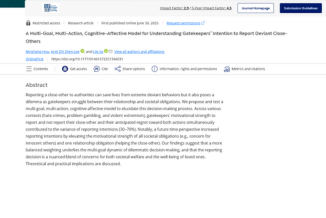 | Journal Article — A Multi-Goal, Multi-Action, Cognitive-Affective Model for Understanding Gatekeepers’ Intention to Report Deviant Close-Others Why do people hesitate to report a close friend or family member showing signs of harmful behaviour, such as hate crimes, problem gambling and violent extremism? This new research article co-authored by Mike Hou introduces a Multi-Goal, Multi-Action, Cognitive-Affective (MMCA) model to explain this dilemma. Through six studies across the US and Singapore, the authors show that reporting intentions arise from balancing societal obligations with relationship obligations, shaped by both cognitive evaluations and anticipated regret. The paper highlights that fostering a future-oriented mindset increases the likelihood of reporting, and offering insights could help communities and authorities encourage timely reporting to prevent harm while protecting relationships. |
For media coverage of IPS experts' views on current affairs and IPS events, click
here.
For upcoming IPS events, click
here. Sign up for the IPS events mailing list
here.
Careers at IPS — please check us out and help to spread the word!