 | This entry received the first prize in Data for Good’s inaugural Data for Public Policy Visualization Competition. Data for Good is a student group that aims to provide opportunities for the Lee Kuan Yew School of Public Policy community to talk, learn, and stay curious about data and its impact. |
China experienced a demographic shift in 2011 when the urban population surpassed the rural population (as shown in Figure 1). This urban-rural crossover symbolises China’s accelerated shift from an agrarian society to an expanding urban-industrial economy, reflecting changes in labour markets, economic structures, and patterns of internal migration. In addition to marking a demographic tipping point, it represents an economic and societal transformation, providing new opportunities across diverse sectors, including industry. But what can China’s urban-rural population crossover reveal about female labour market integration?
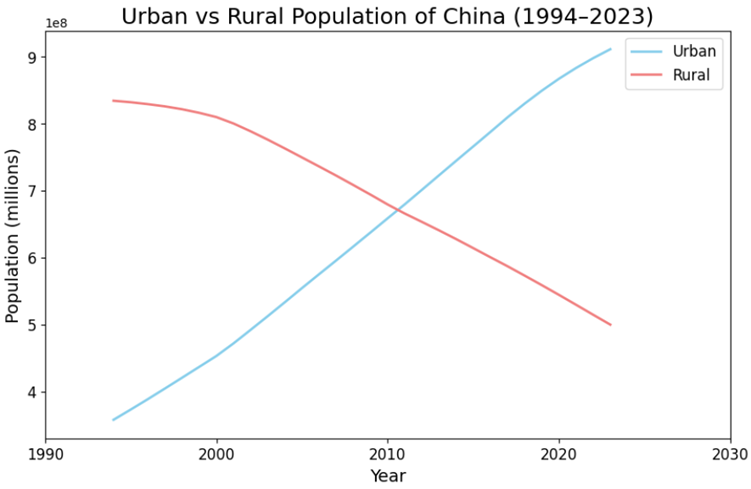
Figure 1: Urban vs Rural Population Crossover
An analysis of trends from 1994 to 2023 reveals a striking contradiction: female employment in agriculture declined sharply, yet industrial employment for women failed to rise proportionally (as shown in Figure 2).
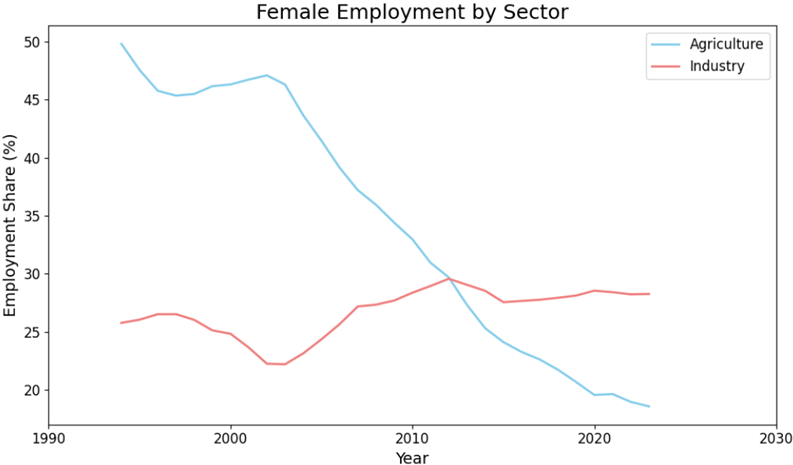
Figure 2: Female Employment by Sector
Despite significant rural-to-urban migration, women were not absorbed into urban industrial sectors at the same rate as men (as illustrated in Figure 3).
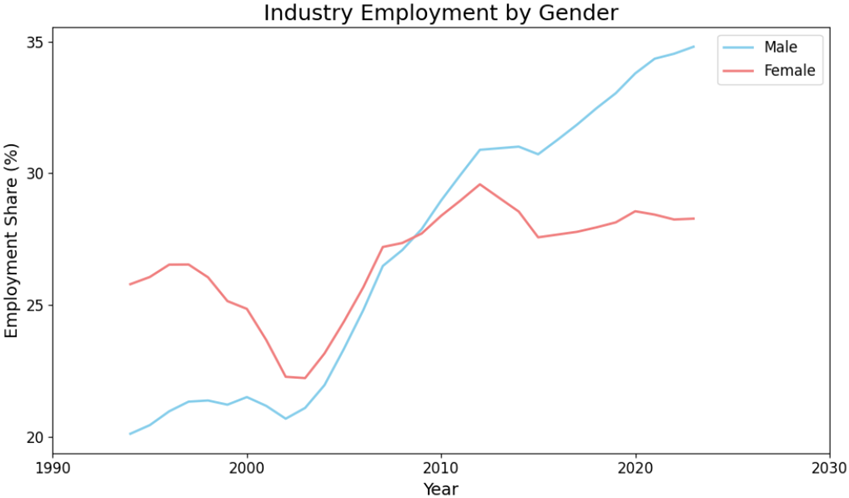
Figure 3: Industry Employment by Gender
The population crossover was not mirrored by a crossover in sectoral employment, highlighting a critical disconnect between spatial mobility and economic mobility. The analysis after 2011 revealed a small but statistically significant uptick in female industrial employment. However, the shift was insufficient to mark a structural transformation in the labour market.
While millions of women left rural agricultural employment in pursuit of better opportunities, structural barriers within labour markets hindered their integration into formal industries, leading to persistent gendered occupational segregation and underrepresentation in the sectors driving urban economic growth. The regression of the gender gap in labour force participation against urban population size yielded no significant association, indicating that increases in urban population alone have not significantly narrowed the gender gap. Additionally, a positive but modest relationship between female industrial employment and urbanisation suggests that urban expansion created opportunities, but women’s inclusion in emerging sectors lagged. A positive correlation of female labour force participation with urban population size and year implies participation growth, but an overall downward time trend reinforces that urbanisation alone does not guarantee equitable economic opportunity.
The persistence of this gap highlights the need for deliberate, gender-sensitive policies beyond spatial transformation to ensure inclusive economic growth.
Migration without mobility. Urban population growth and spatial movement to cities did not necessarily improve the economic status of migrant women, revealing a widening gap between spatial migration and economic integration.
Sectoral employment remains gendered. Male dominance in industrial sectors persists, with the gap widening further. Women's losses in agriculture outpaced their gains in industry, highlighting the lack of an equal crossover in sectoral employment.
Skills development: Targeted skills development programmes must be integrated into the migration process to ensure that spatial mobility translates into economic empowerment. This includes linking rural-to-urban migration with targeted industrial training and job placement strategies tailored for women.
Sector transition vouchers/subsidies: The structural shift from agricultural to urban employment often imposes economic costs on rural women. To address this, policymakers should introduce sector transition vouchers or subsidies such as training subsidies, entrepreneurship grants and conditional cash transfers to encourage labour force participation.
Expansion of social infrastructure: Economic inclusion is impossible without social infrastructure that addresses care responsibilities, which disproportionately fall on women. Affordable childcare and eldercare services within urban residential and industrial zones can enable them to seek, secure, and sustain employment.
While crossover trends illustrate symbolic shifts, causality between migration and economic outcomes cannot be definitively established. Regional disparities and differences in urban policy environments are not fully captured. However, the existing data can still provide insight into what the crossover of China’s population from rural to urban majority might mean for women in the country.
The absence of a corresponding economic crossover for women reveals a significant structural blind spot. Urbanisation must be more than just spatial relocation; it must also guarantee equitable economic opportunities. An inclusive urban economy requires deliberate gender-responsive policies to ensure women are not merely relocating to cities but actively thriving and shaping China's future growth.