Tech competition is at the center of the current US-China strategic rivalry. Of particular importance in this regard is the semiconductor industry with its critical utility for both industrial/economic and military purposes. In this presentation, Assistant Professor Ryu Yongwook discusses the emerging competition over access and dominance of the global chip market and the implications for China.
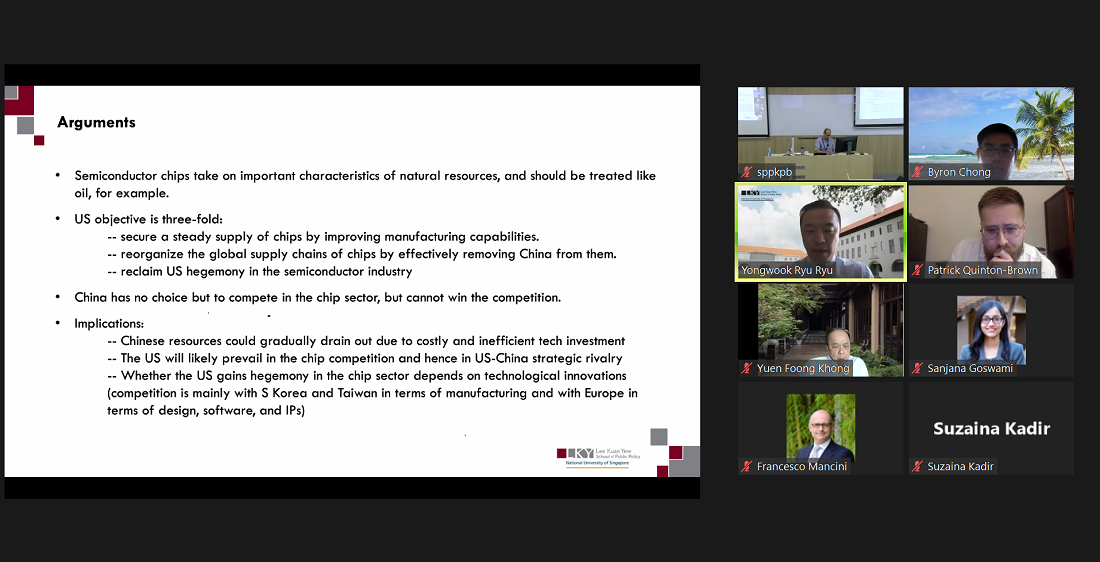
Semiconductor chips have gained critical and strategic importance for their use in emerging technologies like AI, 5G/6G and quantum computing, as well as for their growing industrial and military applications. Much like oil, chips have become essential to running a country’s economy and military, and states need to ensure continued access either by investing in local production or establishing supply chains.
The US has been concerned with maintaining its technological superiority, and by extension, its influence over global chip supply chains. To curtail China’s development in the semiconductor industry, US has undertaken a comprehensive policy of export bans and encouraging local manufacturing and R&D.
Though China has invested heavily in establishing its own domestic chip industry and reducing its dependence on foreign suppliers, its efforts have not been a resounding great success. Chinese companies continue to have little presence in softwares/core IPs and equipment. The high-profile bankruptcy of major Chinese companies like HSMC, Jinan Quanxin, and Tsinghua Unigroup further underscore the difficulty of competing in an industry dominated by China’s geopolitical rivals.
Moving forward, China’s domestic chip industry will likely continue to be plagued by problems like poor innovation and inefficiency despite the huge investments being poured into the sector. This may prove to be a major drain on China’s resources in the long term. The US and its friends will likely succeed in reorganising chip supply chains around China, restricting the Asian power’s access to the most advanced chips even further. If the US is able to maintain its technological superiority over China, it could well tip the balance in their global strategic competition.