Summary:
- ASEAN faces a major transmission investment gap, with more than US$300 billion needed for grid expansion and modernisation by 2040. Of this, cross border interconnectors account for US$27 billion, but they present additional regulatory, financial and coordination challenges.
- A new IES whitepaper finds that transmission investment readiness varies significantly across ASEAN. Drawing on a comparative assessment of market and regulatory structures, policy and implementation readiness, and financing and delivery capacity, the study identifies three broad bankability profiles, each requiring differentiated approaches to private participation.
- Mobilising private capital requires more than innovative financing instruments. Credible long-term revenue arrangements, appropriate risk allocation, institutional capacity and country-specific investment frameworks are essential. Cross-border projects additionally require coordinated arrangements among participating countries to support regional electricity trade.
The ASEAN Power Grid (APG) was first proposed in 1997 as a call for electricity interconnecting arrangements across member states. In 2007, a Memorandum of Understanding formalised its objective to “ensure greater regional energy security and sustainability on the basis of mutual benefit”. The idea is that cross-border connections will make the region more efficient, allowing sources of electricity generation, notably from renewable sources, to flow to the areas of high demand.
Nearly 30 years later, the grid spans nine bilateral connections, largely in the Mekong region, and the Lao PDR–Thailand–Malaysia–Singapore Power Integration Project (LTMS-PIP), which enables multilateral power trading over existing links. While these constitute genuine progress, the grid is not keeping up with the bloc’s demand or even ambitions.
ASEAN’s electricity demand is projected to more than double from 2022 levels by 2050, driven by industrialisation, urbanisation, and fast-growing digital infrastructure. Meanwhile, current transmission expansion plans are estimated to address only about 45 per cent of the infrastructure required. The International Energy Agency (IEA) estimates the region will need more than US$300 billion in grid expansion and modernisation from 2025 to 2040. Planned APG interconnectors account for around US$27 billion of that.
What’s causing the shortfall? Historically, transmission infrastructure across ASEAN has been largely publicly financed; however, growing investment needs and fiscal constraints are increasing the need for private capital. Attracting such investment requires predictable policy and regulatory frameworks. The challenge, therefore, is not simply a lack of capital, but one of bankability and delivery – that is, creating the conditions that make transmission projects investable, repeatable and scalable.
That’s the focus of a new Lee Kuan Yew School of Public Policy (LKYSPP) whitepaper, Unlocking Private Capital in ASEAN: Third-party Investment Models for Grid Decarbonisation and Regional Integration, co-authored by Research Fellow Dr Maitreyee Mukherjee, and Research Associate Anmol Nayak, from the school’s Institute for Environment & Sustainability (IES). The whitepaper points out that private capital is already part of ASEAN’s power sector. Independent power producers (IPP) are a familiar feature when it comes to power generation. But it’s a different story for transmission projects.
Transmission assets – the high-voltage wires, substations, and control systems that move electricity long distances – are capital-intensive and long-tenured. They are also typically embedded in state-led utility systems and dependent on regulated or utility-backed revenues. Funding them with private capital requires predictable regulation, bankable counterparties, credible, long-term revenue arrangements, appropriate risk allocation, and sufficient implementation capacity.
A Three-Pillar Diagnostic
“Transmission investment challenges vary significantly across ASEAN countries,” says Dr Mukherjee. “There is no one-size-fits-all solution. The starting point is to identify the specific regulatory, institutional and financing constraints in each country, and then develop investment frameworks that respond to those challenges.”
To assess the transmission investment landscape across ASEAN, the paper develops a comparative framework organised around three key pillars: whether market, regulatory and tariff arrangements provide predictable revenue; whether policy ambitions are supported by enabling instruments; and whether utilities and institutions have the capacity to deliver.
The comparative assessment reveals significant differences across ASEAN in regulatory and market structures, policy readiness, institutional capacity and access to financing. While some countries benefit from relatively mature regulatory frameworks, financially stronger utilities and established financing mechanisms, others face gaps in policy implementation, utility creditworthiness and project delivery capacity. These differences shape the feasibility of private participation and the types of financing and de-risking approaches required. The study identifies three broad transmission investment bankability profiles, each with distinct characteristics, constraints and investment priorities.
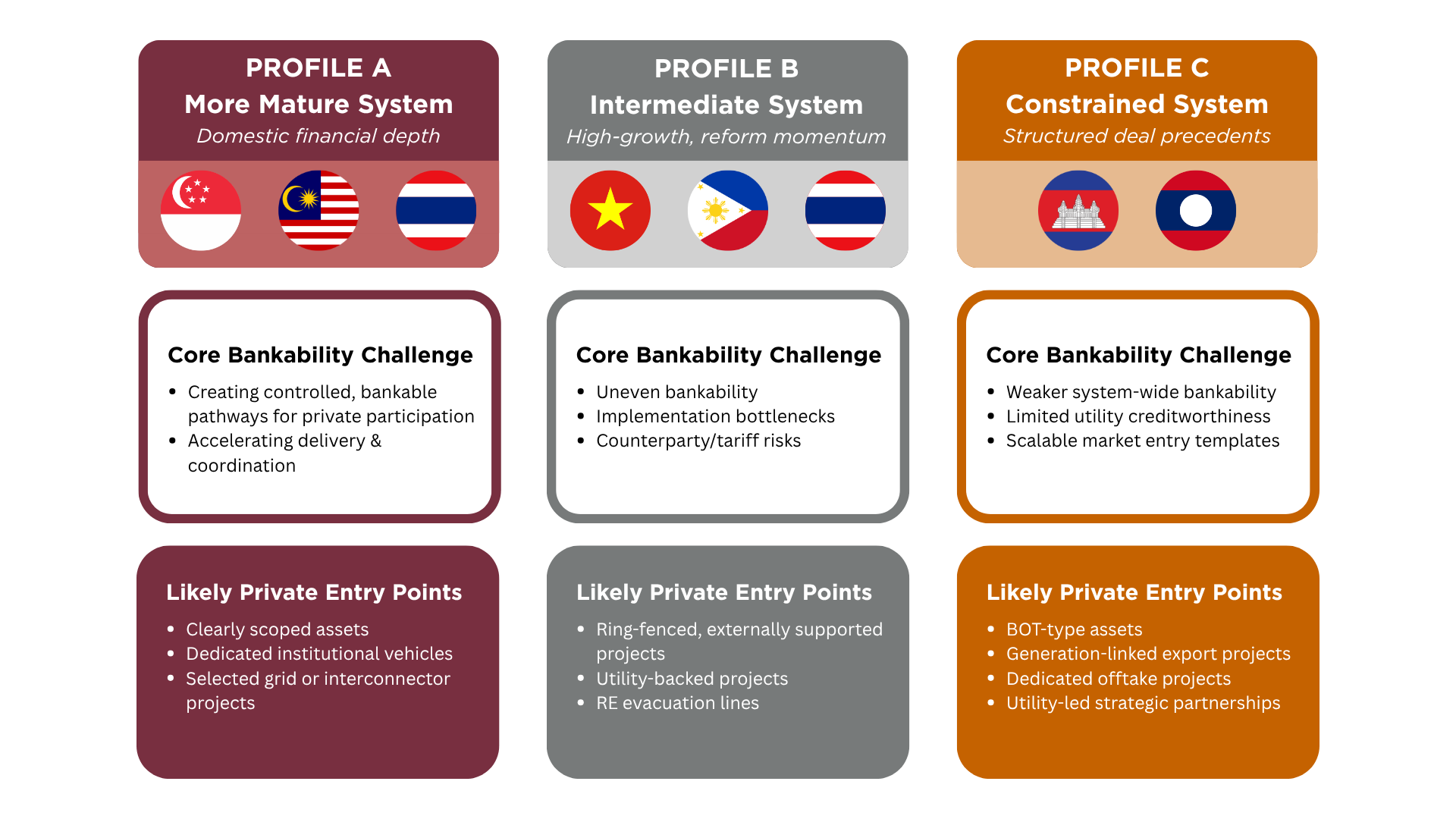
Figure 1: A typology of transmission bankability profile in ASEAN (developed by authors).
Note: Profiles indicate different bankability problems, not country rankings.
Private Participation: Matching Financing Models to Investment Challenges
Beyond assessing the transmission investment landscape, the whitepaper examines different models of private participation, including public-private partnerships, concession-based arrangements and privately financed interconnectors. Each model presents distinct opportunities and challenges, depending on the regulatory environment, revenue arrangements, utility creditworthiness and allocation of risks between public and private stakeholders.
The study also explores a range of financing and de-risking instruments, including blended finance, guarantees and long-term contractual arrangements, to address risks such as revenue uncertainty, counterparty creditworthiness, currency exposure and project delivery challenges. Their effectiveness, however, depends on the underlying country and project conditions.
International experiences offer practical insights. India’s Green Energy Corridor and Brazil’s transmission auctions demonstrate approaches to mobilising private investment in domestic grids, while the Lao PDR–Vietnam Monsoon Wind project and the Ireland–UK Greenlink interconnector illustrate different arrangements for financing cross-border infrastructure. A common lesson is the importance of credible, long-term revenue arrangements in supporting investor confidence.
“A key takeaway is that there is no single prescribed financing model,” says Dr Mukherjee. “Instead, countries need a range of financing and de-risking approaches tailored to their specific regulatory, institutional and market conditions.”
Read more in this whitepaper here.