Border clashes in Eastern Ladakh and North Sikkim along the 3448 km-long Line of Actual Control between Indian and Chinese troops in May and June 2020 have renewed popular concerns over the future of the boundary dispute. With the first reported fatalities along the border in nearly 45 years, it would seem that the period of rapprochement that began with Rajiv Gandhi and Deng Xiaoping, and more recently underwent a renewal at summits in Wuhan and Chennai between Narendra Modi and Xi Jinping, is now truly over. While disengagement has been achieved in Pangong Tso and Gogra hot springs through military-level talks, most of the public debates in India and China have focused on issues of deterrence and signaling resolve moving forward. However, there has been little discussion of why this border issue is indeed so difficult to resolve through territorial swaps or side-payments.
This question is perplexing for a few reasons, as I have argued earlier too. First, the border dispute is not linked to core attributes of national identity, at least not to the extent seen in disputes over Kashmir or Taiwan. This lowers the pulls and pushes of ideological fundamentalism and issue indivisibility. Most of these disputed areas are thinly or non-populated, and do not carry any specific strategic advantages that are critical to national survival either. Second, there exist at least five confidence-building agreements signed between India and China since 1993 that seek to maintain peace and tranquillity on the border. Third, Modi and Xi are perhaps both uniquely placed, due to their strongmen-nationalist reputations and outsized influence over the domestic narrative, to withstand audience costs that would accompany any mutual concessions on the border.
Territorial disputes are certainly more difficult to resolve than other types of contentions in international relations, but even seemingly intractable one’s such as the India-Bangladesh dispute over enclaves and the China-Burma boundary dispute have previously been resolved through bargaining. So, why can’t India and China resolve the border issue?
The first roadblock is the changing dynamics of distribution of power between India and China, who are both rising powers. Both Indian and Chinese elites have good reason to believe their negotiating strength will be greater in the future than it is today. In New Delhi, the perception is evidently that India is on the cusp of sustained double-digit economic growth over the next decade or so, which will consequently enhance its military leverage vis-à-vis China. Already, one can see the rise in Indian investment in road infrastructure and capacity building along the disputed frontier. Furthermore, regardless of how India’s growth story pans out, New Delhi may also believe that the increased securitization of the South China Sea dispute will enhance its relative leverage. As M. Taylor Fravel has pointed out, China has, after all, been willing to make greater concessions on the border with India when it has faced an increasingly hostile security environment elsewhere. For example, Zhou’s territorial swap proposal to Nehru in 1960 came in the backdrop of tremendous domestic upheaval caused by the Tibetan revolution. The QUAD could equally be an effective bargaining chip as much as it is a balancing tool for New Delhi. Beijing on the other hand, is also gradually building up its capacity along the disputed border, with reports of 30 new airports coming up in Tibet and Xinjiang. It already has a dominating material advantage over India, but could still believe this gap will widen in the future, especially considering the deleterious impact of the COVID-19 pandemic on the Indian economy. In light of this, both India and China may consider it better to negotiate from a position of strength tomorrow rather than one of relative weakness today. It is only once China sees the gap in material power as narrowing that it might seek to force a favourable settlement.
The second roadblock is the burden of history and feeling of betrayal that is perhaps more poignantly felt by the Indian side. It is important to highlight that Zhou Enlai and Deng Xiaoping did propose to their respective Indian counterparts a territorial swap that would entail Chinese acceptance of India’s claims in the Western Sector in return for India’s recognition of China’s claims in the Eastern Sector. But, on both occasions, then Indian Prime Ministers Jawaharlal Nehru and Rajiv Gandhi refused to barter. For Nehru, the reason was China’s surreptitious occupation of the Aksai Chin region in 1957 and Zhou’s volte-face on the McMahon Line in 1959. For Rajiv, there were the ghosts of the 1962 Sino-Indian War. For Modi now, it may be the sense of betrayal provoked by China’s fait accompli strategies across the border despite the Indian prime minister’s personal investment in bilateral summitry. The domestic narrative in India has strongly been that China exploited India’s intelligence failure on the frontier and made deliberate forward gains at the cost of friendship. It would be quite challenging for Indian elites to trust their Chinese counterparts with any concession if they believe the latter has a history of acting duplicitously and reneging on long-standing agreements.
A final roadblock is the challenge posed by any mutual concession. If one assumes the barter arrangement proposed by Zhou and Deng is most viable as a basis for settlement (since it essentially means bringing permanence to the existing status quo), the question arises: if one is forced to suffer the status quo anyway, what is the need to legitimize it? For elites on both sides nothing demonstrable is gained, but reputational costs are still incurred. A status quo solution therefore, is certainly advantageous in general terms but may be too costly for elites to support. With every border clash, domestic audiences in India and China are also made more and more aware of the righteousness of their respective territorial claims and the sacrifices made by their soldiers on the frontlines. For leaders on both sides, face-saving or presenting any settlement as a “win” would be crucial to sustaining their reputations.
Even if one refuses to yield to the fatalism surrounding the security challenges posed by China’s rise, it is difficult to predict when a favourable balance of incentives will be available to facilitate a peaceful settlement of the Sino-Indian frontier or how/when India and China will be able to overcome the challenges highlighted in this article. Especially as the race to build infrastructure and improve military and intelligence capacity in border areas intensifies in the short-to-medium term, it is likely that conflict management rather than a final border settlement will dominate bilateral talks.
Ameya Pratap Singh is a Doctoral Student in Area Studies at the University of Oxford. He is also the Managing Editor of the foreign policy news platform, Statecraft Daily.
The views expressed in the article are solely those of the author(s) and do not necessarily reflect the position or policy of the Lee Kuan Yew School of Public Policy or the National University of Singapore.
News Reports
Bilateral relations
India rejects Beijing’s statement on Galwan Valley clash, reiterates LAC standoff due to China’s ‘provocative behavior’
The Times of India, September 24
A Chinese spokesperson had said “Galwan valley incident took place because India violated all the treaties and agreements and encroached upon China’s territory illegally and crossed the line”.
India Military Accelerates Historic Overhaul to Counter China
Bloomberg, September 24
Modi is undertaking plans to integrate India’s army, air force and navy—the biggest reorganization of the country’s military since independence in 1947.
Chinese military steps up night drills and brings in more advanced equipment close to Indian border
South China Morning Post, September 19
The Chinese military’s Western Theatre Command has introduced more night drills for units stationed near the Himalayan border as it seeks to familiarise its troops with new-generation weapons and equipment.
Chinese, Indian FMs agree to safeguard border peace, tranquility
Xinhua, September 17
Chinese State Councilor and Foreign Minister Wang Yi and Indian External Affairs Minister Subrahmanyam Jaishankar on Thursday (September 16) highlighted the importance of maintaining peace and tranquillity in the border areas.
China's PLA continues to build infrastructure along LAC even after disengagement talks with India
India TV, September 16
Satellite images dated August 17, 2021, have revealed upgraded infrastructure near the Depsang Plains along with the Western sector of the LAC between India and China.
News Reports
China and India in the Region
Quad Announces New Partnership on Regional Infrastructure, Keeps Focus On COVID Vaccines
The Wire, September 25
China was not named in public remarks and bilateral documents but repeated reference to a “free and open” Indo-Pacific was perceived, as always, to be a challenge to Beijing’s ambitions in the Indian Ocean.
China sends jets and bombers near Taiwan as Beijing opposes island’s trade deal bid
The Guardian, September 24
Nuclear-capable bombers entered air defence zone, says Taipei, amid simmering row over competing bids to join regional trade agreement.
At SCO meet, Modi says Afghanistan proof that radicalisation key challenge to peace
Hindustan Times, September 17
PM Modi said the SCO should work to develop a strong network among moderate, tolerant and inclusive institutions and traditions associated with Islam.
India Feels the Squeeze in Indian Ocean with Chinese Projects in Neighborhood
Voice of America, September 16
China has been building infrastructure projects in Sri Lanka and Myanmar — countries that provide access to the Indian Ocean, the vital sea lanes that ferry Beijing’s oil imports and carry its exports to the Africa, Middle East and Europe.
News Reports
Trade and Economy
China's decision to declare crypto illegal sparks panic sales in India
The Economic Times, September 26
Several Indian investors rushed to square off their positions in smaller cryptocurrencies while others took refuge in safer names like Bitcoin and Ethereum as the asset class tumbled after the Chinese central bank declared all cryptocurrencies illegal.
With Quad tech plan, India further closes door to China firms
The Hindu, September 25
Friday’s (September 24) Quad summit saw the four member countries for the first time outline joint principles on technology, underlining their ambition to work more closely together in developing common standards in particularly critical technologies of the future.
India Likely to Block Chinese Investment in LIC’s IPO: Report
The Wire, September 23
New Delhi wants to block Chinese investors from buying shares in Life Insurance Corp (LIC) which is due to go public, according to sources, underscoring tensions between the two nations.
India can’t go ‘cold turkey’ on Chinese goods so trade keeps flourishing despite deep freeze in ties
South China Morning Post, September 18
PM Modi wants to promote self-reliance and reduce dependence on China for raw materials and components. But it’s going to take time, as India’s factories rely heavily on Chinese inputs to make finished products and medicines.
World Bank to discontinue 'Doing Business' report after China-linked probe
Business Standard, September 17
The decision was taken after a probe of data irregularities allegedly due to pressure by some top bank officials to boost China's ranking in 2017 came to light.
China officially applies to join CPTPP trade pact
Nikkei Asia, September 16
China has formally moved to join a Pacific trade pact involving Japan, Australia, Malaysia and other regional economies, the Chinese Ministry of Commerce said Thursday (September 16).
News Reports
Energy and Environment
US, India launch task forces on Hydrogen, Biofuels to expand clean energy technologies use
Yahoo News, September 25
The US Department of Energy along with its Indian counterparts launched a new public-private Hydrogen Task Force as well as a Biofuels Task Force under the Strategic Clean Energy Partnership (SCEP).
PM Modi at UNGA: India to become the world's biggest Green Hydrogen hub
Wion, September 25
PM Modi announced that India is moving towards 450GW renewable energy.
China’s Power Cuts Widen Amid Shortages and Climate Push
Yahoo News, September 24
Local governments are ordering the power cuts as they try to avoid missing targets for reducing energy and emissions intensity.
Billionaires Ambani and Adani go head-to-head on green energy
Channel News Asia, September 23
The race between tycoons Mukesh Ambani and rival Gautam Adani is heating up, with the two billionaires going head-to-head to try to claim the title of world leaders in renewable energy.
China will not build new coal-fired power projects abroad, says President Xi Jinping in UN address
The Straits Times, September 23
Xi provided no details, but depending on how the policy is implemented, the move could significantly limit the financing of coal plants in the developing world.
Analyses
Why BRICS Still Matters
Foreign Policy, September 27
By Manjari Chatterjee Miller, Senior Fellow, Council on Foreign Relations
BRICS may be a young institution, but it shouldn’t be underestimated.
India, the Quad and AUKUS
Lawfare, September 24
By Tanvi Madan, Senior Fellow, Foreign Policy program, and Director, The India Project, Brookings Institution
AUKUS is beneficial for India because it reflects continued and intensifying US and Australian concerns about China. Moreover, it is designed to increase their capabilities in the region (which will also, consequently, increase the cumulative capabilities of the Quad).
The Indo-Pacific, the Quad and the reality of Chinese power
East Asia Forum, September 23
By Kerry Brown, Professor of Chinese Studies and Director, Lau China Institute, King’s College London; and Associate Fellow, Asia Pacific Programme, Chatham House
An Indo-Pacific with any real chance of enduring will need to focus on generating a viable and pragmatic framework for cooperation, something that can work within the very different political and security worries that exist across the region.
India Welcomes AUKUS Pact as China Deterrent
Foreign Policy, September 16
By C. Raja Mohan, Director, Institute of South Asian Studies, National University of Singapore
The agreement will help New Delhi with its quest for a stable balance of power in the Indo-Pacific.
Being a staging post for US' strikes against Afghanistan is a bad choice for India
Global Times, September 16
By Long Xingchun, Senior Research Fellow, Academy of Regional and Global Governance, Beijing Foreign Studies University; and President, Chengdu Institute of World Affairs
Given their gap in national strength, India will merely play the role of a follower to the US. India's international status and image will be undermined, so will be its diplomatic autonomy and national interests.
As India aligns itself with the West, is it entering a cold war with China?
South China Morning Post, September 15
By Richard Heydarian, Manila-based academic and author of “Asia’s New Battlefield: US, China and the Struggle for Western Pacific” and the forthcoming “Duterte’s Rise”
After decades of uneasy peace, China has stepped up its territorial claims, while India has abandoned non-alignment in favour of robust ties with the West. An uptick in patriotic populism in China and India has also increased the appetite for territorial assertiveness.
Books and Journals
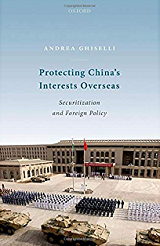 Protecting China's Interests Overseas: Securitization and Foreign Policy
Oxford University Press (2021)
By Andrea Ghiselli, Assistant Professor, School of International Relations and Public Affairs (SIRPA), Fudan University
Many countries in history have faced the problem of how to defend their interests overseas. China is not different. China’s Interest Frontiers: The Making of an International Strategy sheds light on the tortuous securitization process that pushed the Chinese foreign and security policy machine to evolve in order deal to the new threats to Chinese assets and nationals in the Middle East and North Africa. Based on a vast number of Chinese language sources, the analysis presented in the book finds that crises, especially the evacuation from Libya in 2011, deeply influenced how Chinese civilian and military elite think about the protection of the country’s interests overseas. Consistent with this development, the emphasis on ensuring that the People’s Liberation Army can play a larger role, along with the Ministry of Foreign Affairs, has become a crucial issue for Chinese policymakers. Yet, the presence of many bureaucratic actors, each with its own priorities and interests, was a challenge for the creation and implementation of a clear strategy. In the aftermath of the Arab Spring, it seems that the situation has been improving slowly but steadily, although some changes will take more time than others to be completed. Vis-à-vis an extremely complex challenge, China’s cautiously incremental approach to the use of its military has, so far, spared it from strategic overstretching. Yet, the reactive nature of its strategy makes it vulnerable to shocks. This is especially true as Chinese public opinion has become increasingly interested in how the country’s overseas interests are protected.
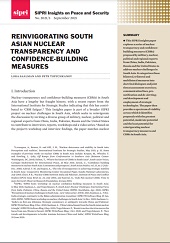 Reinvigorating South Asian Nuclear Transparency and Confidence-Building Measures
Stockholm International Peace Research Institute (2021)
By Lora Saalman, Associate Senior Fellow, SIPRI; and Petr Topychkanov, Senior Researcher, SIPRI
This SIPRI Insights paper explores a series of nuclear transparency and confidence-building measures (CBMs) proposed by military, nuclear, political and regional experts from China, India, Pakistan, Russia and the United States to address nuclear challenges in South Asia. It categorizes these bilateral, trilateral and multilateral measures into doctrinal dialogues and joint threat assessment exercises; communication lines, pre-notification and de-alerting; and development and employment of strategic technologies. The paper then provides a spectrum of viability across which it identifies proposals with the greatest potential, moderate potential and the least potential for reinvigorating nuclear transparency measures and CBMs in South Asia.

Compiled and sent to you by Centre on Asia and Globalisation and the Lee Kuan Yew School of Public Policy, National University of Singapore.
Have any feedback or comment?
Contact our editor: Byron Chong (Research Associate), email: decb64_Ynlyb24uY2hvbmdAbnVzLmVkdS5zZw==_decb64
Subscribe