Critical minerals, including nickel, rare earth elements, cobalt, tin, lithium, and copper, have become the defining resource contest of the twenty-first century, underpinning the global energy transition, advanced manufacturing, and defence industries. Southeast Asia sits at the heart of this competition: Indonesia controls over 40 percent of global nickel reserves; Vietnam holds one of the world’s largest rare earth deposits; and the Philippines, Myanmar, and Malaysia each occupy significant positions in global supply chains. For a region long defined by great-power hedging and ASEAN-style non-alignment, the scramble for critical minerals has created a heightened strategic dilemma.
The intensification of US–China rivalry has transformed routine resource-sector decisions into geopolitical choices. The US Inflation Reduction Act restricts green-energy subsidies to materials sourced from US trading partners, effectively disadvantaging Indonesia in the absence of a bilateral free trade agreement and amid Chinese capital dominance in its nickel sector. China, meanwhile, has locked in upstream assets through Belt and Road investments, extended its processing dominance across many critical minerals, and restricted the export of certain rare earth–related technologies. In this context, Southeast Asian states seek to leverage their endowments without being captured by either side.
Yet resource abundance does not automatically translate into strategic autonomy. Indonesia’s aggressive export ban on nickel ore drew significant smelting investment but deepened dependence on Chinese capital and invited a WTO challenge from the EU. By contrast, Vietnam’s neutrality paired with deep FTA integration has attracted a large share of manufacturers relocating from China. Furthermore, domestic oligarchic coalitions sometimes override official diversification commitments, and ASEAN-level coordination through the ASEAN Minerals Cooperation Action Plan (AMCAP-IV) 2026–2030 remains a non-binding regional framework. Without robust institutional anchors, hedging may become increasingly difficult.
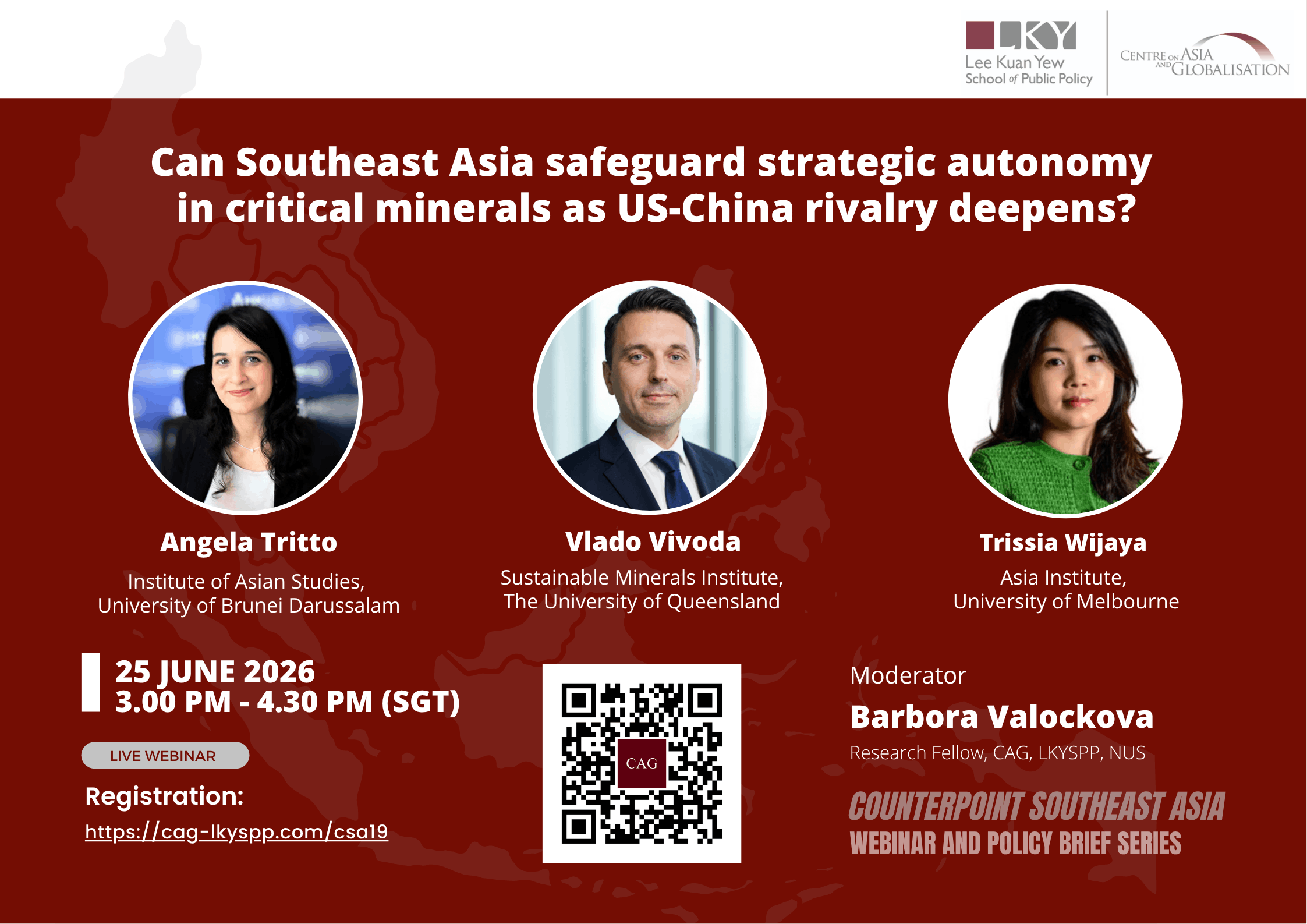
For an engaging conversation on this topic, join us for the 19th Counterpoint Southeast Asia webinar on 25 June 2026, which asks: “Can Southeast Asia safeguard strategic autonomy in critical minerals as US–China rivalry deepens?” Three experts will provide their unique perspectives on the challenges and opportunities ahead.