More than five years after the February 2021 coup and ASEAN’s Five-Point Consensus (5PC), Myanmar’s crisis has entered a new phase. The military regime’s tightly controlled election of December 2025–January 2026 excluded much conflict-affected territory and delivered a widely expected landslide for its proxy party. Min Aung Hlaing was sworn in as president in April 2026, and successive amnesties freed former president Win Myint and moved Aung San Suu Kyi to house arrest, though over 13 years of her reduced sentence remain. The regime presents this as a return to democracy, while critics see military rule formalised under a constitutional veneer.
The election has resolved little on the ground. Fighting continues across much of the country, ceasefires remain fragile, and the Arakan Army controls most of Rakhine State while resistance forces regroup. The humanitarian toll is staggering: millions displaced, an estimated quarter of the population acutely food insecure, and illicit economies, from narcotics to cyber-scam centres, spilling across the region. China has moved to centre stage, brokering ceasefires and endorsing the post-election order, while Western actorz remain largely on the sidelines and Naypyidaw courts Russia and India.
For ASEAN, Myanmar remains the sternest test of its credibility and centrality, and its posture is shifting. Under the Philippines’ 2026 chairmanship, Myanmar returned to the ASEAN Summit in Cebu at permanent-secretary level, and on 12 July, ASEAN foreign ministers met their Myanmar counterpart in Bangkok, their first in-person meeting since the coup, while insisting normalisation hinges on the 5PC. This “gradual and principled engagement” raises several questions. Is ASEAN seizing a genuine opening, or normalising a military authority that controls only part of the country? Can the 5PC be adapted to this new landscape without abandoning its principles? Does bilateral outreach restore ASEAN’s leverage or dilute it? And what does engagement mean for the resistance and ethnic organisations shaping facts on the ground?
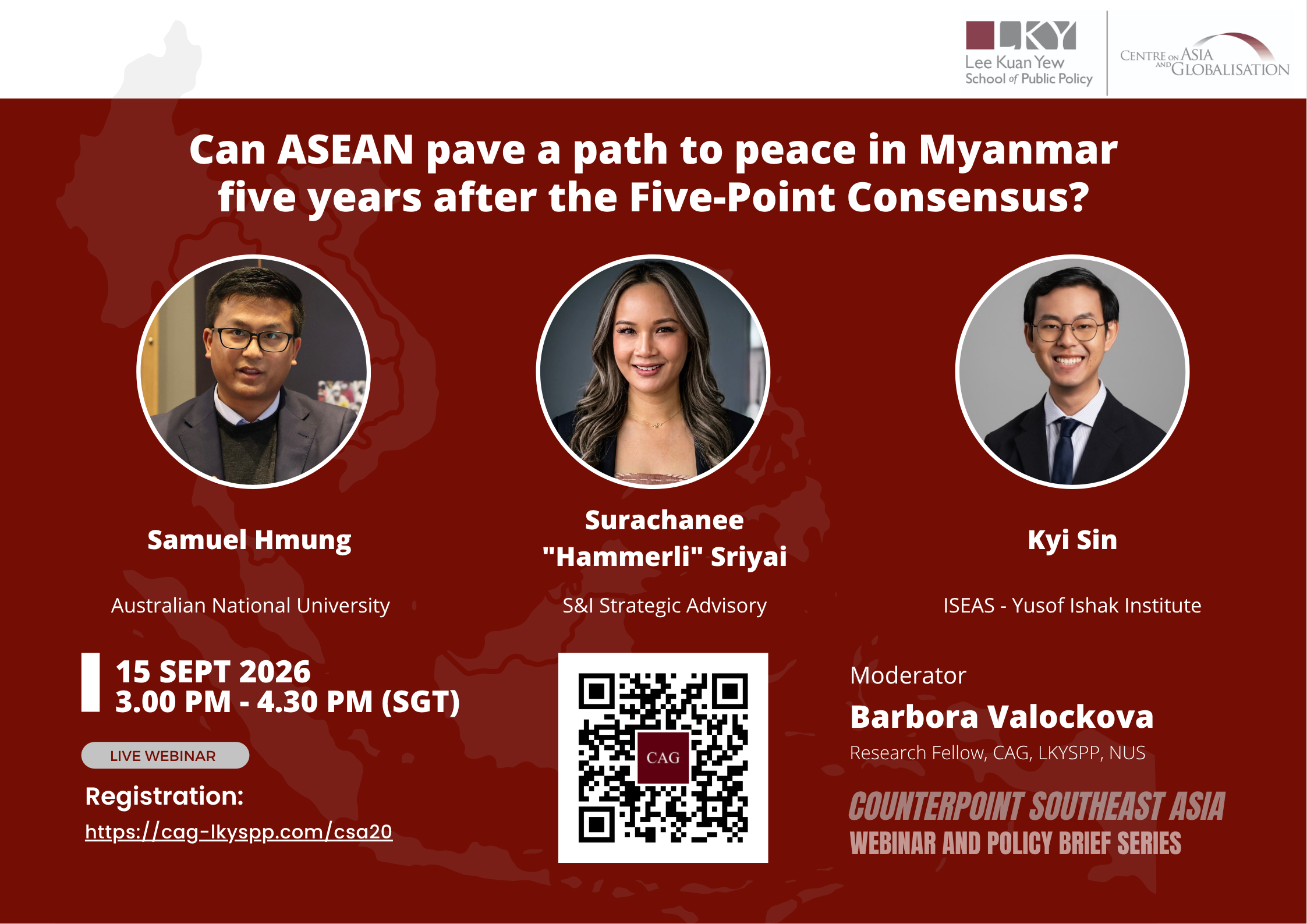
For an engaging conversation, join us for the 20th Counterpoint Southeast Asia webinar on 15 September 2026, which asks: “Can ASEAN pave a path to peace in Myanmar five years after the Five-Point Consensus?” Three experts will provide their unique perspectives on the challenges and opportunities ahead.