The geopolitical landscape in Southeast Asia has undergone significant transformation, challenging the region’s traditional approaches to economic security. The heightened US-China rivalry has created an environment of geo-economic fragmentation, forcing ASEAN and its member states to reconsider their strategic approaches. This rivalry has led to reconfigurations in global supply chains, resulting in trade diversion and fragmented production networks that threaten ASEAN’s longstanding emphasis on economic interdependence and cooperation.
Economic security in Southeast Asia has historically been framed within the concept of “comprehensive security,” focusing on economic development and integration as strategic approaches to achieve regional security. ASEAN has implemented various initiatives like the ASEAN Trade in Goods Agreement (ATIGA), ASEAN Comprehensive Investment Agreement (ACIA), and broader frameworks such as the Regional Comprehensive Economic Partnership (RCEP) to foster closer economic integration and ensure security.
However, emerging challenges – including digital transformation accelerated by the pandemic, and demographic trends like aging populations – require rethinking traditional security paradigms. Climate change further complicates the region’s economic security landscape by affecting food production and commodity price stability. The return of Donald Trump to the US presidency, with his emphasis on reshoring and protectionist policies, poses additional challenges to the region’s export-oriented economies.
As ASEAN navigates this complex environment, several questions emerge: How should Southeast Asia strengthen economic security in the face of current geopolitical challenges? Should the concept of economic security be redefined to align with today’s geoeconomic realities? Can ASEAN maintain its relevance as a champion of regional economic security? What role can other actors and institutions play in complementing ASEAN’s efforts to manage external shocks and promote economic resilience?
As Southeast Asia confronts these interconnected challenges, the need for innovative, inclusive, and sustainable solutions is more urgent than ever. We invite you to join the 15th Counterpoint Southeast Asia panel discussion on 4 June 2025, titled “How should Southeast Asia strengthen economic security in the face of current geopolitical challenges?” Four regional experts will share their insights on reimagining economic security paradigms for a changing Southeast Asia.
Dr Denis Hew is a Senior Research Fellow at the Centre on Asia and Globalisation at the Lee Kuan Yew School of Public Policy, National University of Singapore. Previously, Dr Hew was the Director of the APEC Policy Support Unit (PSU) from 2011 to 2022. The PSU is the research arm of APEC, a regional grouping that promotes trade and investment liberalisation and facilitation in the Asia-Pacific region. He also spent two years at the Asian Development Bank (ADB) in its Southeast Asia department, where he managed technical assistance programs on regional cooperation and integration. From 2001 to 2008, Dr Hew was a Senior Fellow and Regional Economic Studies Coordinator at the Institute of Southeast Asian Studies (ISEAS) in Singapore. During his time at ISEAS, he was also the Managing Editor of the ASEAN Economic Bulletin, an academic journal that focuses on policy-relevant economic issues in Southeast Asia.
Ms Joanne Lin is the Senior Fellow and Co-Coordinator of the ASEAN Studies Centre, ISEAS – Yusof Ishak Institute in Singapore. She has over 20 years of work experience in the Singapore public sector, regional and international organisations, think tanks, and NGOs. She has previously served at the ASEAN Secretariat from 2015 to 2021 and was the Head of the External Relations Division under the ASEAN Political-Security Community Department. Her research includes ASEAN institutions, external relations, and political-security developments in ASEAN.
Ms Catharine Kho is a Senior Economist in the Regional Surveillance team at the ASEAN+3 Macroeconomic Research Office (AMRO). She is one of the lead authors of AMRO’s flagship publication, the ASEAN+3 Regional Economic Outlook (AREO), which provides in-depth analyses conjunctural and structural issues in the 10 members of the Association of Southeast Asian Nations (ASEAN) and China; Hong Kong, China; Japan; and Korea. Prior to joining AMRO, Catharine was a Senior Economist in Bank Negara Malaysia (BNM). During her 11 years with BNM, she has conducted macroeconomic surveillance, specializing in the real and external sectors, during various turning points in the global and Malaysian economies from 2009-2020. She has also led research to develop policy proposals to promote economic growth as well as to mitigate risks and vulnerabilities for the Malaysian economy. Catharine holds an MPA in Economic Policy Management from Columbia University and a BSc in Statistics from University of Malaya.
Dr Pasha L. Hsieh is Jean Monnet Chair Professor at the Singapore Management University Yong Pung How School of Law. He received his J.D. and LL.M. degrees from the University of Pennsylvania and also holds a Ph.D. in Political Science from the Free University of Brussels. Prior to academia, he was a Legal Affairs Officer at the WTO Appellate Body Secretariat and an associate at Shearman & Sterling LLP. His monograph, “New Asian Regionalism in International Economic Law,” was published by Cambridge University Press and has been translated into Chinese and Japanese. He is a member of the editorial boards of the Journal of International Economic Law and the Journal of World Investment & Trade, and a panel member of the Hong Kong Research Grants Council. He has been invited to present on trade and sustainability issues by the European Parliament, the Korea National Diplomatic Academy, and the Singapore Judicial College.
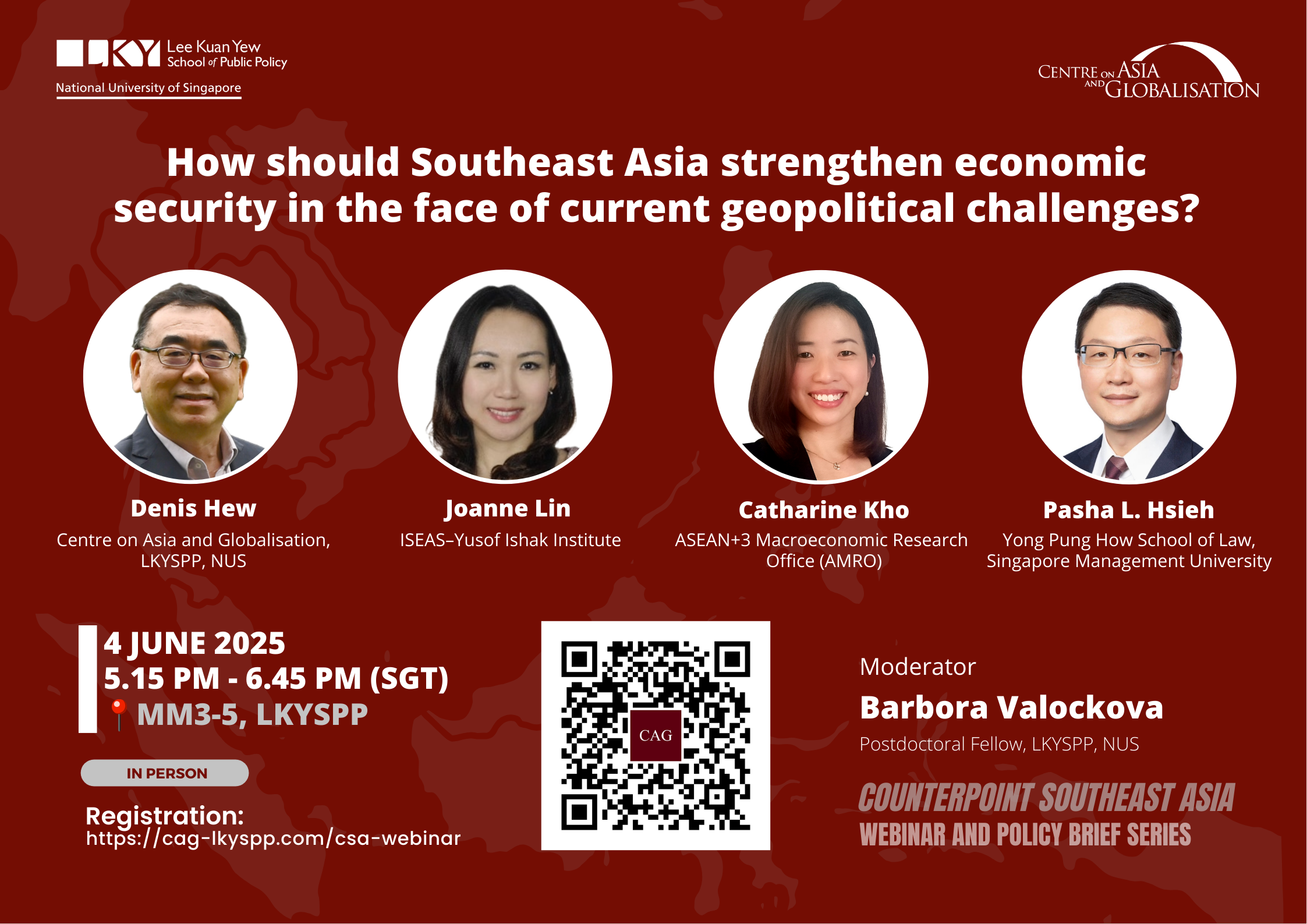 Counterpoint Southeast Asia is a webinar and policy brief series that tackles strategic and complex questions facing Southeast Asia by presenting the perspectives of regional academics and policy experts. It is organised by the Centre on Asia and Globalisation, LKYSPP, NUS.