The Mekong River, supporting over 70 million people across six countries, is a critical artery for Southeast Asia's food security, energy, and livelihoods. In recent years, the region has faced mounting pressures from dam-building, climate change, and intensifying US-China rivalry, making water diplomacy more important than ever. Unlike the South China Sea, the Mekong's tensions centre on managing shared water resources—from hydropower development and operation to sand mining and water diversion—which disrupts flows, fisheries, and downstream livelihoods. Climate change has intensified, bringing compounded risks.
Despite these challenges, the Mekong has avoided militarization, thanks to cooperative mechanisms such as the Mekong River Commission (MRC) and other Mekong frameworks. These frameworks facilitate dialogue and joint projects, but their effectiveness is sometimes limited by weak enforcement, overlapping mandates, and China's non-membership in the MRC. Despite increased interest, ASEAN has remained largely a bystander, with Mekong issues seen as sub-regional rather than regional priorities.
The Mekong's geopolitical significance is rising as both China and the US deepen their involvement, framing engagement as development assistance while pursuing broader strategic competition. This has increased the politicization of water governance and complicated consensus-building. Civil society movements are calling for more inclusive and sustainable water governance.
How are Mekong countries and external partners navigating these complex waters? What lessons does their experience offer for transboundary river diplomacy, and how can regional institutions such as ASEAN and local communities play a greater role in safeguarding the river's future?
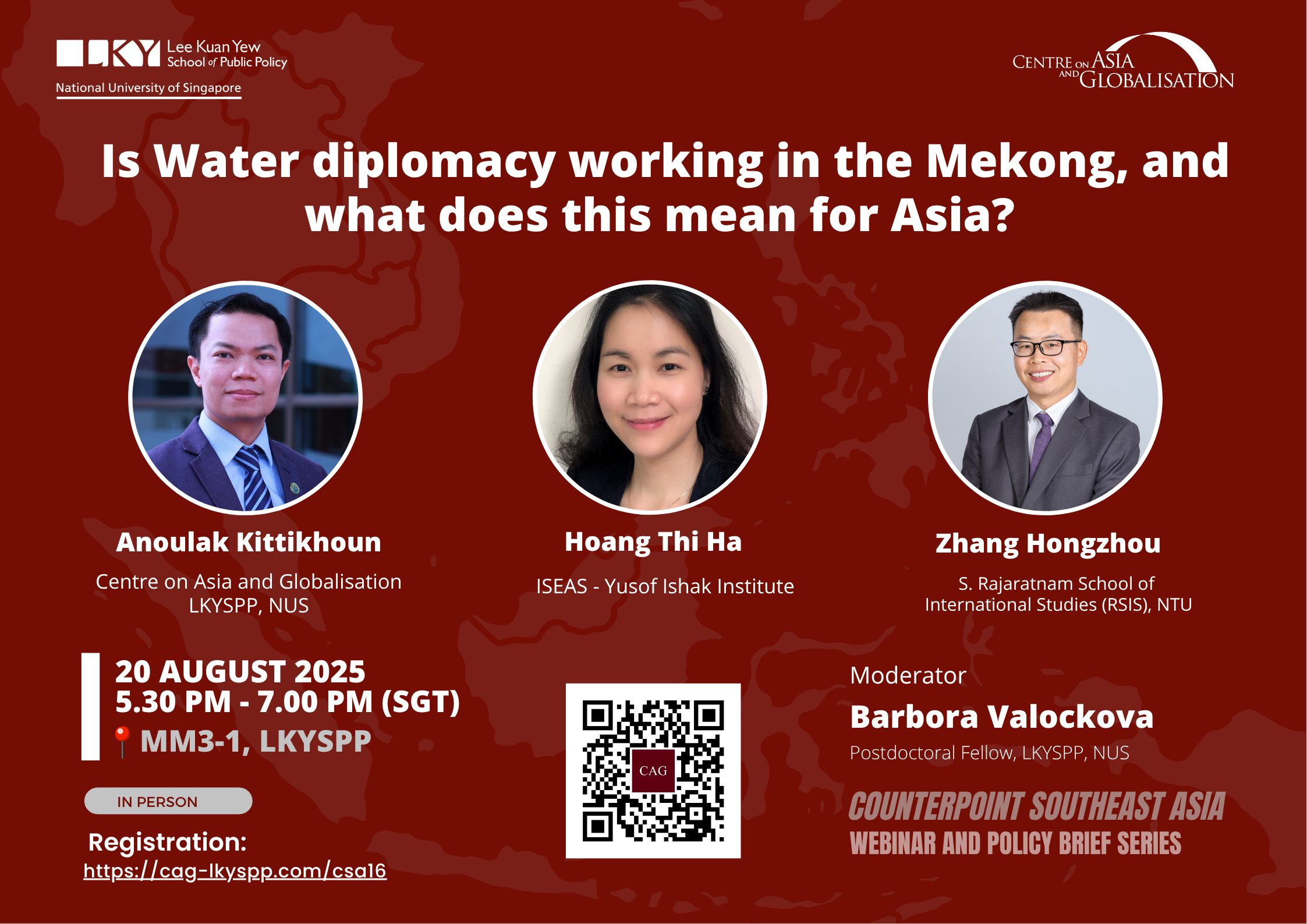
For an engaging conversation on this topic, join us for the 16th Counterpoint Southeast Asia public panel discussion on 20 August, which asks, "Is water diplomacy working in the Mekong, and what does this mean for Asia?". Three experts from the region will provide their unique perspectives on this question.