Guest Column
Negotiating China-India Digital Cooperation in an era of Hybrid Warfare
By Atmaja Gohain Baruah
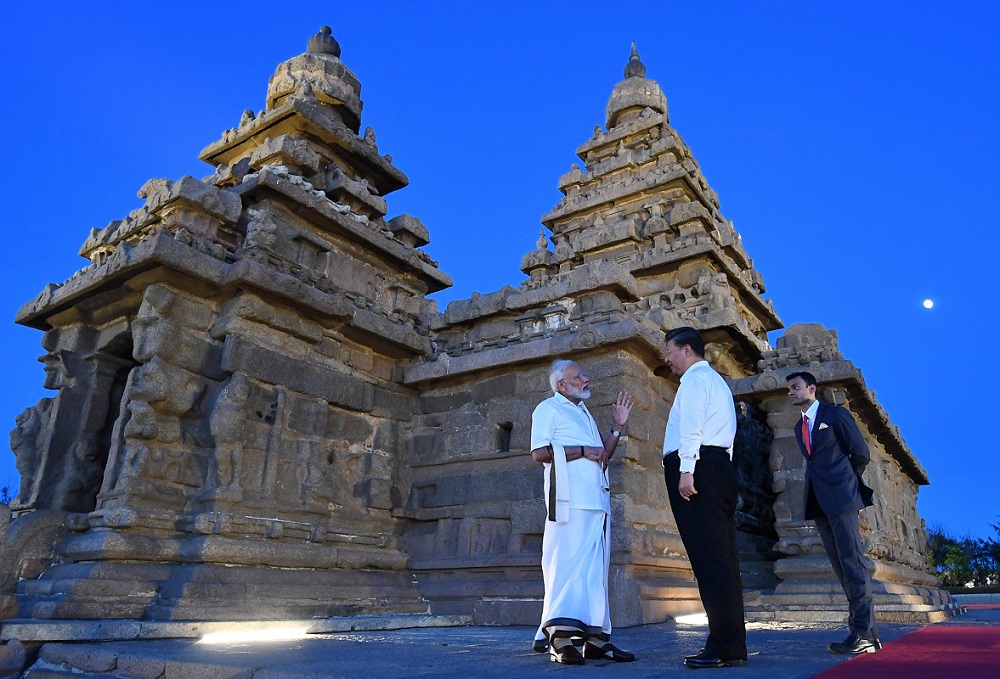 Narendra Modi and Xi Jinping visiting the Shore Temple Monuments, in Mamallapuram, Tamil Andu on October 11, 2019.
Photo from Prime Minister's Office of India
The optimism emanating from the recent informal summit between Indian Prime Minister Narendra Modi and Chinese President Xi Jinping in Mamallapuram, India, bodes well for their bilateral relations. At a time when diverging strategic national interests amidst a changing international order is causing increasing strains in their relationship, informal summits like this can do wonders. As the focus at these meetings is more on addressing commonalities than quarrelling over contentious issues, a more accommodating stage is set for further cooperation.
Since the trade balance between the two countries is still heavily skewed in favour of China, much attention was diverted towards creating a new trade mechanism—the High-Level Economic and Trade Dialogue mechanism—as well as a manufacturing partnership to concretise trade dialogues. Considering the more pressing trade issues confronting the two countries—especially with regards to the United States’ trade policies—the extent to which Xi and Modi address each other’s concerns could lead to a meaningful change in their bilateral dynamics. Ironing out the frictions that exist on bilateral trade might even help bring about geopolitical convergences.
China and India do not see eye to eye when it comes to recent US trade policies, including the imposition of oil sanctions on Iran, trade incompatibilities arising from the Countering America’s Adversaries Through Sanctions Act (CAATSA) sanctions, or the tariffs levied on exports to the US. Moreover, the vortex of regional tension stemming from troublesome neighbours like Pakistan and North Korea leave little time for India and China to court each other. In such a scenario, finding long-term and sustainable forms of cooperation are important.
The use of technology
Digital cooperation is a sphere in which India and China could do much more to deepen their strategic partnership. In fact, their digital economies are experiencing massive changes—multiplying digital ecosystems binds their netizens as they seek to unlock the potential for new e-commerce and e-governance services. The much anticipated 5G technology will not only create intelligent hardware but accelerate the emergence of the Internet of Things (IoT) that will aid in the development of smart cities through faster machine-to machine-communication, intermodal transport networks, and extend healthcare services to previously disconnected areas.
In effect, 5G will be a key feature of a new model of governance adopted by developing countries. Suffice to say, Chinese investments in 5G technology is huge. It forms the core of the Belt and Road Initiative (BRI), especially as it is going to be innovation-driven. While the economic dimension of the technology is huge, the political impact is even more significant. The strategic consequences of collaborating with China to acquire 5G has left many countries in a dilemma. Much like defence and economy, 5G has become a strategic call. While China has been accused of forced technology transfers and cyber theft, the recent spat on 5G has intensified, with the US cutting off its supply of software and critical chips to China’s Huawei, banning its use, and encouraging countries like Australia, New Zealand, Japan, and Vietnam to join its team. The fear of the US and its friends is the belief that adopting Huawei’s 5G network will give China unprecedented access to critical infrastructure, thus compromising intelligence sharing and increasing the possibility of cyber-attacks on communication networks, vital financial centres, and public facilities.
Hybrid Warfare?
Such worries actually are not unfounded. Gone are those days when the army, navy, and air force were seen as the only forms of initiating warfare. Technological advancements are not only leading to military transformations but also inducing what is known as hybrid warfare. While the concept is not new and gained prominence during the Israel-Hezbollah War of 2006, it is now a lot more sophisticated, with cyber warfare becoming a vital component. Expanding connectivity and excessive dependence on information technology (IT) has not only made countries more vulnerable to cyber-attacks but has also challenged their national security. What makes such hybrid warfare so powerful is that it is guised within broader political or economic campaigns, thus creating a “grey zone”, where instead of overt military conquests or open warfare, states rely on unconventional means to reap territorial or political benefits.
The hullabaloo regarding Chinese espionage through Huawei has intensified given the importance Beijing places on information domain capabilities as a measure of its national strength and its growing presence in the organisational structure and warfighting capabilities of the People’s Liberation Army (PLA). Such an integrated civil-military network is enshrined in China’s Five Year Plans as well, which raises concerns about China using cyber means to fortify its military capabilities. While Huawei has rejected all accusations of espionage and other malicious operations and has opened its doors to a “no backdoor” agreement, security concerns remain for potential partners like India. The strategic implications of the technology have presented India with a conundrum. While it has leverage in dealing with China and the US in acquiring advanced technologies like 5G, it is not prepared, neither commercially nor technologically, to take a stand and mould the global conversation. Despite its massive market, there is a lack of public awareness of how 5G is going to re-structure the bedrock of cities, electricity and transportation networks.
So, while the prospects of India-China economic and digital cooperation look bright as Xi and Modi discuss capacity-building in artificial intelligence and big data, creating more compatible and transparent models of data governance, which addresses national concerns while offering a secure internet, would go a long way in boosting China-India ties. As their digital economies continue to grow, so does the web of netizens and start-ups, which could help boost investments between the two countries. However, the new possibilities also require policy-makers to take extra precautions in managing the “hybrid” challenges, particularly at a time when the race for 5G supremacy is at its pinnacle and has inextricably interlinked global economic and security considerations.
Atmaja Gohain Baruah is a PhD Candidate at the National University of Singapore (NUS), where she is also a recipient of the President's Graduate Fellowship. She has previously worked at the Institute for Defence Studies and Analyses (IDSA), and was the editor-in-charge for the East Asia Military Monitor (EAMM).
The views expressed in the article are solely those of the author and do not necessarily reflect the position or policy of the Lee Kuan Yew School of Public Policy or the National University of Singapore.
News Reports
Bilateral relations
“India, China Handled Differences With Maturity,” Says Rajnath Singh
NDTV, October 22
Asserting that India and China share “cordial relations”, Defence Minister Rajnath Singh on Monday said that “perceptional differences” between both countries on boundary issue have been handled with “great maturity and responsibly”.
China's Huawei says open to ‘no backdoor’ agreement with India
Reuters, October 15
China’s Huawei Technologies is ready to enter into a “no backdoor” agreement with India to allay security concerns, the telecom group’s local head said on Monday (October 14), as the giant South Asian country prepares to launch next generation 5G networks.
‘Dance of dragon and elephant’ only correct choice for India, China: Xi
The Times of India, October 13
Calling for a long-term plan to develop India-China relations, Chinese President Xi Jinping, who had lengthy meetings with Prime Minister Narendra Modi in Chennai, said bilateral differences should not be allowed to “dilute” the cooperation and the dance of the dragon and the elephant is the only “correct choice” for both sides.
Xi-Modi informal meeting achieves fruitful results: Chinese vice FM
Xinhua, October 13
During the second informal meeting in the southern Indian city of Chennai, Xi and Modi exchanged in-depth views on overarching, long-term and strategic issues of global and regional importance, and agreed to enhance the closer development partnership of the two countries.
News Reports
China and India in the Region
China Wants India And Pakistan To Have Good Relations: Chinese Envoy
NDTV, October 19
China wants India and Pakistan to have good relations and join hands for promoting peace and stability in the region, said Chinese Ambassador to India Sun Weidong.
US lists rise of China as challenge before India; wants free flow of goods, capital, data
The Economic Times, October 14
As India and the US negotiate a free trade agreement, Washington on Monday said it wants free and fair trade along with free flow of goods, services, capital, and data as it went on to list rise of China alongside dealing with terrorism and promoting economic growth as challenges before India.
Nepal pushes to end dependency on India with China rail, tunnel deals
The Straits Times, October 13
Chinese President Xi Jinping wound up two days of meetings in Nepal on Sunday (October 13) with separate deals for a rail link to Tibet and a tunnel, an official said, as the Himalayan nation seeks to end an Indian dominance over its trade routes by increasing connectivity with Beijing.
News Reports
Trade and Economy
China unveils new commercial carrier rockets to compete with India for global market
The Economic Times, October 21
China has unveiled its new generation of commercial carrier rockets which could carry up to 1.5 tonne payload as it gears up to compete with India to attract the lucrative global space launch market.
China, India, 18 other countries will dominate global growth in 2024: IMF
The New Indian Express, October 20
The global economy, weighed down by tensions that have stalled international trade and elevated uncertainty, is expected to see slower growth in the next half-decade across a wide swath of economies.
BRICS should unite, cooperate to uphold multilateralism: senior Chinese official
Xinhua, October 19
The five BRICS countries should strengthen unity and cooperation to uphold multilateralism and promote the development of the international order in a more just and rational direction, a senior Chinese official has said.
India retains world's fastest-growing rank, tying with China: IMF
The Economic Times, October 15
In the gloomy global economic picture painted by the International Monetary Fund (IMF), India retains its rank as the world's fastest-growing major economy, tying with China, with a projected growth rate of 6.1 per cent for the current fiscal year, despite an almost one per cent cut in the forecast.
Xi, Modi agree to trim trade deficit, boost mutual trust amid US-China tensions
South China Morning Post, October 12
The leaders agreed to set up a mechanism to boost economic ties and tackle India’s trade deficit with China after their second informal summit. As 2020 is the 70th anniversary of diplomatic ties between both countries, India and China will hold 70 events next year to promote relations.
News Reports
Energy and Environment
Asia poised to become world leader in wind energy market by 2050
Channel News Asia, October 22
The International Renewable Energy Agency (IRENA) noted in a report on Monday (October 21) that much of this is down to China, which will have 2525 gigawatts (GW) of installed onshore and offshore wind capacity by 2050, followed by India (443 GW), Republic of Korea (78 GW) and Southeast Asia (16 GW).
China to surpass U.S. in buildings’ power consumption by 2030: EIA
Xinhua, October 22
The U.S. Energy Information Administration (EIA) said on Monday (October 21) that electricity use by buildings in China is projected to increase more than that in any other country in absolute terms, but India will experience the fastest growth rate in buildings' electricity use from 2018 to 2050.
EU, China, others, team up to coordinate ‘green’ investment financing
Channel News Asia, October 19
The European Union, China, India and several other countries teamed up on Friday (October 18) to coordinate rules and standards for trillions of dollars of private and public "green" investment needed over decades to prevent irreversible climate change.
Investments in the energy sector in India recorded second highest growth in the world: Dharmendra Pradhan
The Hindu Business Line, October 14
“Today India is 6th largest economy in the world and the 3rd largest energy consumer after US and China. India will be the key driver of global energy demand in the coming decades,” said Minister for Petroleum and Natural Gas, Dharmendra Pradhan.
US ambassador cautions India against China, Iran on energy security
Livemint, October 14
The statements come in the backdrop of the September 14 drone attacks on Saudi Aramco’s facilities. India and China are working towards establishing a buyers’ bloc to bargain collectively for crude oil purchases amid escalating tensions in the Persian Gulf.
Analyses
Now for the hard part: another ‘informal summit’ is over but China and India are no closer on core issues
South China Morning Post, October 19
By Ankit Panda, Senior Editor at The Diplomat
Candid exchanges between the two leaders are meant to pave the way for progress. However, there’s little indication that this sort of progress is really under way as part of the Wuhan-Mamallapuram process.
Looking Into the Future
Beijing Review, October 18
By Lin Minwang, researcher with the International Studies Institute of Fudan University in Shanghai
China and India share common interests in development issues such as disease prevention and control, food, environmental protection and sustainable development. Only by widening cooperation in improving people's livelihood can they keep their relations on the right track and bolster strategic mutual trust.
China, India march in step to economic future
Global Times, October 17
By Swaran Singh, Professor, Jawaharlal Nehru University (New Delhi); Senior Fellow, The Charhar Institute (Beijing)
The optics-laden summit between Chinese President Xi Jinping and Indian Prime Minister Narendra Modi came amid the unceasing stream of tariffs the White House is dousing the two countries with. This saw the leaders of the two Asian powers emphasize the economic partnership, which is ordained to set growth trajectories and crystallize the geopolitics of tomorrow.
Mahabalipuram dialogue was part of a striving for more balanced India-China ties
Indian Express, October 14
By Sanjaya Baru, Distinguished Fellow, Institute of Defence Studies & Analysis, New Delhi
Given Xi’s 100-year perspective, both countries have to learn to live with year-to-year bumps while journeying together towards a new Asian Century.
Toward Greater Progress Of China-Nepal Friendship Across The Himalayas
Spotlight Nepal, October 11
By Xi Jinping, President of the People’s Republic of China
The Nepali often say, “Drop by drop is the water pot filled.” There is also a Chinese saying: “The flame runs high when everyone adds wood to the fire.”
Books and Journals
India and China: A Managed Nuclear Rivalry?
The Washington Quarterly 42(3) (2019): 151–170
By Rajesh Basrur, Visiting Professor at the S. Rajaratnam School of International Studies (RSIS) at the Nanyang Technological University in Singapore; and Research Associate in the Contemporary South Asian Studies Programme (CSASP) at the Oxford School of Global and Area Studies, University of Oxford.
Despite mitigating factors, seemingly well-managed rivalries have the potential to deteriorate and run serious risks of nuclear escalation, particularly soon after the nuclear rivalry has been established. This can happen when there is a leadership change in either country, domestic political pressure, or instabilities between the two militaries arising from strategic interaction, either on land or sea. Although I had previously concluded in 2013 that it was unlikely that India and China were entering a nuclear rivalry, I believe the situation has changed as exemplified by Doklam. India and China have now entered into such a nuclear rivalry.

Compiled and sent to you by Centre on Asia and Globalisation and the Lee Kuan Yew School of Public Policy, National University of Singapore.
Have any feedback or comment? Email us
decb64_Y2FnQG51cy5lZHUuc2c=_decb64
Subscribe