Guest Column
After the Wuhan Summit: A Re-set in Sino-Indian Relations?
By Jingdong Yuan
 Photo from Prime Minister's Office of India
The Bharatiya Janata Party’s (BJP) landslide election win secured a second term for Narendra Modi. During his first term, Modi was effectively a foreign policy prime minister, trotting the globe selling the India brand as an emerging market and economic powerhouse and an ascending global power to be reckoned with. Modi also revived the ‘Gujral Doctrine’ of placing India’s neighbourhood as a foreign policy priority and an active diplomatic agenda in South Asia.
Modi’s first term coincided with the first two years of China’s fifth-generation leadership. Li Keqiang chose India as the first foreign country to visit upon assuming the premiership in early 2013, while President Xi Jinping visited India in late 2014. These early bilateral interactions at the highest level were as symbolic as they were substantive. A clear signal was being sent from Beijing: China would like to build on the generally stable bilateral relationship developed with the previous two Indian governments and further consolidate Sino-Indian ties.
Likewise, the new Modi government seized the opportunity to promote the bilateral relationship. Modi hosted Xi in his hometown and visited China in early 2015, and Xi returned the favour in extending a hometown welcome in Xi’an. The two governments seemed to have started their terms on a positive note: Beijing and New Delhi reiterated their mutual interest in building a multipolar world, reforming existing international institutions, and emphasizing the importance of state sovereignty and domestic stability.
At the same time, beyond the rhetoric of cooperation, bilateral economic, security, and global cooperation had been strengthened going back to the early 2000s. This was a base upon which the two sides could build. On the economic front, there were growing Chinese investments in India as well as discussions and negotiations on Indian businesses access to the Chinese market. On the security front, while there had been border incidents such as the Daulat Beg Oldi standoff of April-May 2013 (during Prime Minister Manmohan Singh’s tenure) and the Chumar standoff of September 2014 (during the Modi-Xi summit), these had been dealt with and brought under control without further escalation. In addition, after Prime Minister Atal Vajpayee’s visit to China in 2003, the two countries had cooperated on a range of global issues such as climate change, trade talks, and financial institutions reform.
However, the momentum in Sino-Indian cooperation did not last long after Modi came to power and have since been overtaken by emerging bilateral disputes and regional differences, culminating in the 72-day Doklam confrontation of June-August 2017, with heightened tensions threatening to escalate to military confrontation. Meanwhile, the foundation of global cooperation has been eroded, as Beijing has reached bilateral agreements on climate change with key counterparts such as the US. The Modi government has pursued a more active diplomacy including its ‘Act East’ policy, strengthened US-India ties, participation in the revived ‘Quad’ (Australia, India, Japan and the US), and endorsement of the Washington-advocated ‘free and open Indo-Pacific’ strategy.
The strain in Sino-Indian relations in 2017-18 can be traced to both structural and perceptual factors. The structural factors include unresolved territorial disputes, the growing gap in China-India economic and military power, and the two countries’ roles and positions in global and regional organisations. In addition, China’s growing presence in the Indian Ocean Region (IOR) impinges on India’s traditional sphere of influence and is perceived as directly challenging the latter’s security interests. New Delhi’s participation in arrangements deemed to have China as the target, such as the Quad, likewise is viewed in Beijing as external balancing to counter China’s rise and influence.
Sino-Indian territorial disputes and the fact that border negotiations have largely stalled in recent years reflect both countries’ hardened positions. They also reflect domestic opposition to deals that are perceived to make too many concessions. In turn, this means that major breakthroughs are unlikely. However, what has been most worrying in recent years, as the frequent border incidents show, is the increasingly unyielding stance each has adopted. This may explain why the Doklam standoff lasted over 70 days and almost flared into an actual military clash.
China’s growing presence in South Asia, is epitomized by its Belt and Road Initiative (BRI), especially its 21st Century Maritime Silk Road (MSR). Launched in 2013 but with many projects already in the works, China has become increasingly involved in building ports, roads, and railways in countries such as Bangladesh, Myanmar, Pakistan, and Sri Lanka. These appear to aim at developing alternative land routes for oil transportation should maritime passages be disrupted. At the same time, they would create a series of points from where Beijing could project Chinese geopolitical influence and military power in the Indian Ocean, the so-called ‘string of pearls’.
Indeed, whereas Beijing views its BRI as more about geo-economic matters, where connectivity, trade and investment, and energy security in the broader framework of ‘comprehensive security’ are front and centre, New Delhi views the growing Chinese presence largely through the lens of security and strategic rivalry, for reasons deeply embedded in India’s strategic culture. Not surprisingly, India is highly sensitive to the expanding influence of China in its vicinity, especially where its geographical advantage could be eroded by the establishment of Chinese maritime facilities.
New Delhi’s stated reservations about the BRI and MSR are that such initiatives have been largely unilateral (or as then Indian foreign secretary S. Jaishankar termed it, a ‘national Chinese initiative’). In the Indian view, they were designed by Beijing without consultation with the parties that might be affected by the initiatives, including India. But more critically, New Delhi’s objection to the MSR – in particular, one of its flagship projects, the China-Pakistan Economic Corridor (CPEC) – has become more open in recent years. The Indian objection is that the CPEC route runs through Gilgit-Baltistan through what India regards as Pakistan-occupied Kashmir. It is therefore a violation of India’s sovereignty. Prime Minister Modi has stated that ‘only by respecting the sovereignty of countries involved can regional connectivity corridors fulfil their promises and avoid differences and discord’.
These structural and perceptual factors have produced a zero-sum tussle between Asia’s two emerging powers. On the one hand, if the MSR is considered a deliberate Chinese strategy, it is as much about establishing a Chinese naval presence and dominance in the IOR as it is about how China can use a combination of diplomatic and economic means to influence the littoral states. Crucially, it is also about the development over time of naval power projection capabilities to protect China’s maritime interests should it have to confront security threats to its critical supply lines.
On the other hand, while it is unlikely that India will join the MSR anytime soon, if ever, this does not mean that Beijing and New Delhi cannot find and explore opportunities for cooperation on infrastructure and connectivity in the region. India was among the first group of countries to endorse and subsequently join the Asian Infrastructure Investment Bank (AIIB). It is the second largest shareholder in the bank after China, and Indian officials hold senior positions at the bank.
In fact, India and China are already working together in what China has viewed as a part of the broader BRI initiative—the Bangladesh-China-India-Myanmar (BCIM) Economic Corridor. Initially an academic concept, the so-called Kunming Initiative launched in 1999 has gradually evolved to become a track 1.5 platform to develop plans for the sub-region.
The Doklam standoff and the emerging regional challenges for China and India were somewhat addressed but not fundamentally resolved at the April 2018 Wuhan informal summit between Modi and Xi. The two leaders agreed that China and India should remain good neighbors, good friends, and good partners. In the process, they created a new and innovative platform for themselves – to meet and exchange views on a wide range of bilateral, regional and global issues, without being bound by the need to achieve specific results. In addition to calling for expansion of bilateral cooperation in education, trade, youth, and local exchanges, a critical point of consensus was the need to enhance confidence building measures, and through regular consultation between the two countries’ special representatives, to strive for stability and tranquility in the border region so as to seek a fair and mutually acceptable resolution to the boundary disputes.
The Wuhan summit has been characterized as a reset in Sino-Indian relations. More than a year on, there has been some progress. The two sides have maintained relative stability in the border region, including in the Doklam area. Joint military exercises (‘Hand-in-Hand’) have resumed, and the two militaries have agreed to set up direct hotlines between the defense ministries. Beijing has agreed to have Masood Azhar blacklisted on the UN list of terrorists. The two countries have also made efforts to address the issue of trade imbalances, including having China import more generic drugs from India. However, serious challenges remain, as India’s close to $60 billion trade deficit cannot be reduced quickly and, in all likelihood, will continue to increase in the coming years.
It can be expected that Modi’s second term will place more emphasis on domestic issues. But the extent of his victory gives the BJP government the opportunity to pursue a more ambitious foreign policy agenda. This also applies to the Sino-Indian relationship in the coming years. The growing US-China rivalry has given Beijing the incentive to improve relations with its neighbors. The recent rapprochement between China and Japan is a good example. Likewise, as President Trump’s trade protectionism has negatively affected both Chinese and Indian interests, this creates room for economic cooperation between the two countries. While Modi’s recent action on Jammu-Kashmir has increased tensions between India and Pakistan and to some extent has also raised the heat in Sino-Indian relations, Beijing and New Delhi have so far been careful in keeping the dispute in perspective and have sought to continue the momentum generated by the Wuhan reset. Xi’s upcoming visit to India will show whether the reset is merely tactical or whether it is strategic with the two sides coming to see the overall importance of their relationship and hence the imperatives to manage disputes and conflicts from a much larger perspective.
Jingdong Yuan is Chair of the Department of Government & International Relations and an Associate Professor of International Security at the University of Sydney.
The views expressed in the article are solely those of the author and do not necessarily reflect the position or policy of the Lee Kuan Yew School of Public Policy or the National University of Singapore.
News Reports
Bilateral relations
5G trials: China aggression will work against Huawei, say India officials
The Indian Express, August 26
India’s decision on whether to allow Huawei in upcoming 5G trials could be negatively influenced by the aggressive posturing by China in recent weeks, which has heightened the possibility that an all-clear for the world’s largest telecommunications equipment maker could be seen as New Delhi “pandering” to threats, a senior government official told The Indian Express.
India, China defence joint working group meets in Beijing
The Hindu, August 19
India and China reviewed the situation on the border and agreed on more port calls by each other’s Navies as part of measures to improve military to military cooperation, at a meeting of the Joint Working Group (JWG) between the Defence Ministries in Beijing last week.
RSS' economic wing sees Chinese telecom firms as security risk for India
Channel News Asia, August 18
A Hindu nationalist group close to Prime Minister Narendra Modi's ruling party has stepped up criticism of Chinese telecom equipment makers, warning that their presence in India posed "an unacceptable security risk".
Nehru's "Forward Policy" On China "Became Backward", Says Ladakh BJP MP
NDTV, August 18
BJP MP from Ladakh Jamyang Tsering Namgyal said the region did not get importance in defence policies when the Congress was in the centre, and that was why "China captured its area up to the Demchok sector".
News Reports
China and India in the Region
India joins France, US to counter China in Indo-Pacific
Deccan Herald, August 23
India has joined France and the US in calling for a free Indo-Pacific, tacitly opposing maritime aggression by China in the region. The move comes against the backdrop of the communist country echoing the stance of its 'iron brother' Pakistan in slamming New Delhi for its recent moves on Jammu and Kashmir.
India to take part in massive war game with Russia, China in Sept
Money Control, August 22
In a move that comes after America withdrew its troops from Afghanistan, Moscow has invited India to participate in one of the biggest war exercises in central Russia this September, along with China.
China, Vietnam Coast Guard Ships Face Off Near Indian Oil Block In South China Sea
International Business Times, August 19
China has deployed its coast guard ships near an oil block in the Vietnamese EEZ (Exclusive Economic Zone) where India’s state-run Oil and Natural Gas Corporation (ONGC) has been carrying out oil exploration in the South China Sea.
China-Brazil relationship model for South-South cooperation, says Chinese ambassador
Xinhua, August 17
The China-Brazil relationship is a model for South-South cooperation, Chinese Ambassador to Brazil Yang Wanming said. That cooperation has a solid foundation, a great potential and broad prospects, said Yang during an interview with Xinhua.
India, Bhutan deepen trade ties
Livemint, August 17
Prime Minister Narendra Modi inaugurated the 720-MW Mangdechhu hydropower project during his two-day visit to Bhutan. It underlined the NDA's 'neighbourhood first' policy, as well as India’s 'special relationship' with the strategically located country
News Reports
Trade and Economy
India ramps up privatization of state enterprises
Nikkei Asian Review, August 25
The Indian government has drawn up a list of 23 state-owned companies it wishes to sell off to the private sector by next March as part of an ambitious plan to balance the budget and revitalize industry.
Indian economy doing better than US, China despite weak global growth: Nirmala Sitharaman
India Today, August 23
Addressing the press conference, Nirmala Sitharaman asserted that India still the fastest economy in the world despite weak global cues.
Modi Ally Calls for Boycott of China Companies on Kashmir, Trade
Bloomberg, August 23
Indians should stop buying from Chinese companies and the government should reconsider trade concessions to its biggest neighbor after China allied with Pakistan on Kashmir, according to an economic policy group linked with the ruling Bharatiya Janata Party.
Indian firms in China see profit and growth amidst Sino-U.S. trade tensions
CGTN, August 21
Despite the ongoing U.S.-China trade tension and India’s sluggish economic growth, a number of Indian companies which have been doing business in China, have sounded bullish on their prospects in the Chinese market as per a just-released industry survey.
Economic ties between India and China will continue to grow, finds CII survey
The Hindu Business Line, August 18
Ninety eight per cent of Indian companies present in China have said they will make investments in China this year, according to a Confederation of Indian Industry (CII) survey.
News Reports
Energy and Environment
In India, Modi is betting big on electric vehicles. But does he need China’s help?
South China Morning Post, August 26
The South Asian nation wants to become a 100 per cent EV nation by 2030, despite teething problems implementing the switch. But China controls the bulk of components essential to the manufacture of EV batteries, so the prime minister’s dream is dependent on Beijing’s blessings.
How trailblazer India is losing its renewable energy momentum
Livemint, August 25
Solar capacity additions in the June quarter fell 14% from the March quarter, and 9% from a year ago. Over 80% of solar procurement globally this year is expected to be achieved by reverse auction, up from just 10% in 2018.
China's coal demand to peak around 2025, global usage to follow: report
Reuters, August 23
China’s coal demand will start to fall in 2025 once consumption at utilities and other industrial sectors reaches its peak, a state-owned think tank said in a new report, easing pressure on Beijing to impose tougher curbs on fossil fuels.
Low-quality Chinese batteries could slow down India’s EV drive
Livemint, August 21
As China nudges battery makers to move up the value chain, makers of older models are finding few takers. India is currently giving final touches to a plan to build Tesla-style giga factories to develop its own domestic battery manufacturing ecosystem.
Pakistan, India spar over using water as a weapon in Kashmir dispute
Reuters, August 19
Accusing India of waging “fifth-generation warfare”, Pakistan said on Monday New Delhi had failed to inform it about the release of water from a dam that could cause flooding across the border.
China storms past US and Japan to take lead in wind and solar power
Nikkei Asian Review, August 17
China has come to dominate worldwide solar and wind energy generation, in terms of both its own capacity and its companies' share of global markets, leaving previous powerhouses -- particularly the U.S. and Japan -- to play catch-up
Analyses
India’s rethink on ‘no first use’ nuclear policy won’t surprise China or Pakistan
South China Morning Post, August 25
By Ankit Panda, Senior Editor at The Diplomat
Recent comments by India’s defence minister highlight the evolution of New Delhi’s thinking and the mutual scepticism between it and its two biggest rivals.
China extends terrestrial rivalries into orbit with new space race
Nikkei Asian Review, August 23
By Rajeswari Pillai Rajagopalan is a distinguished fellow and heads the Nuclear & Space Policy Initiative at the Observer Research Foundation, New Delhi.
While such peaceful rivalry can spur countries to greater feats, unfortunately competition between Asian nations is now having more hostile effects: earlier in the year, India tested an antisatellite weapon, or ASAT, in space, trying to match a capability that China had demonstrated earlier.
China, Pak & Kashmir: Testing time for India
The Asian Age, August 18
By K C Singh, Former Secretary in the External Affairs Ministry.
It is clear that while China will not abandon its ally Pakistan in its moment of trial, nor does it want a new hurdle in Sino-Indian relations.
India is playing with fire on Kashmir
Global Times, August 18
By Lan Jianxue, Deputy Director of the Department for Asia-Pacific Studies at China Institute of International Studies
New Delhi's intention may be to completely change the status quo of the disputed region by revising its domestic law. But its careless move could put the already fragile geopolitical balance at risk, with many fearing the situation could deteriorate in the future.
Why China may want to play down its reaction to India’s actions in Kashmir
South China Morning Post, August 17
By Mohan Guruswamy, Distinguished Fellow, United Service Institution of India in New Delhi
While Beijing has supported its long-term ally Pakistan over the decision to revoke Jammu and Kashmir’s special status, it has so far been relatively restrained. India’s insistence that this is purely an internal matter has strong parallels with China’s stance on Tibet, Xinjiang and Hong Kong
Books and Journals
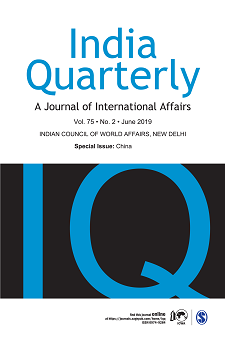
How Status-seeking States Can Cooperate: Explaining India–China Rapprochement After the Doklam Standoff
India Quarterly 75, no. 2 (2019): 172-189.
By Chao Xie, Assistant Research Fellow at the Institute for International and Area Studies (IIAS), Tsinghua University, Beijing and visiting faculty scholar (2018–2019), at Jindal School of International Affairs (JSIA), O.P. Jindal Global University, Haryana. His areas of interest include Indian politics and foreign policy, major power relations and international relations theory.
Noticing the gap in the existing literature, this article attempts to argue that status-seeking motives do not necessarily result in zero-sum games and hence tries to summarise conditions for status-seekers to manage conflicts and realise cooperation with one another through creative use of social mobility and creativity strategies. As a case study, this article examines the evolving relations between India and China since 2013 and demonstrates how relations between these two status-seeking states can become confrontational with conflicting status-seeking incentives. For some time, the status competition seemingly dominated their interactions, when India was not willing to accept China’s power status second only to the USA, and China reluctant to recognise India as another rising power with nuclear capabilities. After the Donglang (Doklam) standoff, both governments are finding ways to manage an indirect path for cooperation through a newly discovered multilateral framework. The elements contributing to the stability of their relations lie in their choice of international identity and political calculations in which they can engage with the other based on their shared interests in fostering solidary among developing countries.

Compiled and sent to you by Centre on Asia and Globalisation and the Lee Kuan Yew School of Public Policy, National University of Singapore.
Have any feedback or comment? Email us
decb64_Y2FnQG51cy5lZHUuc2c=_decb64
Subscribe