 Cities are the lifeblood of many countries – consuming a disproportionate amount of its resources but also contributing the lion’s share of its GDP. In terms of sustainability of built environments, cities, with their compact structure represents one of most efficient forms of human settlement.
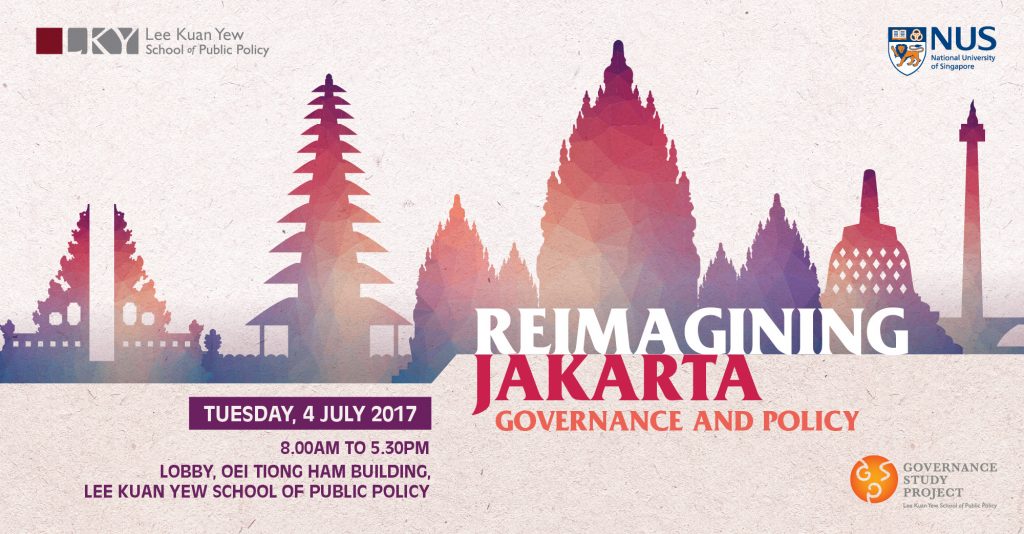
The Governance Study Project Conference will take place on 4 July 2017 at the Lee Kuan Yew School of Public Policy. This conference focuses on Jakarta, a fast-growing metropolis with complex urban challenges. Many of these revolve around water: water supply and sanitation, land subsidence, seasonal flooding and the possibility of a coastal flood that could submerge large parts of the city.
These urban challenges are reimagined as new possibilities within the framework of the Sustainable Development Goals (SDGs). In the full range of social, developmental, societal and infrastructural explorations, we will examine the difference good policies can make at the city level. Additionally, cities are intricately tied to the countryside, where the process of rural development influences the level of urbanization, and urban development could act as engine of rural growth or decline. Students also researched a plantation in Kerinci, one of the largest pulp and paper producers in the world.
In this conference, students will rely on knowledge and skills learned throughout the MPA programme. The outcomes are detailed policy proposals based on rigorous primary and secondary research and analysis which aims to make an impact on urban governance of this complex city.
Conference Schedule
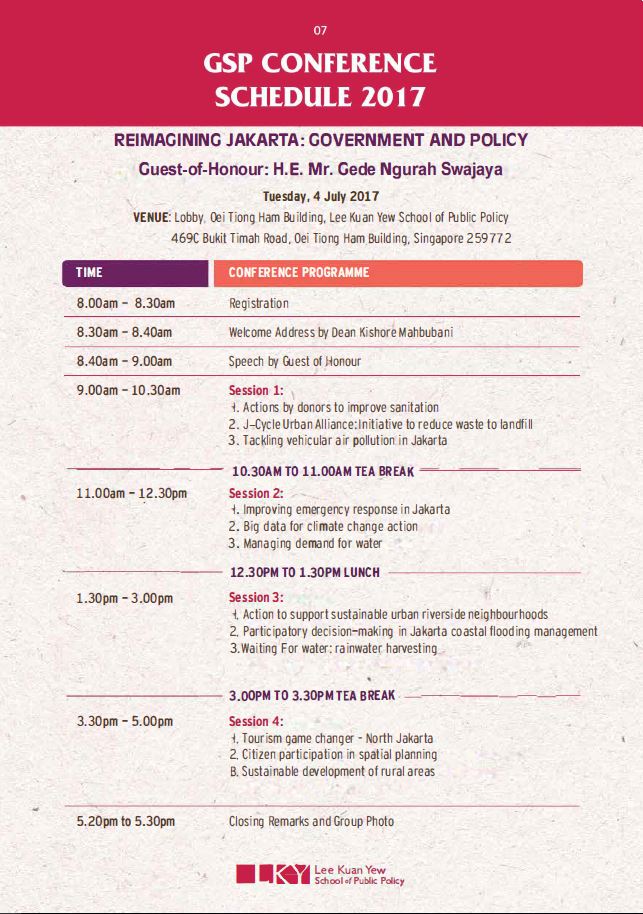
Session 1
Venue: Lobby, OTH Building
Time: 09:00 a.m. – 10:30 a.m.
Click to hide details
Click to show details
Actions by donors to improve sanitation
Group Members: Jane Du, Atul Sanganeria, Masato Mikamo, Mak Yuen Mei, Adeline, Harry Pham
Jakarta is the vibrant capital city of Indonesia. Already housing 9.6 million people, it has a strong potential for growth. While the city is aiming for 100% sanitation coverage by 2019, the project has been dogged by institutional, budgetary and technical challenges.
We have examined the issues that Jakarta needs to overcome to achieve its goal, and humbly propose two complementary policies to improve sanitation in the city: regulation to impose regular desludging of onsite septic tanks, together with investment loans from donors to improve the state of sanitation management in Jakarta.
J-Cycle Urban Alliance: Initiative to reduce waste to landfill
Group Members: Dharani Kanth Koganti, Shruti Singh, Khulangoo Purevjav, Mariam Frances Maglaya, Teoh Meng Wee
Solid Waste Management (SWM) is one of Jakarta’s biggest problems, with 64 million tonnes of waste produced annually. Although 65% of the waste generated is organic, a lack of community awareness and low adoption rates when it comes to segregation at source mean that only 1% of organic waste is composted, with the rest ending up as landfill. We propose an economically viable and scalable pilot project: “J-Cycle Urban Alliance”. Such a project would capitalise on the strengths of stakeholders within the existing system to optimise downstream waste management, raise community awareness regarding segregation at source, and promote communal composting to convert waste into fertiliser, eventually achieving a total reduction of landfill waste of 80%.
Tackling vehicular air pollution in Jakarta
Group Members: Ruan Boting, Neha Simlai, Zainab Kyari, Loi Kok Woo, Eric
The city of Jakarta has been struggling to address the problem of air pollution for several years. A sharp growth in the various sources of pollution – and notably an increase in the number of vehicles on the road – has contributed to worsening air quality in the city.
Using various policy instruments, we propose three alternative methods to tackle pollution in Jakarta. These include:
Regulatory changes to incorporate international standards and strengthen emissions test requirements;
An incentive-based approach to promoting self-regulation;
A ‘Breathe Free Jakarta’ public awareness campaign.
Session 2
Venue: Lobby, OTH Building
Time: 11:00 a.m. – 12:30 p.m.
Click to hide details
Click to show details
Improving emergency response in Jakarta
Group Members: Tania Angelica Morales Galarce, Murali Krishna Reddy Venugopal, Hnin Wut Yee Win, Teo Mei Nah, Mayna, Edward Batoctoy Aparis
While Jakarta has experienced severe flooding in the past, studies have found that the frequency and intensity has increased in recent years, to a point at which flooding has become the city’s number one natural hazard. Causes range from changes in rainfall patterns and soil conditions to drain congestion caused by high groundwater levels. More direct anthropogenic causes have also been identified, including the city’s urban planning and design.
The increasing severity of Jakarta’s floods has made the issue a top priority for the city’s emergency management services. Out research and policy recommendations focus on enhancing inter-agency communication in emergencies, promoting community involvement, improving current governance structures, and harnessing information and communication technology.
Big data for climate change action
Group Members: Mou Xu, Sujatha Uthiramadan Govindan, Pranayna KC, Dan Liu, Wang Chee Yann
Indonesia is likely to be one of the countries most affected by the catastrophic effects of climate change. The WHO predicts that temperatures in Indonesia will rise by 3.8°C by the end of the 21st century. According to a 2013 survey, a quarter of Jakarta residents felt that climate change posed a risk to their household.
However, while climate change data is being collected in Indonesia, many of Jakarta’s citizens lack the capacity to access and understand it. Our goal is to address this information gap. We recommend leveraging the Jakarta Smart City platform to share data and notify users about climate change forecasts.
Actions to secure Jakarta’s water sources
Group Members: Wu Yue, Abhay Kumar, Muneeza Majeed, Phua Chui Leng, Jasmine, Sachdeva Pawan Kumar
The Special Capital Region of Jakarta is facing a chronic water supply problem. This issue has been aggravated by rapid urbanization and migration into the city.
This paper discusses alternative sources of clean water to increase the overall supply. To formulate our recommendations we spoke to the relevant city water authorities and conducted an extensive literature review. We looked at potential policy options, infrastructure and finance issues, as well as international best practice in supply and demand management.
In this paper we recommend demand management via public education campaigns aimed at effecting behavioural change among school children as a long-term sustainable solution.
Session 3
Venue: Lobby, OTH Building
Time: 1:30 p.m. – 3:00 p.m
Click to hide details
Click to show details
Action to support sustainable urban riverside neighbourhoods
Group Members: Marrwa Ibrahim Abdelhamed Ibrahim, Shrutika Suresh Jadhav, Naoki Yoshino, Chin Li Lian Pauline Ruth, Montserrat Ishimwe Pejuan
Under the Jakarta Urgent Flood Mitigation Project (JUFMP) many kampung residents are at risk of being uprooted from their homes and losing their livelihoods. Current legislation and regulations provide for no compensation in such cases, though residents can choose to be resettled in new low-income housing. Nevertheless, resettlement is in itself a social and economic shock. We therefore propose a financial inclusion model to be integrated within the resettlement framework to mitigate risks arising from loss of livelihood.
Participatory decision-making in Jakarta coastal flooding management
Group Members: Reka Tozsa, Anwar Ali Thevaraparambil, Cristamarie Dayag Tabilas-Abiva, Li Jialin, Johannes Andreasson Unterstaller
Flood management and planning are critical in controlling flooding in coastal areas. In Jakarta, however, attempts to do this are undermined by inadequate public participation in the process. In this paper we look at ways to improve this, examining three policy options – interactive communication, facilitated consultation and participatory decision-making – and producing a detailed feasibility analysis. We conclude that participatory decision-making would be both an effective and a politically feasible way to optimise coastal flood management efforts.
Waiting for Water: Rainwater Harvesting
Group Members: Li Yuexi, Seema Chowdhry, Alex Yeo Sheng Chye, Desmond Tan Chee Wee
The unsustainable extraction of groundwater is a complex problem for the city of Jakarta. Research and empirical evidence suggest that many of Jakarta’s ancillary problems, such as land subsidence and flooding, are directly related to the excessive demands placed upon the groundwater supply.
One of the key issues that came to light during our research was the Jakarta government’s failure to address this issue as part of their water management plan. The city also suffers from a lack of enforcement of existing legislation regarding the extraction of groundwater, particularly for commercial purposes.
Keeping in mind UN Sustainable Development Goal 6.4 (to substantially increase water-use efficiency across all sectors and ensure sustainable withdrawals), we propose a community-based rainwater harvesting project as a viable alternative to the use of groundwater.
Session 4
Venue: Lobby, OTH Building
Time: 3:30 p.m. – 5:00 p.m.
Click to hide details
Click to show details
Tourism game changer – North Jakarta
Group Members: Andreas Johannes Unterstaller, Yeni Imaniar Hamzah, Nadia Monira Binti Mohamed Taib, Lim Chien Chien Serene
North Jakarta is a strategic location with a distinctive history and heritage dating back to the Dutch colonial era. The area is not a major destination for local or international tourists. In light of this, we were inspired to analyse the area’s tourist potential with a view to transforming it into a “must-see” destination.
Citizen participation in spatial planning
Group Members: Anshika Arora, Nur Hidayati, Manabu Shirahama, Lydia Fu Wing Kay
Citizen participation in Jakarta’s spatial planning process is rare due to the inaccessibility and complexity of spatial planning information, as well as a lack of interest on the part of the citizens themselves.
However, citizen participation falls under the UN’s 11th Sustainable Development Goal: making cities inclusive, safe, resilient and sustainable. We assess the potential cost, impact and effect of three policy tools for encouraging participation: an informative website, an on-the-ground outreach programme, and an online game platform. We conclude with the recommendation that a $17,000 budget be used to trial an outreach programme in combination with a gamification project to increase citizen awareness of spatial planning.
Sustainable development of rural areas
Group Members: Poojan Rana, Sanny Djohan, Temirbek Azhykulov, Dong Limin
As the private sector pursues profit maximization, what can be done to encourage companies to have a positive impact on the communities in which they operate? Should companies be forced by law to work towards the sustainable development of rural areas? What should be the role of the government on this issue?
We make the case in favour of increased regulation to oblige companies to make greater efforts when it comes to corporate social responsibility (CSR). This will help Jakarta to achieve UN Sustainable Development Goals in the field of sustainable consumption and production patterns, and notably the requirement concerning actions by private companies to promote sustainable rural growth.