[ALUMNI-INFO TEXT="We see ourselves as “civilian ambassadors,” helping to strengthen ties between China and Singapore. Over the years, we’ve developed a close relationship with the Singapore Consulate-General in Shanghai, even though most of us aren’t Singaporeans. The consulate treats our alumni group as part of its extended community, sharing news of its activities and joining us for key events. I’ve had the chance to work with five different Consuls-General so far—all of them fellow NUS alumni—and it’s been a privilege."][/ALUMNI-INFO]
As CEO, Dr James Geng Jing (MPM 2011) leads Greenland Holdings, one of China’s major enterprise groups with core businesses in real estate, infrastructure, and financial services.
Over the course of his career, he has worked across banking, insurance, securities, and trust, placing him at the intersection of financial leadership and public policy. Midway through that journey, he arrived in Singapore to study public policy at the Lee Kuan Yew School of Public Policy (LKYSPP), seeking a clearer understanding of how government decisions shape markets.
He returned to Shanghai able to think like a policymaker when it mattered—and with a lasting connection to the School. For over a decade, he has served as President of LKYSPP’s Alumni Shanghai Chapter, and continues to build bridges between business, policy, and community.
Below is his story, in his words.
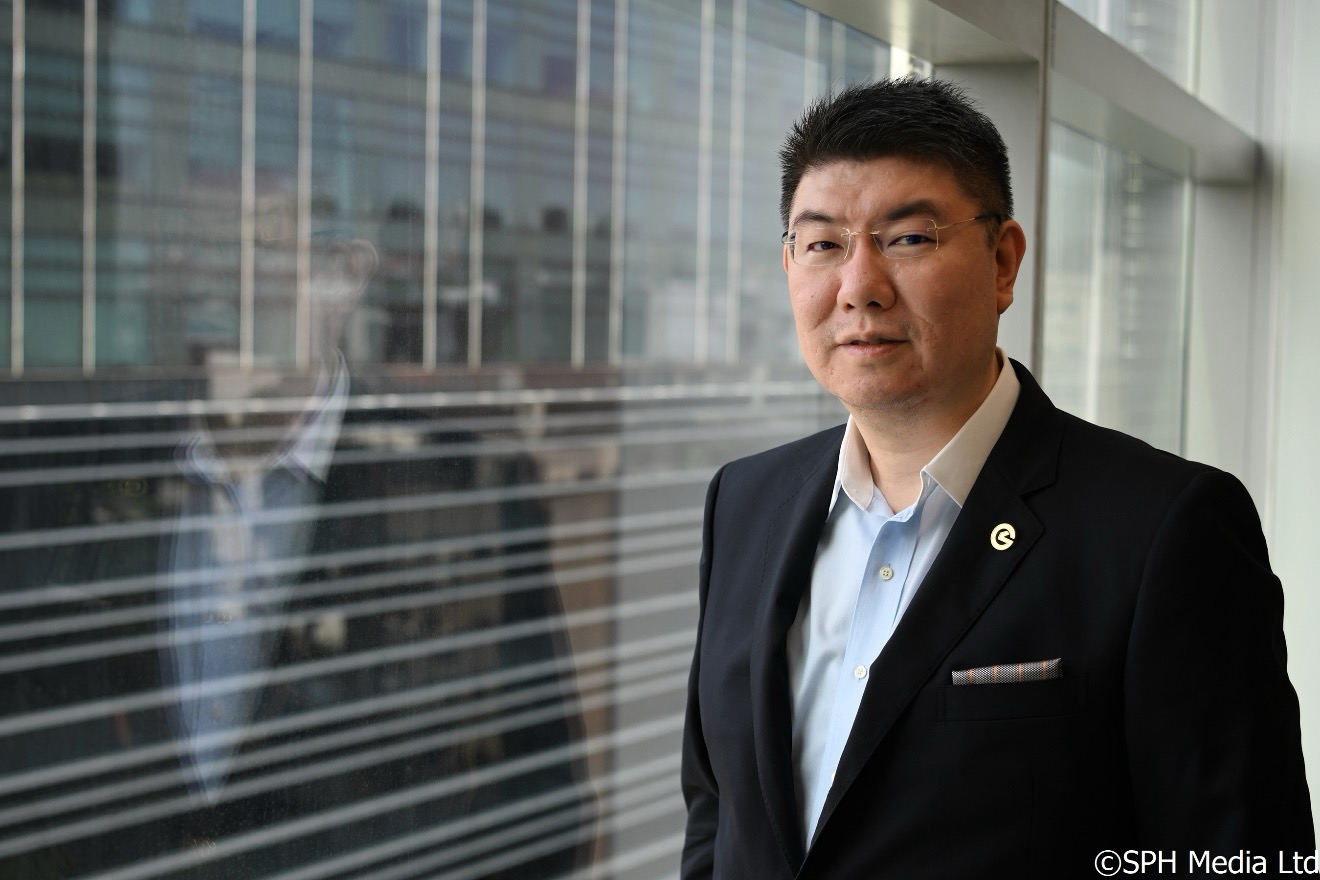
My earliest ideas about the world were shaped by my father’s fascination with finance. To him, finance was not just a sector, but the engine that powers all industries. I came to share that conviction, and by the time I entered university, I knew I wanted to study economics and build my future in the financial world.
Professionally, I worked in senior management in the financial sector, but I also saw myself as part theorist—drawn to economic models, policy shifts, and the broader forces shaping the financial landscape.
Yet my perspective came entirely from the private sector. I had never worked in government, and I lacked insight into how public policies were developed or what impact they could have. I recognised that without this awareness, even the most promising businesses could eventually hit a bottleneck. This is particularly true in China, where managing the relationship between enterprise and state is central to long-term success.
In 2009, I took a professional break to study public policy in Singapore. It was a deliberate step to close that gap.
Mastering Policy for Business
I chose the Master in Public Management (MPM) programme, a collaboration between LKYSPP and Harvard Kennedy School, because it combined two distinct strengths. LKYSPP draws on Singapore’s model of governance, known for its clarity and results. At Harvard, the emphasis is on Western political systems, with exposure to cutting-edge theory.
My time at LKYSPP taught me to think from a government perspective, and to grasp the core concerns and policy logic. The training helped me interpret public decisions, and apply this understanding in a business context. At Harvard, where I spent a semester, the experience was different but complementary. The course content was taught through case studies, scenario simulations, and brainstorming, all part of a well-honed teaching model.
Some lessons from the MPM were immediately useful, such as the courses on crisis management and public communication. In today’s climate of fast-moving public opinion, large companies and governments face similar challenges in managing sentiment as situations evolve. These skills became part of my day-to-day toolkit as a business leader.
As for a standout moment, that would be in 2016, when Greenland was exploring investment opportunities under China’s Belt and Road Initiative. One of my MPM classmates, then serving as a senior official in Cambodia, assisted us to quickly understand local policies. This shows how alumni relationships can open doors years later and enable real cooperation across borders.
During the one-year study, we also had the opportunity to gain an inside view of Singapore’s public sector. My placement was at the Monetary Authority of Singapore (MAS), where I saw firsthand how regulators make judgments, oversee institutions, and approach decisions. This experience proved crucial in 2019, when Greenland applied for a digital banking licence in Singapore. The familiarity I had built at MAS allowed us to engage in meaningful dialogue, and ultimately secure one of only two licences granted to foreign firms.

Alumni Networks in Action
Back in Shanghai, I didn’t want to lose the kinship I had experienced at LKYSPP. With the School’s encouragement, I reached out to earlier alumni cohorts, and we began talking about forming a network to serve our community.
This eventually became LKYSPP Alumni Shanghai Chapter, created around two goals. Our top priority was to bring together all LKYSPP alumni living and working in Shanghai, locals and foreign graduates alike. We also took inspiration from the Western Returned Scholars Association, a nationally recognised platform in China for overseas-educated professionals. While we’re not affiliated, adopting a similar framework gave us the legal footing to represent the School in an official capacity.
The response was overwhelmingly positive. When it came time to formalise the group, the alumni nominated me as founding president, and I was honoured to accept. Since then, we’ve focused our efforts on three areas that reflect the School’s values as well as the needs of our local community.
First, we serve as a bridge between the School and its alumni. We host visiting faculty, pass along feedback, and support the School’s efforts in recruitment and fundraising.
Second, we promote lifelong learning through forums and lectures, such as this year’s NUS Innovation Forum in Shanghai, which we co-organised with alumni from other NUS faculties. It was a fully volunteer-led effort, and we did this out of a sense of duty to NUS.
Third, we see ourselves as “civilian ambassadors,” helping to strengthen ties between China and Singapore. Over the years, we’ve developed a close relationship with the Singapore Consulate-General in Shanghai, even though most of us aren’t Singaporeans. The consulate treats our alumni group as part of its extended community, sharing news of its activities and joining us for key events. I’ve had the chance to work with five different Consuls-General so far—all of them fellow NUS alumni—and it’s been a privilege.
We also contribute to the consulate’s outreach efforts, and one example is Singapore Day, an annual celebration for overseas Singaporeans. Thanks to one of our alumni working in the tourism sector, we helped integrate the event into Shanghai’s official tourism festival. Because our group is officially recognised in China, we were able to act as the formal host, while the consulate supported the event behind the scenes.
Beyond events, we work with the Singapore Chamber of Commerce in Shanghai to help connect Singaporean businesses with local authorities and vice versa.
I’ve always believed that an alumni chapter should run on collaboration, not hierarchy. As president, my role is to listen, coordinate, and support the efforts of our members. More than a decade on, I still find this work deeply rewarding.