Through her various platforms, Carolina Lima Perlingiere (MPP 2014) is working to change Brazil’s fashion industry for good.
[ALUMNI-INFO TEXT="As a young Master’s student at Lee Kuan Yew School of Public Policy (LKYSPP), Carolina Lima Perlingiere already had a burning interest in sustainability. In fact, some alumni from her batch may recall she was a founder of the school’s Environmental Committee when she lived in Singapore from 2012 to 2013 – getting the school to place recycling bins on campus.
Recalling that memory of the school’s fledgeling green movement back then, Carolina says, “it was such a relief to see those bins across LKYSPP! It was a small victory and yet so important to start raising awareness on campus.”
That step was just one part of a lifelong journey in sustainability for the Brazilian citizen, now 32 and living in Rio de Janeiro.
As a co-founder of Brazil’s first international sustainable fashion forum Rio Ethical Fashion, Carolina is now paving the way for sustainable fashion in her home country."][/ALUMNI-INFO]
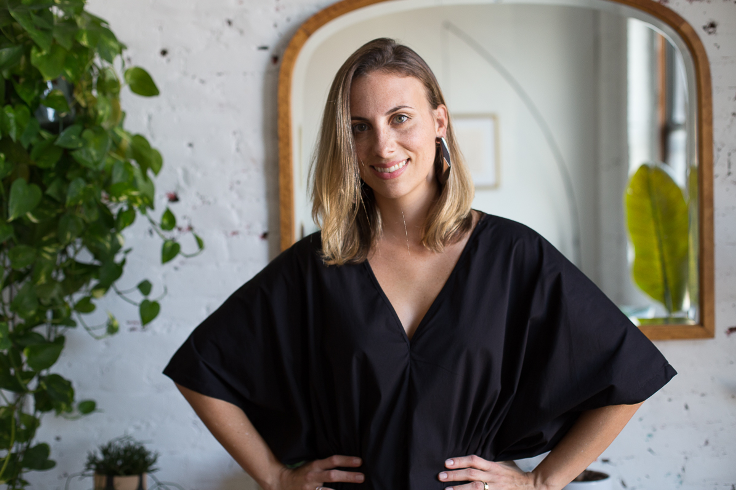
Sustainable fashion activist-entrepreneur and LKYSPP alumna, Carolina Perlingiere (Photo: Aline Müller)
No stranger to forays into sustainable fashion, in 2017 she had also co-founded online marketplace Fauna, which took small-scale sustainable fashion brands from Brazil to the global marketplace.
Carolina, who also works as an independent corporate social responsibility consultant, says, “I believe that fashion has a fundamental role in our lives. It is always present as a form of expression, defining attitudes, identities and cultures. I believe in the transformative power of fashion, which, by dictating trends and influencing behaviours, can act as an agent of change, a force for good.”
For her, that force for good is Rio Ethical Fashion. While she was at Fauna, she got to know “two amazing women”, Yamê Reis and Lilly Clark, who invited her to join them in setting up Rio Ethical Fashion.
“It was a no-brainer, and I am very proud of what we’ve achieved in such a short period of time. We launched Rio Ethical Fashion in June 2019 and are now going to our third edition.”

Carolina (left) with Yamê Reis and Lilly Clark, the founder and co-founder of Rio Ethical Fashion, respectively. (Photo: Felipe Haua/Rio Etc; Wall art: Nicolau Mello)
A COMMUNITY OF CHANGE-MAKERS
Today, Carolina leads
Rio Ethical Fashion’s international engagement strategy with sector specialists and sustainable fashion brands and is also one of its content curators. “We have a small team, so everyone needs to be hands-on,” she says.
Rio Ethical Fashion started quickly in 2019 as they got together more than 1,000 participants from Brazil and elsewhere.
Their second edition was in November 2020, which took place virtually because of the pandemic. Says Carolina, “The online format allowed the event to reach a greater number of people, attracting an even more international audience and a greater number of speakers who might not have been able to travel had the event been in person (which would also significantly increase the forum’s carbon footprint!).”
That event brought together over 70 speakers from Brazil and abroad in more than 20 sessions. Among other topics, speakers shared their insight on the current state of the sustainable fashion industry, disruptive and innovative cases from across the globe, and ideas on the best ways forward. The next event is taking place online in June 2021.
[ALUMNI-QUOTES TEXT="As Carolina puts it, the impulse for Rio Ethical Fashion is simple. “We are a change-makers community and want to change the world through fashion. We aim to bring industry leaders and players together to debate, inspire, create partnerships and spread the values of sustainability in fashion and its cultural and socioeconomic aspects in Brazil and in the world.
“Rio Ethical Fashion’s mission is to promote change in the fashion sector, placing the planet and people first. We aim to stimulate courage and resilience among the industry players in order find solutions for our current model of overproduction and exhausted consumption.”
Starting a sustainable fashion platform in Brazil is significant. The country, Carolina explains as she provides the numbers, is a major contributor to the global fashion industry. It is the world’s fifth largest textile producer, the second largest denim manufacturer and the fourth largest knitwear producer — producing 9 billion pieces of clothing per year. In turn, the fashion sector is Brazil’s second largest employer, generating more than 9 million direct and indirect jobs."][/ALUMNI-QUOTES]
She says, “We understand that the country has a significant role to play in fashion sustainability and want to actively contribute to the debate by, among other actions, sharing best practices developed in Brazil.
“We want to place Brazil in the midst of the international debate, bringing an outside look to our creative potential, and developing new opportunities for our industry. Our role is to inspire change in the fashion sector in Brazil, for a fairer and more ethical fashion industry, contributing to the country’s economic and sustainable development.”
GREEN DREAMS
To alumni or students keen on taking a similar career path, Carolina says in fact that “sustainability should be part of every single job out there”.
She offers this view as someone who has worked in the private sector and the United Nations, as well as an independent consultant and an entrepreneur. After graduating with a double Master’s from LKYSPP and Columbia University’s School of International and Public Affairs, Carolina held roles as the United Nations Global Compact’s Client Engagement Manager for the Americas and Spain, and as a consultant at the UN-backed Principles for Responsible Investment and the UN Global Compact's LEAD platform in New York.

Carolina at the first edition of Rio Ethical Fashion in June 2019.
“In an ideal world, we will no longer have sustainability departments in organisations as it should be embedded in everything we do. With that in mind, I’d suggest students explore different issues and understand their interconnections (the UN Sustainable Development Goals are a great framework for you to start with).
“Exercise critical thinking and identify where or what are the social, environmental and governance aspects of any of your assignments or case studies.”
She adds, “You will also find that collaboration is key to achieving success. At the end of the day, it doesn’t really matter if you are working from a company, government agency or NGO to have an impact. We all need each other to create real change.”
It is certainly what Carolina hopes to achieve. Ultimately, she says, “I see Rio Ethical Fashion transforming the fashion industry in Brazil (and hopefully elsewhere), accelerating a transition towards a more regenerative, circular economy in general, as I believe the sector can inspire and drive change in other sectors as well.”
Here are some tips from Carolina on how to shop better when it comes to fashion.
- Her first rule? Don’t buy at all. “The most sustainable option of all time!”
- If you do decide to shop, purchase second-hand items. “Besides doing right for the planet, it also helps you save some money.”
- If you are buying new items, pick quality over quantity. “Avoid fast fashion.”
- Buy consciously. “Learn about your favourite brands’ social and environmental practices, where the garments are been made and by whom. Opt for ethical brands that are aligned with your personal values.”