In the Spotlight
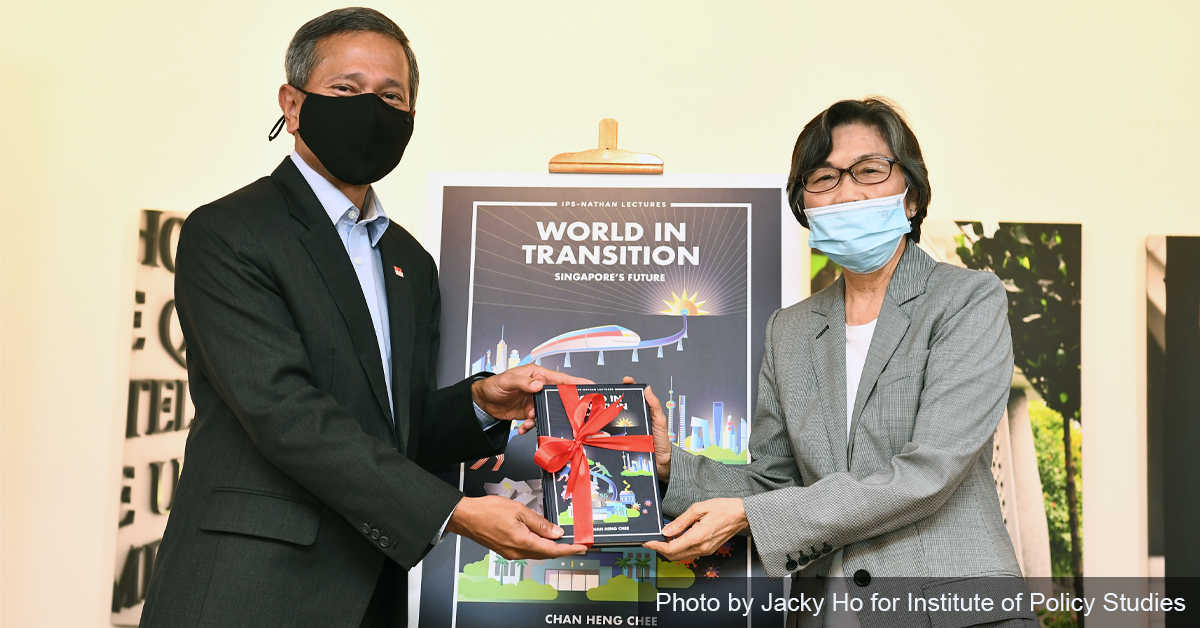
IPS recently launched World in Transition: Singapore's Future by the 7th S R Nathan Fellow, Professor Chan Heng Chee. This edited collection of her IPS-Nathan Lectures, delivered between June and July 2020, includes highlights of her dialogue with the audience.
Minister for Foreign Affairs and Minister-in-Charge of the Smart Nation Initiative, Dr Vivian Balakrishnan graced the launch as Guest of Honour. In his remarks, he said that Prof Chan reminded us that we are no longer in a unipolar world, "and perhaps we're moving to a world order of 2½ poles." In her first lecture, Prof Chan had mentioned a new global order led by the United States and China, and Europe as a "half" pole.
The book is now available to be purchased online and in selected bookstores. For online purchases, you may enjoy 20% off all IPS-Nathan Lecture Series books in the month of March by entering the promo code ‘WSWIS20’ upon checkout on World Scientific Publishing’s website.
Watch the launch, featuring remarks by Prof Chan, Minister Vivian Balakrishnan and IPS Director Janadas Devan here.
Articles

Commentary — Coup, Covid and other tests of Asean unity
(The Straits Times)
By Tommy Koh
• 5-min read
In this Straits Times op-ed, IPS' Special Advisor Professor Tommy Koh deals with four challenges of ASEAN. This includes managing the political crisis in Myanmar and maintaining ASEAN’s unity and neutrality in the face of intense rivalry between the US and China.

Commentary — Let's build immunity against vaccine falsehoods
(The Straits Times)
By Carol Soon and Shawn Goh
• 5-min read
Recent vaccination efforts have been compromised by many COVID-related scams, cheating victims of at least $1.4 million. How can we cultivate and strengthen “network immunity” and protect our family and friends from falling prey to misinformation? In this Straits Times commentary, IPS’ Carol Soon and Shawn Goh explore these questions and more.

Commentary — 张家绮:何谓代沟?
(Zaobao)
By Teo Kay Key
• 5-min read
A recent study conducted by Institute of Policy Studies showed a sharp contrast in views held by the younger and older generation of Singapore. No matter how large, having an open discussion is imperative to bridge this generation gap. IPS researcher Teo Kay Key discusses these findings and their implications in Zaobao.

Commentary — Class divisions: The risks to Singapore's cohesion
(The Straits Times)
By Mathew Mathews and Melvin Tay
• 4-min read
A look at the effects on people of one measure introduced in last week's Budget 2021, the hike in petrol duty rates, illustrates class-based divisions that have implications for social cohesion. If left unchecked, these divisions may result in a rise of populism. IPS' Mathew Mathews and Melvin Tay writes for The Straits Times on how we can move meaningfully towards a socially cohesive future in Singapore.

Commentary — Engineering for a healthy planet
(The Straits Times)
By Seeram Ramakrishna and Jaspal Singh
• 5-min read
Everyone needs to play a part to transition to net-zero emissions by 2050, or very soon thereafter, in line with the target set by many countries to achieve net-zero economies by 2050." IPS' adjunct senior research fellow Jaspal Singh co-wrote a commentary for The Straits Times about how an engineer's role can impact and help create more sustainable developments and a low-carbon economy.
Recent Releases on the IPS Website
 The Year in Review: Policy and Political Developments in 2020
This review provides a rundown of key policy and political developments in Singapore in 2020. These were, in large part, the country’s response to the multi-faceted implications of the outbreak of a new strain of coronavirus (COVID-19) which spread from China to Singapore and globally in January. The World Health Organisation (WHO) declared its emergence a Public Health Emergency of International Concern on January 30, and a pandemic by 11 March. Apart from the figures relating to 2020’s economic performance, which were officially reported in February 2021, the discussion in this review draws on developments up to December 31, 2020.
 Report — Singapore Perspectives 2021: Reset
Singapore Perspectives, IPS’ annual flagship conference, was held on 12, 14, 19 and 25 January 2021. Titled “Reset”, this years’ conference explored various challenges triggered by the COVID-19 pandemic, as well as pre-existing trends and issues in different domains. The conference comprised nine online forums, featuring global thought-leaders, academics, community leaders and policymakers, as well as a final hybrid conference day event with in-person plenary sessions. This iteration of the Singapore Perspectives Conference formed part of the first phase of Reimagining Singapore 2030, which seeks to explore how Singapore and the world might change in the next decade, and what strategies can and should be taken to build a better future.
 IPS Working Paper No. 38 — Public Debt and Intergenerational Equity in Singapore
In this working paper, IPS’ Kunal Pawa and Christopher Gee propose a Debt Issuance Framework that allows the Government to issue debt for budgeted expenditures while still maintaining intergenerational equity. A simulation of this Framework for the period 2021-2025 creates additional fiscal space of $16.5 billion to $17.5 billion each year to finance public expenditure in an intergenerationally equitable and fiscally sustainable manner, whilst limiting debt-servicing obligations of the government to below 1 per cent of GDP.
Recent Publications
 Book Publication — Capacity-building and Pandemics: Singapore’s Response to Covid-19
This book, written by IPS Senior Research Fellow Woo Jun Jie, focuses on the policy capacities, built up since the 2003 SARS crisis, that have contributed to Singapore’s Covid-19 response efforts. In doing so, the book discusses the fiscal, operational, analytical and political capacities that have driven Singapore's policy response to the pandemic, and proposes a broad policy capacity framework that will be applicable to the analysis of other contexts as well.
IPS in the News
For media coverage of IPS experts' views on current affairs and IPS events, click here.
For upcoming IPS events, click here. Sign up for the IPS events mailing list here.
Careers at IPS — please check us out and help to spread the word!