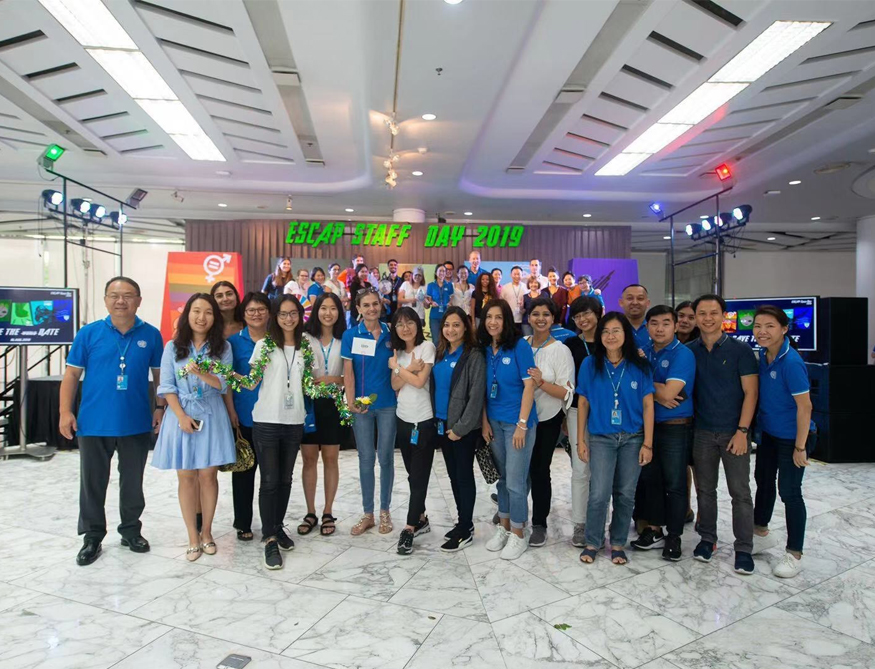
In September 2019, I completed my two-month internship at the United Nations Economic and Social Commission for Asia and the Pacific (ESCAP) in Bangkok, Thailand. I decided to undertake this internship in order to gain an in-depth understanding of the Thai society and culture, and to experience working in international organization. My two months in Bangkok turned out to be very different from what I expected – in terms of what it would be like, what stories I would have and how I would feel, and I am grateful for all the unforgettable experiences that have reshaped my understandings.
The ESCAP serves as the United Nations’ regional hub promoting cooperation among countries to achieve inclusive and sustainable development. The largest regional intergovernmental platform with 53 Member States and 9 associate members, ESCAP has emerged as a strong regional think-tank offering countries sound analytical products that shed insight into the evolving economic, social and environmental dynamics of the region. The Commission’s strategic focus is to deliver on the 2030 Agenda for Sustainable Development, which is reinforced and deepened by promoting regional cooperation and integration to advance responses to shared vulnerabilities, connectivity, financial cooperation and market integration. ESCAP’s research and analysis coupled with its policy advisory services, capacity building and technical assistance to governments aims to support countries’ sustainable and inclusive development ambitions.
I was accepted as an intern at the ICT and Development Section of the ICT and Disaster Reduction Division under the guidance of Ms. Atsuko Okuda. The current assignment of the section is to promote the development of regional broadband connectivity and inclusive broadband through the Asia-Pacific Information Superhighway (AP-IS) initiative.
My work plan was to develop policy briefs on topics related to the AP-IS initiative. The structure of the policy briefs was framed with research outputs from my colleagues. The objective of the policy briefs was to advocate for more efficient and effective policymaking and hence facilitate a better ICT infrastructure landscape in the region. I was completely unfamiliar with ICT and infrastructure when I first started this work, so during the first two weeks of my internship, my main goal was to familiarize myself with this field by reading all the working papers produced by my sector. The knowledge in the field, especially the technical, is rather difficult to digest. But the difficulty also reveals to me what I have gained from my learning process at LKY school, that I was able to self-teach and create my own knowledge base from scratch. I was also able to call into use the writing and communicating skills I learned from LKY school in drafting those policy briefs and discussing with my colleagues and supervisors. In my internship, I have finished a total of five policy briefs, namely:
- Building e-resilient and the role of ICT for disaster reduction risk
- Effects of open international gateways on the broadband market
- Satellite communications in Pacific Island Countries
- ICT statistics for evidence-based policymaking in Pacific Island Countries
- ICT codeployment with the electricity infrastructure – the case of Bhutan
As a part of my work, I also participated in two intergovernmental conferences and was responsible for their preparation and report writing. This entailed attending and digesting a large number of speeches given by senior experts in the field, as well as assisting and coordinating with different levels of incoming guests and UN staffs. This was an intensive learning experience. It forced me to stay focused and be in an active thinking mode for a few hours straight and quickly translate my understanding of the speech into accurate report writing. The frequent interaction with guests and speakers has also brushed up my skills in communicating in a professional setting.
My biggest takeaway from this internship, however, was a brand-new perspective on development and myself. One thing I have learned from this experience is the importance of continuously cultivating stewardship in the development sector for efficient work culture. I also found myself much less confrontational and decisive than I thought at times of conflict. I am grateful how I gained a deeper understanding about who I am and where I come from through these challenges.