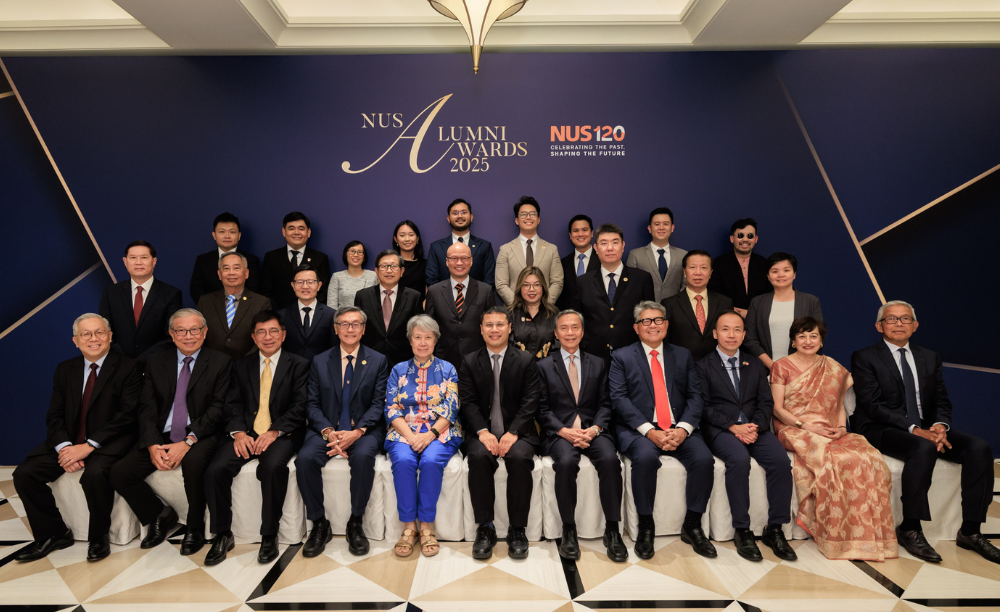
Proud moment for the Lee Kuan Yew School of Public Policy (LKYSPP): three of our alumni were among the 22 honoured at the NUS Alumni Awards — a biennial recognition for those who’ve made meaningful contributions to their alma mater, society and the world.
Congratulations to our alumni for this achievement. Hear from them about how their time at LKYSPP influenced their careers and their approach to policy-making.
Dr James Geng Jing (MPM 2011), CEO, Greenland Holdings,
Distinguished Alumni Award

The MPM program at the Lee Kuan Yew School of Public Policy (LKYSPP), offered in partnership with the Harvard Kennedy School, held a unique appeal for me. I particularly valued the two schools’ complementary strengths: LKYSPP offered practical insights into Singapore’s governance success, while the Kennedy School provided theoretical rigor in Western political systems and a global outlook. This fusion of Eastern and Western policy thinking created a rare cross-cultural learning platform for business leaders. Over the course of the intensive year-long program, I experienced a threefold transformation in my approach to leadership and policy thinking. My time at LKYSPP allowed me to adopt a policy mindset, provided me with a broadened global perspective, use my learning for real life and work applications, as well as allow me to build strategic connections with my fellow schoolmates.
Upon completing my studies at LKYSPP, my career experienced a great leap, advancing from senior financial executive to Executive President of Greenland Group, a Fortune Global 500 company, where I am currently directing strategic decisions in finance and investment for a trillion-yuan enterprise. In this capacity, it is policy thinking, that I have picked up during my time at LKYSPP, which helped anchor my leadership in navigating global complexity and technological disruption.
With the rapid advancement of artificial intelligence, the world is undergoing a profound shift in governance paradigms. Against this backdrop, the policy insights and governance principles I have developed at LKYSPP took on renewed significance. AI is not merely technological breakthrough, but a profound challenge to governance systems—one that upends traditional assumptions behind policymaking and adds new layers of complexity. I believe that enterprises facing governance challenges of artificial intelligence must develop more agile and forward-looking policy analysis systems, and exercise a policy-led mindset during this process of technological innovation and strategic decision-making. In this sense, my policy training at LKYSPP has not only retained its relevance but also gained renewed significance in the AI era, providing crucial guidance for enterprises striving for sustainable growth amid technological disruption and evolving governance landscapes.
Mr Lim Huan Chiang (MPAM 2019), Executive Director and CEO, A-Smart Holdings,
Distinguished Alumni Award

My time at LKYSPP was invaluable in shaping how I approach leadership and impact. Through visits to ministries / departments and conversations with policymakers and implementers, I saw firsthand how data is transformed into policy and how decisions are guided by the realities on the ground. This experience gave me the perspective to connect policies with people in my community work — helping residents not only understand the ‘what,’ but also appreciate the ‘why’ and ‘how’ behind them.
In today’s world of AI and rapid change, policy work remains more important than ever. AI can process information and support decisions, but it cannot replace the empathy, trust, and shared values that define governance. Good policy is not just logical; it is human. It must resonate with people’s emotions and aspirations if it is to succeed. That is why, even in an age of technology, governance and leadership rooted in people will always matter — because progress is ultimately about improving lives and building a society that reflects our collective hopes.”
Mr Harry Pham Van Anh (MPA 2017), President, ECO Vietnam Group,
Outstanding Young Alumni Award
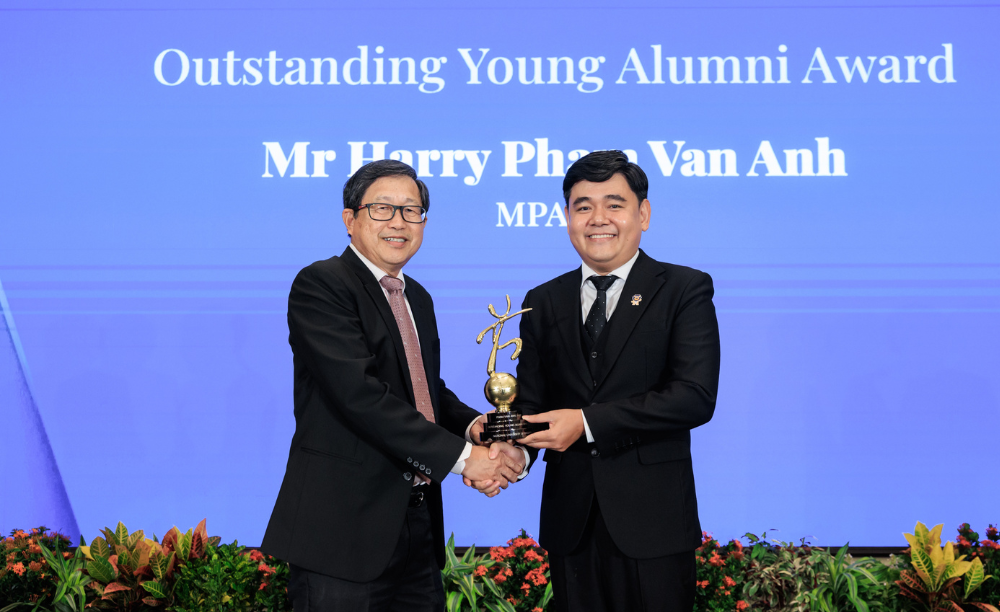
My experience at the Lee Kuan Yew School of Public Policy was deeply formative, both intellectually and professionally. One of the most enduring takeaways from my time at the School is the emphasis on public–private partnerships as a mechanism to achieve social welfare. The idea that enduring progress is built not by one sector alone, but through collaboration across government, civil society, and business, continues to shape the way I approach development work. Everything we do must ultimately be for people and by people, with communities placed at the heart of any sustainable solution.
In my field, policy is not a distant or abstract concept — it is the very foundation that determines whether initiatives can scale, endure, and create meaningful social impact. Policy provides the enabling environment for innovations to take root, ensures that resources are allocated equitably, and builds the accountability structures necessary for trust. This is especially critical in today’s world of rapid technological advancement, where artificial intelligence and new governance models are reshaping societies at an unprecedented pace.
While technology can accelerate change, it is policy and governance that anchor these changes to the values of inclusion, fairness, and social responsibility. Sound governance ensures that the transformative potential of AI is not just captured by a few, but distributed broadly to improve the lives of citizens. In this sense, the role of policy work remains indispensable: it provides both the guardrails and the guiding vision to navigate uncertainty while keeping people’s welfare at the center.
The School instilled in me the conviction that leadership is not simply about decision-making from the top, but about creating enabling ecosystems where individuals, communities, and institutions can thrive together. This lesson continues to inform my work every day as I seek to bridge sectors, foster dialogue, and co-create solutions that uphold the dignity and aspirations of the people we serve.