Will I be able to compete with all these people?
That was my main concern when I finally got the admission to the Lee Kuan Yew School of Public Policy (LKYSPP). I wasn’t sure if my background as a Geographer among all these economists, political scientists, and international affairs folks was enough to succeed at LKYSPP.
Singapore was not my first leg in Asia since I was already living in the Philippines before I came to LKYSPP. I was working at the International Rice Research Institute (IRRI), approximately 60km south of Manila. For the readers who do not know IRRI: they have driven the green revolution by developing new and high-performing rice varieties and management methods that have boosted rice production globally. They are a leading agricultural research institute and part of the Consultative Group on International Agricultural Research (CGIAR).
With my Bachelor in Geography and (first) Master in Geoinformatics, I came to IRRI to map rice areas across Asia with radar remote sensing satellites and forecast the yield. What still sounds like either magic or nerdy science for many people is an important contribution to food security for many countries. Knowing how much rice is growing, when the harvest periods are and the estimated yields are fundamental concerns of governments so as to design relevant policies such as trade policies or rice subsidies to the poor.
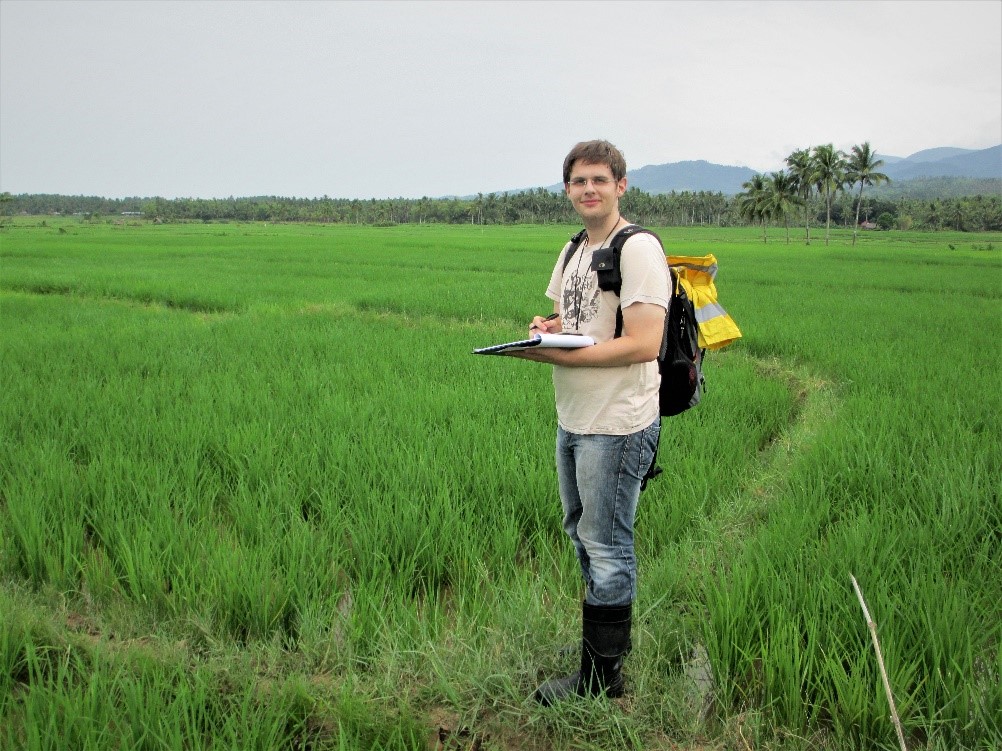
Roman in a Philippine rice field to validate his rice maps in July 2012 (with 20kg less bodyweight – Roman)
But I have not only seen rice from space, I have also literally grown it with my own hands! IRRI offers rice growing courses for everyone. In that one season, I have not just learned how to plan and manage the rice cropping, but also how to seed, apply fertiliser and maintain the field. I have even picked snails from the field that are common pests. But most importantly, I now understand how hard the work is and the challenges that millions of rice farmers face every day.
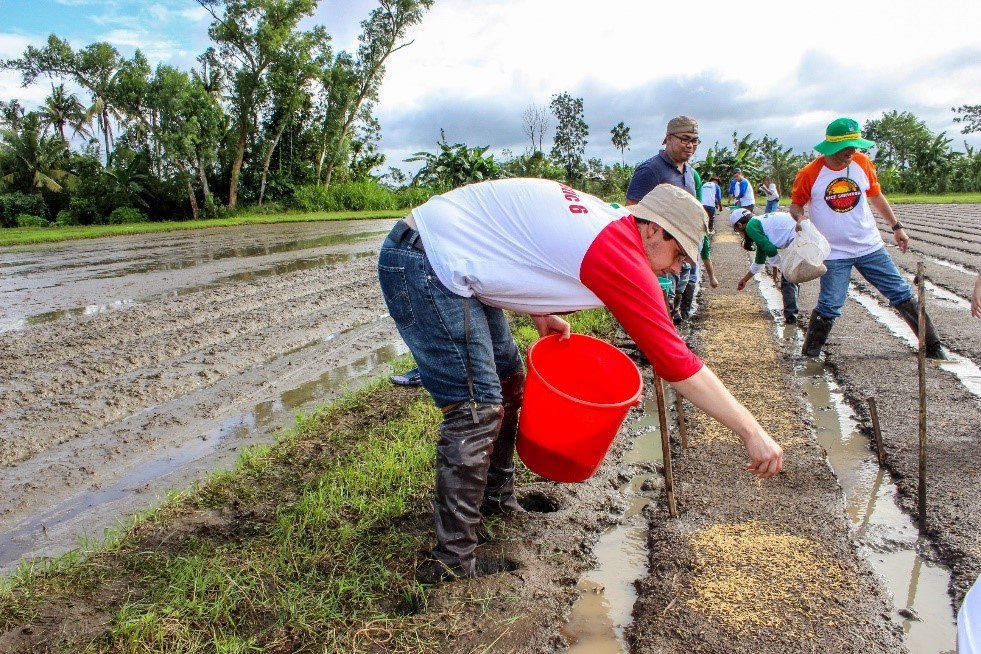
Roman seeding rice during the rice cropping course in 2014
[ALUMNI-INFO TEXT="All that knowledge helped me at LKYSPP to see the big picture with my localised experience. Indeed, I was very well equipped for the programme at LKYSPP, and my background in Geography and my first-hand experience in the Philippines have given me the right knowledge and basics to get the most out of the Master in Public Policy (MPP) programme. I think the German philosopher Immanuel Kant was right when he said: “Nothing educates and cultivates the common sense more than geography.”
While at LKYSPP, I did a summer internship in the Philippines with the public policy team of Ayala Corporation, the oldest and one of the largest conglomerates in the country; I also got an internship opportunity at the World Bank, which has ultimately shaped my career in the past few years. I continued to work for the World Bank as a full-time consultant after graduation, where I was able to work in many different projects, such as evaluating infrastructure investments in Sri Lanka with geospatial data, reviewing Public-Private-Partnership policies in Turkey as well as the analysis of economic corridor connectivity in Northern Vietnam. I was also able to travel to Bangladesh, a country I have always wanted to visit since one of my first undergrad study projects was about access to healthcare in marginalised communities in Dhaka. Interestingly, my work as Consultant at the World Bank benefits from both my new skills learned at LKYSPP and my previous background. A unique combination has been formed: a solid methodological background to deliver quantitative results with geospatial data (such as the location of toilets in Bangladeshi refugee camps to analyse the access of people to sanitation facilities or satellite imagery to monitor deforestation in Indonesia), as well as knowledge about policies and the economics behind it. My view has been broadened substantially."][/ALUMNI-INFO]
[ALUMNI-QUOTES TEXT="Before LKYSPP, a policy was more like a rule for me, rather than the complex instrument that it really is. But thanks to LKYSPP, I now understand what it means to design, implement or analyse policy and to be very honest, that has helped me a lot to understand my work at World Bank, the IRRI or even in conglomerates such as Ayala in the Philippines. For instance, for the World Bank I once analysed Turkey’s Public-Private-Partnership laws and regulations to understand if they are meeting their expected goals or not. Here the training of LKYSPP was crucial.
However, the work of the World Bank and other global institutions is often pitched at the high-level political scale, which makes it very hard to measure the impact on individual people. I believe that true impact comes from individuals for individuals.
Ultimately, studying at LKYSPP gives me the chance to learn the tools to make the world a better place. But apart from high-level policies, one can do an individual part to save lives. One of the things I am proudest of is that I have saved a life, no joke. I have donated bone-marrow in 2011 when I was around 25 years old. A lady suffered from an aggressive bone and blood cancer and would have died without my intervention. Two years after my donation, we were allowed to get in contact, and I found out that she was already a grandmother and able to see her grandchildren grow up, because of me. Unfortunately, she died five years after the donation since cancer returned. But before she died, she told me that I gave her five wonderful years."
The Lee Kuan Yew School has advanced my career and indeed my life. I met great, inspiring people and learned a lot about Asia and the rest of the world."][/ALUMNI-QUOTES]
However, making an impact neither starts nor ends with policies but is up to us to be brave enough to do what is right. Whether you are a rice farmer or a policymaker, you sometimes make decisions that can help or harm, and it is up to every one of us to take the right one.