Financial markets’ meltdown, pandemics, nuclear proliferation, climate change, human trafficking, humanitarian crises, cybersecurity and data theft are only some of the problems that transcend national borders and cannot be managed by individual states alone. All require coordinated interventions and cooperation among governments, non-government entities, private sector corporations and citizens alike. ‘Global Governance in a Changing World’ is a core module for the Master in International Affairs programme at LKYSPP. As part of the course, students investigate the production of the global system today and critically analyze evolving architecture, processes, and norms of global governance.
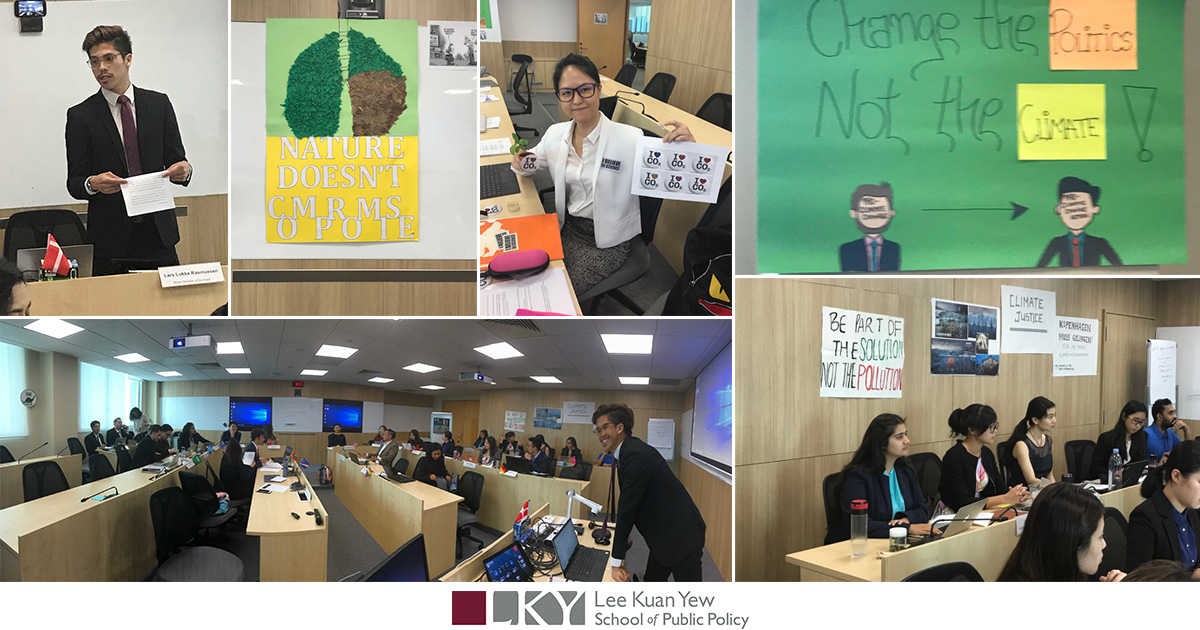
Designed to provide experiential learning experience, the course engages the students in numerous simulation exercises, including the recreation of global events such as the Reacting to the Past Module, 2009 Copenhagen Climate Summit.
Here's a first-hand account of some of the students’ reflections from Semester II, 2019.
Derek Hum (Playing Denmark)
“The simulation was exhausting. In many ways, this was both expected and unexpected. It was unexpected that so much chaos ensued. While I anticipated some level of conflict and messiness, I did not imagine that the conference would devolve into a shouting match at times. In general, I was expecting at least some level of civility, and more room for negotiation and consensus. In addition, the multiplicity of interests was also slightly unexpected. I had naively thought that there would generally be two camps: those for a strong treaty and those not. In reality, lines were not so clearly drawn and people who were aligned on some aspects were not on others. All of this made settling on a treaty that much harder. However, in retrospect, this was not surprising. After all, we have learned in IR theory that each state pursues its own interests. That the big powers like China and US managed to get their way is thus to be expected. The simulation was a good example of a failure to organise collective action.”
Read Derek's full account.
Mathew Kelley (Playing Saudi Arabia)
“Homo sapiens have single-handedly caused anthropogenic climate change within the equivalent of a fraction of a second in Earth’s cosmic history, and our myths have hindered us from effectively working together to remedy the problem.” - Jolene Lim in Governing Climate Change: Global Cities and Transnational Lawmaking
The myths that constrain us and the banks that fund destruction.
No other quote better sums up how I feel about global environmental governance at this present moment. When the foundation of our current global system is predicated upon the Westphalian nation-state, which is in many ways bound by interests as dictated by national/cultural myths that are often inimical to those of other states, how effective can state-based global governance ever truly be? The myths that tie each person, negotiator, politician, or whatever actor you may want to identify to her or his nation seem to be the root of so much global conflict and inaction. To build on Francesco Brusaporco’s eloquent statement on “making a point”, because these are singular humans managing various national interests, goals, and priorities, one can imagine that the majority arrive at these global meetings to score points that tie neatly into their respective myths. But I would also argue that the issue goes beyond national myth and we can more specifically link it to the construction and nature of global capitalism. The US$1.9 trillion that has gone to the fossil fuel sector from major banks since the Paris agreement is a stunning reflection on how much vested corporate, financial, and (in the US case) governmental interest there is in maintaining the status quo regarding fossil fuel usage. What we didn’t see in our simulation was the underlying power that banks and fossil fuel companies gain through lobbying many of the actors - but perhaps that is most pronounced in domestic U.S. considerations on the topic. I’m just not sure any degree of collective action could change the behavior of these gigantic financial institutions. Divest movements may work at the university level, but what are the chances enough people would care and coordinate enough to challenge the behavior of a behemoth like Bank of America? Thanks to the UN, environmental, social and governance (ESG) focused investing has taken off, but responding to climate change is just one of four components to ESG investing, and this clearly hasn’t stopped big banks from continuing to support the fossil fuel industry.
Read Mathew's full account