[ALUMNI-INFO TEXT="On March 25, 2020, India entered a countrywide lockdown to contain the spread of Covid-19, leaving thousands of day-wage labourers and migrant workers jobless and at risk of starvation.
While local authorities got relief operations off the ground, other civil servants stepped up to try and fill the gap by aiding social workers on the ground. Among such civil servants were trainees from the National Academy of Indian Railways (NAIR), guided by Lee Kuan Yew School (LKYSPP) alumnus Sachinder Mohan Sharma (Sachin).
Sachin graduated from the Master in Public Administration programme at LKYSPP in 2013 and has been Senior Professor Management at NAIR since 2015 – this is a government appointment equivalent to the joint secretary post. NAIR trains Indian Railways officers from entry to senior-level and had about 200 trainees when the lockdown was announced."][/ALUMNI-INFO]
Classes and seminars went online but the trainees were eager to contribute to the relief effort. A core group of six worked with Sachin to develop a plan, now titled One For Fifteen.
First, the trainees checked with the district administration, state government and NGOs to identify the needs they could best fill. This turned out to be the need for cooked food to feed families and workers at risk.
The NAIR trainees originally wanted to cook food and distribute it themselves but found this difficult, given the restrictions on mobility. Instead, they liaised with two organisations that had permission to operate during the lockdown: Akshaya Patra, an NGO which operates a school lunch programme, and the Maharaja Sayajirao University kitchen, which had a voluntary food distribution programme already in place.
Funds raised by NAIR trainees go to the preparation and distribution of food to the needy. As of early May 2020, 32,400 meals have been distributed, feeding approximately 1,500 people daily in the city of Vadodara, Gujarat, where the NAIR campus is located.

Preparing curry for 1,500 meals
Sachin says the title “One For Fifteen” comes from the idea that every single person who contributed Rs 2000 (approximately US$ 26) could feed 15 needy people during the first period of lockdown for about one week.
He adds: “The trainees at our academy were very keen to do their bit. Early in life, they saw an opportunity to serve the people and fulfil the very purpose of their joining the public service.”
The trainees also started Mission Suraksha (“suraksha” means “safety” in Hindi) to donate personal protective equipment (PPE), including masks and hand sanitizer, to frontline workers such as police officers and healthcare workers. The purchase of PPE was funded by further contributions, including from NAIR’s Women’s Welfare Association and an ongoing online drive.

NAIR trainees packing masks and hand sanitizer for distribution to frontline workers
[ALUMNI-QUOTES TEXT="While mentoring and guiding the trainee-led relief effort, Sachin and other faculty at NAIR had to ensure that training at the academy continued smoothly. “One benefit of this lockdown has been that for our seminars it has been easy to get eminent speakers as they are all working from home. This has added value to the training,” he says.
He also kept extra-curricular activities going. “I had to shut down the sports complex and so we started a competition for individual runs wherein the trainees would submit their lap timings and we would decide the winners. Online games, photography and other competitions were also conducted.” Winners could pick up their awards and medals at staggered times and pose for selfies.
Sachin believes in the value of outdoor activities to build esprit de corps. He has fond memories of team games of volleyball and cricket at LKYSPP, which helped students from different countries interact and become friends. He also organized and participated in a walk across Singapore – 41km from Changi to Jurong – and went on a 10km walk every week with a friend. At NAIR, he took trainees for high-altitude treks to help them forge bonds with each other and hone their skills in leadership and organization."][/ALUMNI-QUOTES]
Sachin (far right) with fellow students from LKYSPP on a 41km walk from Changi to Jurong
A career officer in Indian Railways, he had around 19 years of experience before joining LKYSPP and after graduating from the MPA programme, was posted as director efficiency and research at India’s Ministry of Railways. He was also a Chevening scholar at University of Oxford and is currently pursuing his doctorate in Strategic Management from IIM Kozhikode.
Why did he join NAIR in 2015? “I decided to give back to my organisation and opted for a posting to the academy so that I could improve the standard of training and engagement with the trainees by implementing things I had learnt from my LKYSPP experience,” he says. “At the academy I regularly conduct international programmes and my learnings from LKYSPP help me understand different cultures better and help me conduct the programmes more professionally. I feel that my experience at LKYSPP has provided a wider perspective and helped me contribute better to the organisation.”
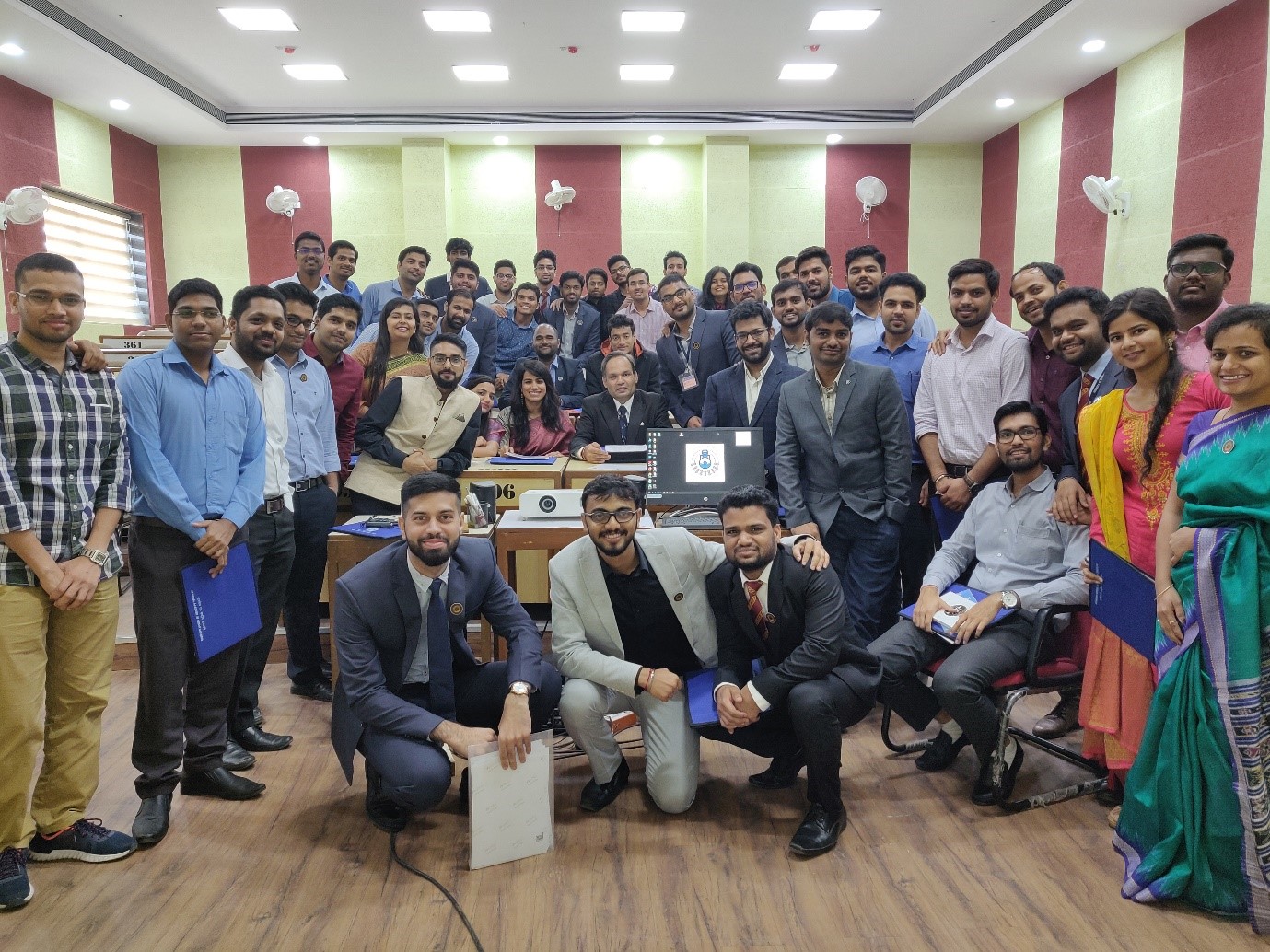
Sachinder with trainees at the National Academy of Indian Railways
In June 2020, he will move back to train operations, joining the DFCCIL (Dedicated Freight Corridor Corporation of India Limited) in Delhi as group general manager mechanical. He will leave with fond memories of his time at NAIR and the achievements of the trainees.
“Professionally the pandemic brought these new challenges but I think this has made us all more flexible and empathetic,” he says. “We should realise the power of one- we can make a difference if we choose to do so. A crisis like this is an opportunity to help others unconditionally, to be a leader and to think of innovative solutions.”
Visit https://www.onefor15.org.in/ for more details on One For Fifteen