In the Spotlight
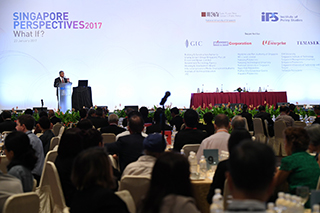 Singapore Perspectives 2017: What If?
What if Singapore becomes a two- or multi-party system? What if we ignore race and religion? These were some questions discussed at IPS’ annual flagship Singapore Perspectives conference held last month. But the conference went beyond dialogue and discussion — besides impassioned speeches from speakers and members of the audience, there was also a surprise celebration for a special someone. Read on for our coverage of the event and click here for the full report.
Views
By Janadas Devan
As Singapore’s social, political and economic landscape becomes increasingly diverse, the challenge is in maintaining the standards and ethos of governance that have made the country successful. To IPS Director Janadas Devan, “Singapore cannot have exceptional government unless Singaporeans too are exceptional…. If ever our politics became so toxic as to allow nativist, neo-fascist, populists into power; we are unlikely to have a second chance, a redo; we would be finished.”

What is the possibility of Singapore remaining a single-party dominant system in the next 50 years? What events could lead to a massive loss of legitimacy in the People’s Action Party (PAP)? IPS’ 2014/15 S R Nathan Fellow for the Study of Singapore Ho Kwon Ping contemplated these questions and more in his remarks at the recent Singapore Perspectives 2017 conference.

According to IPS Special Adviser Tommy Koh, Singapore has a very bright future despite its economic challenges. Why? It can count on its core strengths, he says, including our skilled workforce, IT-literate population and world-class infrastructure.

By Faizal Bin Yahya
We need to develop rigorous regulations for the sharing economy so that disruptive business models do not thrive by exploiting legal loopholes. IPS Senior Research Fellow Faizal Bin Yahya explores how we can make the sharing economy work in Singapore.
Features
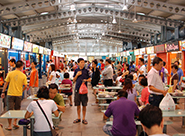 Cheapest Hawker Food in Singapore: Makan Index Report
In 2016, the IPS Social Lab visited 26 neighbourhoods to establish how much it would cost to eat hawker food in those areas. They subsequently compiled the Makan Index to show the geographical variations in the cost of eating out in different parts of Singapore, and the implications on the cost of living in different neighbourhoods. Full report here.
 The Year in Review 2016
The 2016 edition of The Year in Review, which highlights changes in Singapore’s public policy over the course of the year, will be published here next week. It is compiled by the Politics and Governance research cluster of IPS.
Upcoming
Lunch Dialogue with Minister Lawrence Wong on “Budget 2017”
Date: 23 February 2017
Budget 2017 will be delivered on 20 February. Minister for National Development and Second Minister for Finance Lawrence Wong will join the IPS Corporate Associates to discuss its most salient points as well as the broader issues concerning Singapore’s economic future.
Closed-Door Discussion on The Sharing Economy in Singapore
Date: 24 February 2017
Grab, Uber and Airbnb have disrupted traditional business models in the accommodation and transport sectors. How will other sectors of the economy by impacted by the sharing economy? This closed-door discussion will examine the potential impact of the sharing economy, as well as implications on welfare, platform revenue and ownership.
IPS in the News
IPS Researchers commented on worker displacement, technological disruption, and the challenge of our ageing population in the past month.
To read their comments, click here
For media coverage of IPS seminars and lectures, click here
Copyright 2016 by Institute of Policy Studies. All Rights Reserved. Best viewed with IE 7.0 and above in 1024 by 768 pixels.