
[ALUMNI-INFO TEXT="Master in International Affairs (MIA) alumnus Saneet Chakradeo did his best to get into a top engineering university in India, only to be hit with the realisation that he “was not cut out for it.” While completing his undergraduate degree, he discovered an inclination for political theory and public policy, which led him to the LKY School and his current job at Brookings India. In this Q&A, Saneet shares his thoughts about switching academic fields and finding meaningful work."][/ALUMNI-INFO]
Tell us about your work.
I am part of the foreign policy research team at Brookings India. Our team studies how India is linked to countries in the South Asian region—economically, politically, and culturally. For example, my colleagues recently published their research on India’s trade with its neighbours. There have also been studies to find out how many foreign students from South Asia are studying in India, and how many South Asian tourists are visiting India. We try to reach out to people in the policymaking circles to disseminate the results of our studies and suggest policy recommendations. And we engage with policy experts through panel discussions, and now webinars.
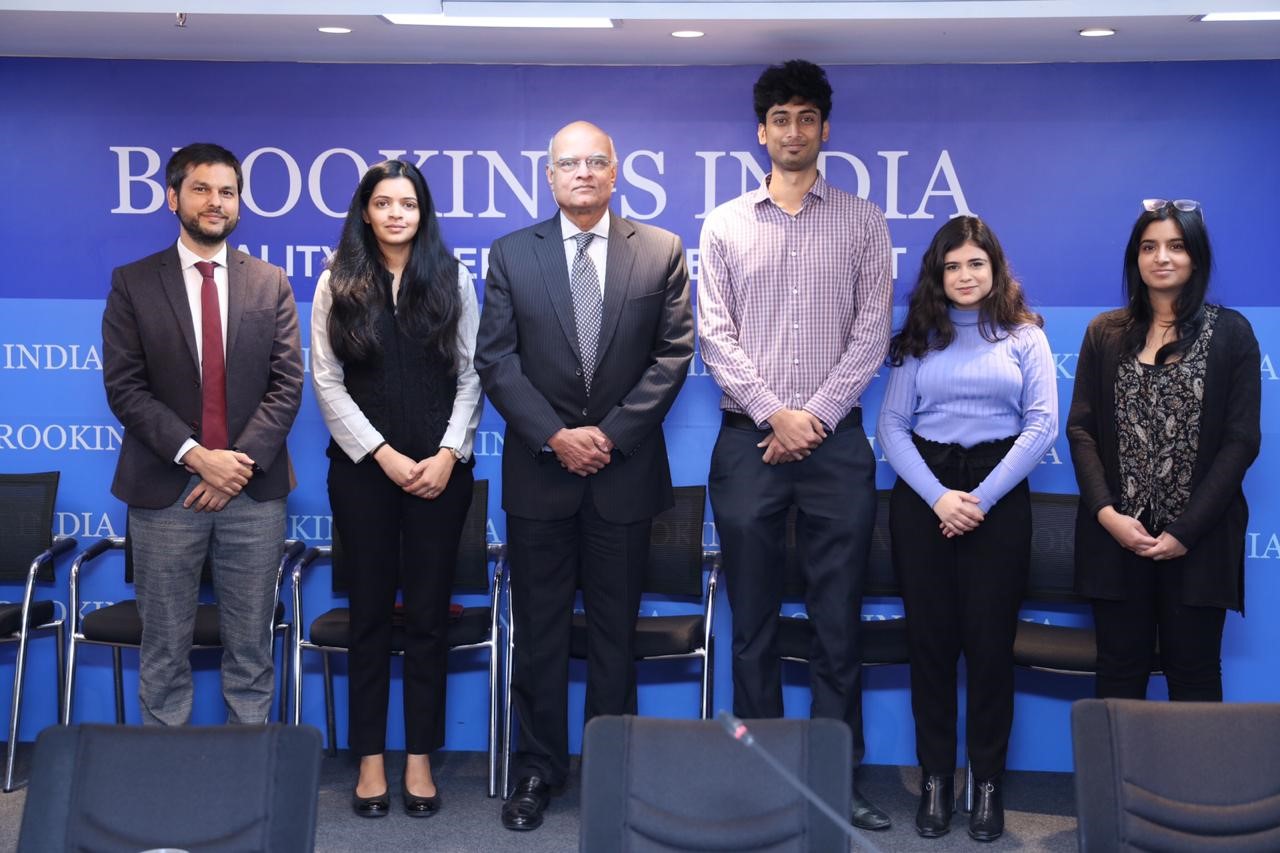
Saneet (third from the left) is part of the foreign policy research team at Brookings India.
What are you doing right now?
I am currently working on a couple of projects, to examine India’s air connectivity with South Asian countries, and its humanitarian assistance in times of disasters. All our projects require digging out evidence from official reports and databases—our sources include data from government ministries and multilateral agencies, as well as the media. My work focuses on analysing trends in data and addressing potential gaps.
What would you like others to understand about your work?
In all walks of life, but especially in the world of policy, significant change happens when people keep working on issues over a painstakingly long period of time. As a policy research institution, our work is based on making a case for change and pushing for it. Independent research plays a huge part in building consensus towards a policy, even if it might take years to implement it. That is why believing that you are part of change is important, because it is true.
You joined Brookings at the beginning of this year. Did you face any teething issues?
Initially, I did find it slightly difficult to switch back to professional life. Being in a setting like the LKY School, there are little or no constraints on the scope of work or research that you can undertake. Moving into a space with a fixed research agenda took some getting used to.
While I am confident that I have been able to adjust reasonably well, it helped that I have a brilliant and understanding team to work with. Professionally, I have gained a lot by being open and communicating with my team. I’ve been able to improve not just my research skills, but also my people skills.
Tell us how you landed this job.
After doing well in a couple of courses and working as a research assistant at the LKY School, my faculty advisor, Professor Kanti Bajpai, referred me to Professor Rohan Mukherjee of Yale-NUS, who is also affiliated with the School and was working on a research project that I was interested in—getting involved required me to work from Delhi. I was extremely lucky to get this opportunity. Professor Mukherjee then helped put me in touch with my current supervisor at Brookings India, who, at the time, was looking to fill a research position.
You went from studying civil engineering as an undergraduate to pursuing the MIA at the LKY School. What was the transition like?
[ALUMNI-QUOTES TEXT="In India, it is expected that kids who do well in school will take up engineering as a career. There are only a few universities in India that can be termed “world class,” and most of them are engineering institutes. Having worked really hard to get into a great university to study engineering, I quickly realised that I was not cut out for it.
But a feature of a great institution is that it attracts a lot of brilliant people and creates a space for students to explore their interests. Although I did complete my engineering studies—and it was hard work—I simultaneously discovered my inclination towards political theory and public policy, and met people with similar interests. My undergraduate studies allowed me to take up a job at the intersection of technology and policy, which in turn helped me to make a case for myself while applying to study public policy in Singapore.
I must say that I did not find it difficult to adapt to studying the social sciences. I felt at home, and I enjoyed attending classes and learning about things I had always wanted to learn.
However, it took me a bit of time to adapt to academic writing in the social sciences. Because of my technological background, I saw the world as binary—2+2 would always be 4, an acid and a base would always react to form a salt, and force would always be mass times acceleration. Studying international affairs taught me that the world is not straightforward. You can almost never be entirely correct, no matter how convincing you think your argument is. I emerged with a considerably changed outlook on the world."][/ALUMNI-QUOTES]
How has the MIA programme been relevant to your current work?
I acquired a lot of my domain knowledge on Indian foreign policy through the courses at the LKY School. I was also able to build a research mindset through some of the projects I undertook while studying international affairs.
I worked as a business consultant for three years before joining the LKY School. It involved a lot of interaction with the corporate sector, and I wanted to move towards working with other stakeholders, such as the government and organisations with on-ground impact. My time at the LKY School made me realise that I was better suited to a research career, and it certainly helped me get a foot into the policy research ecosystem in India.
Who were your favourite lecturers at the LKY School?
In my first semester, I learned international relations theory from Professor Khong Yuen Foong. He is a master at orchestrating class discussions, some of which are standout memories from my time at the School.
Professor Kanti Bajpai has also been an inspiration. I gained most of my knowledge on Indian foreign policy and international relations from him, and he also taught me about Chinese strategy and other strands of international strategic thought. Being my faculty advisor, he guided me in my capstone project and gave me the opportunity to work with him as a research assistant.
You made the Dean’s list at the LKY School—what were the learning strategies that worked for you?
I must admit that my learning strategies weren’t the most ideal! Most of my class submissions were last minute, and I found it difficult to manage my time to complete assignments.
But what I realised was that picking classes of interest, doing the readings diligently, and frequently consulting professors helped me to narrow my focus and hone my point of view. I also found studying with friends to be useful. I remember having discussion sessions with my unit-mates in College Green on the day of an exam, which helped immensely with consolidating ideas and retaining information.
Any advice for fellow alumni or current students hoping to get into research and consulting?
I think a good way to craft a career is to make a deep-dive into it—both academically and professionally. Picking the right courses, pursuing projects, attending conferences and events, actively scouting for internships at relevant organisations, applying early, and utilising the network presented by the school administration and fellow students helped me with assessing the requirements of the job market and building my resume.
If you can demonstrate your interest in a particular field of work, through your grades and your policy ideas or projects, it would automatically help with starting a conversation. In this regard, the School’s resources help a lot.
What’s ahead for you, career-wise?
I want to build on my research credentials and get to a stage where I have a substantial body of work to show in the research domain. There is a long way to go and a lot of work to do in that regard, but with the willingness to put in the effort and the right guidance, I will hopefully be able to get there.