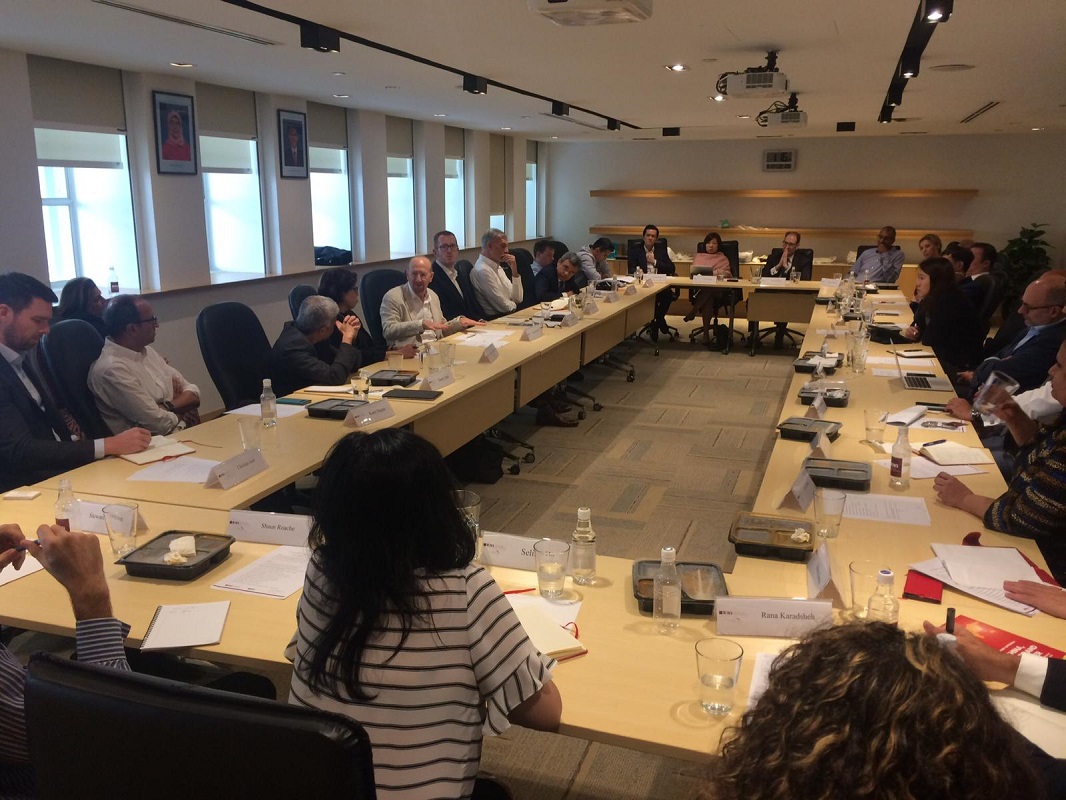
On September 19, 2019, Prof. Richard Baldwin, Professor of International Economics at the Graduate Institute in Geneva and author of The Globotics Revolution, presented at a roundtable held at the Centre on Asia and Globalisation, on the theme of The Forever Trade War: Can the Multilateral Trading System be Saved?
Tan Sri Datuk Dr. Rebecca Fatima Sta Maria, Executive Director at the APEC Secretariat in Singapore, and Dr. Razeen Sally, Associate Professor at the Lee Kuan Yew School of Public Policy, responded to Prof. Baldwin’s presentation. The event was held under the Chatham House rule, but the following points were made by presenters and participants during the discussion.
- When Trump launched his trade war against China and the rest of the world, his actions have been tactically incompetent and intellectually incoherent. In a nutshell, Trump has no plan for his trade war.
- Trump not only engaged a trade war with China, but he walked away from TPP without terminating it, and with Japanese leadership, the new CPTPP is hurting US farmers with tariffs.
- The oversupply of steel has been a long-standing problem to the global economy, but Trump, instead of addressing the problem from its source, he started trade war with every other country including its US allies. It must be pointed out that China has already embarked on several rounds of de-supplying steel, so Trump’s policies ended up hurting US allies more.
- Additionally, Trump also threatened NAFTA, but ended up renegotiated it to another NAFTA but with elements of the former TPP. However, the new NAFTA is receiving much resistance both in the Congress and from labor unions.
- Trump’s economic policies are mismatched with his geopolitical goals. If he is planning to contain China’s growth, he should be allying his allies in Asia. However, in the current dispute between South Korea and Japan, Trump has decided not to step in, thus causing frictions between US allies and Trump’s China containment policy might be less effective as planned.
- When the US confronted China and escalated the conflict, the US was dealing with China the way it dealt with Japan in the 1980s. It did not know anything about the history of China, of how the current trade war reminds China of foreign interventions and unfair treaties since the 1840s. Therefore, the US did not anticipate China to retaliate with such force. In fact, instead of import protectionism, the US could have introduced export promotion in order to reduce trade deficits against China.
- The trade war and other trade policies of the US has resulted in a condition of “reverse-regionalism”: The US has put up tariffs on almost all its major trade partners and vice-versa. This is like a reversed FTA, or a state of “trade-diversion”. With tariffs going up at all directions, investors have no more confidence and certainty.
- The question now is whether Trump’s policies will cease to be relevant after he steps down, or would his policies become long-term US policies? The problem of bilateral trade deficit has faded and is no longer the central problem in the current US-China trade war. In fact, the current trade war has escalated in its intensity and has spilled over to other domains such as finance, IP rights, and 5G technology. Many of these trends could be traced back to the advices and theories of Peter Navarro and other hardline China-hawks in the US.
- On the question of whether everything will go back to normal after Trump steps down, it must be noticed that tariffs around the world are at its highest in decades. Individual countries could not tackle all the current problems in world economy along, so major economies in the world must sit down to discuss for a way out and rules that are agreeable to everybody. As of now, we may have more of the same, but nonetheless, damages to the world economy must be kept at the lowest.
- On the role of the APEC, it has been argued that the APEC is still the most diversified economic group that included the world’s most vibrant economies and has been furthering the agendas of the WTO. Discussions have been going on in the APEC on next-generational economic issues such as designing new trade rules. Some of these new trade rules have been introduced in the charter of the CPTPP.
- As it is difficult to find common ground between the member states of the WTO, if member states of the APEC, which is a smaller but more vibrant group, could at least achieve some progress, then the APEC could lead progress in the WTO.
- The RCEP is a particularly interesting model, since both China and India belong to this group. To have trade negotiations developing especially between these two economies provide us with a sneak peek of the potential achievement of the RCEP. While RCEP may not allow member states to avoid trade issues, but it could provide us a way of diving deeper into these problems in finding out the solutions.
- The RCEP reflects the diversity of countries that are involved, and it might be fundamentally a strategic, rather than merely trade project, since it is focused more on balance of trade between countries. The RCEP is a flexible framework, but in terms of services, the offers made by potential member states are extremely conservative. In the case of India, despite past unsatisfactory experiences with FTA, the Indian government is willing to be part of the RCEP, but it is facing strong opposition from its industrial sector.
- We might be witnessing the early stages of a paradigm shift of international trade policies, and we might be entering a phase of traditional mercantilism, whereby multilateral trade regime has been replaced by bilateral short-term transactions dominated by great powers, with more pronounced relations between core, peripheries, and dependencies. While this trend might appear to have been triggered by Trump, but this could be something that is systematically going on in the world among major economies.
- There has been an emerging systematic competition, which is a competition on rule- and standard-setting, and the main competitors are namely the US, the EU, and China. This competition might cause blockages in the WTO.
- Trump did not change the overall US strategy towards China, but he drastically changed the tactics, such as implementing policies that are protectionist and mercantile in nature. Therefore, the US will probably not change its overall pressure on China. Yet, while the majority of the US populace are not in favor of tariffs, it is unclear why Trump wants to use tariffs as a weapon against China.
- It has been speculated on what would happen if China joins the CPTPP? However, if China wants to join the CPTPP, then it needs to embark on structural changes or even sea changes to the party-state in order to be qualified. Yet, there are already groundwork researches within the Chinese government that seeks to study the feasibility of China joining the CPTPPP, it is gaining support from Chinese bureaucrats and some talk of the benefits of the reforms that China has to undertake in order to be qualified to join the CPTPP.
- It was asked if the multilateral trade regime is based on an international order. Is it possible that US trade policies against China are not merely about trade, but geopolitical in nature, that China poses an existential threat to US leadership in the world?
- With the global value chain and greater economic integration in place, there could not be two trading systems in the world. Hence a decoupling between China and the US in terms of trade is not foreseeable and there will be no unwinding in basic rules of global trade, even though there might be separate “internet systems”.
- Perhaps we can separate the WTO into WTO 1.0 and WTO 2.0: WTO 1.0 is shallower as it mainly focuses on facilitating the trade of goods. On the other hand, WTO 2.0 focuses deeper on trade discipline on globalization and IP right. The former is more popular than the latter, even though Trump is destabilizing WTO 1.0.
- The internet of things and 5G will have major impact on MNC. However, the EU is strongly opposing it, and it might be possible that the global value chains might be Balkanized, China will have difficulties coping with this unless it could negotiate with other standard or rule-setting organizations.