In his landmark address at the World Economic Forum’s Annual Meeting in January 2026, Canadian Prime Minister Mark Carney called on the world’s middle powers to collaborate to shape a new international order – one that upholds multilateral institutions, preserves rules and limits the coercive leverage of great powers.
The evolving geopolitical dynamics of the Indo-Pacific have lent renewed urgency to this long-standing yet unresolved debate: do small and middle states possess meaningful agency in shaping regional order, or are they ultimately constrained by structural pressures imposed by great power competition?
As Sino-American rivalry intensifies, the space for independent action appears simultaneously more necessary and more constrained. Middle powers are increasingly called upon to uphold multilateral institutions, bridge competing blocs, and mitigate the risks of the bifurcation of the regional order. Yet their actual capacity to do so remains contested. In academic literature, the roles of small and middle states are often overshadowed by the gravitational pull of the great power dyad.
The inaugural issue of CIP is animated by that tension. First, small states have emerged as one significant terrain over which great power competition is conducted, through infrastructure investment, basing rights, aid conditionality, and diplomatic recognition contests. Their preferences and agency are routinely overlooked precisely because great powers portray them as passive stakeholders rather than active participants.
Second, middle powers are among the key architects of the region’s institutional architecture, from ASEAN Centrality to the Quad, AUKUS, and the proliferation of minilateral groupings. Their strategies on alignment, hedging, coalition-building and norm entrepreneurship will shape whether the regional order will fracture along great power lines or evolve into new forms of multilateral cooperation. Yet, it remains unsettled whether these strategic choices reflect genuine strategic autonomy or the skilful management of structural constraints.
Third, the agency of small and medium states has received comparatively less scholarly attention than the conduct of great powers. This leaves their interests, coalitions, and leverage underexamined relative to their potential significance.
Against this backdrop, this issue does not seek to resolve the debate. Rather, it seeks to advance and open the debate by examining the conditions under which small and medium states exercise agency and the structural limits within which that agency is constrained.
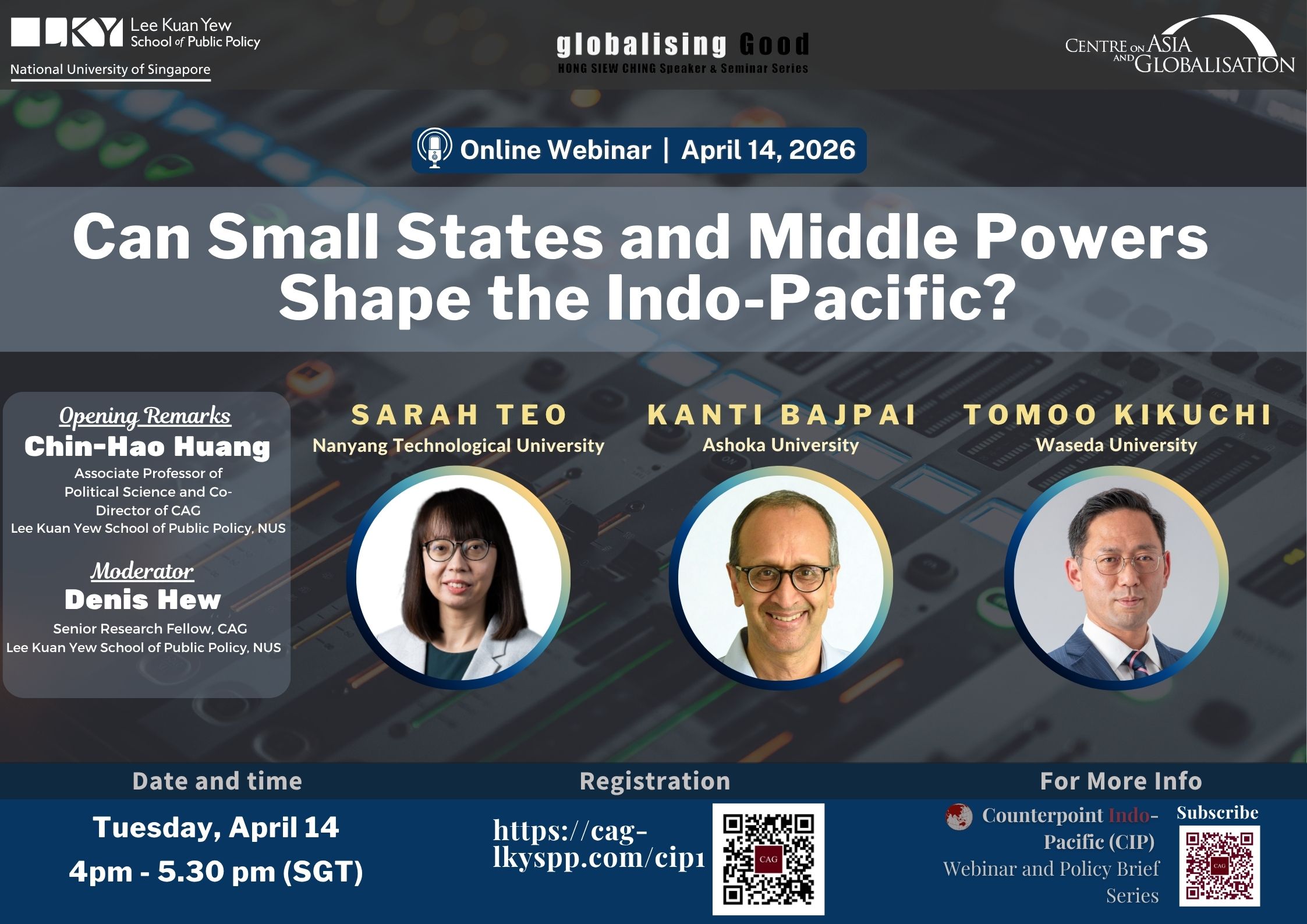
For an engaging discussion on this topic, join us for the inaugural Counterpoint Indo-Pacific panel discussion on 14 April, which asks, “Can Small States and Middle Powers Shape the Indo-Pacific?”. Three experts from the region will offer distinct perspectives on the scope, limits and implications of small and middle power agency in an era of intensifying great power rivalry.
Counterpoint Indo-Pacific is a webinar and policy brief series published by the Centre on Asia and Globalisation at the National University of Singapore's Lee Kuan Yew School of Public Policy. The main objective of CIP is to bring together experts from across the region to discuss critical issues concerning the Indo-Pacific. Each issue will tackle one question from three different perspectives.